
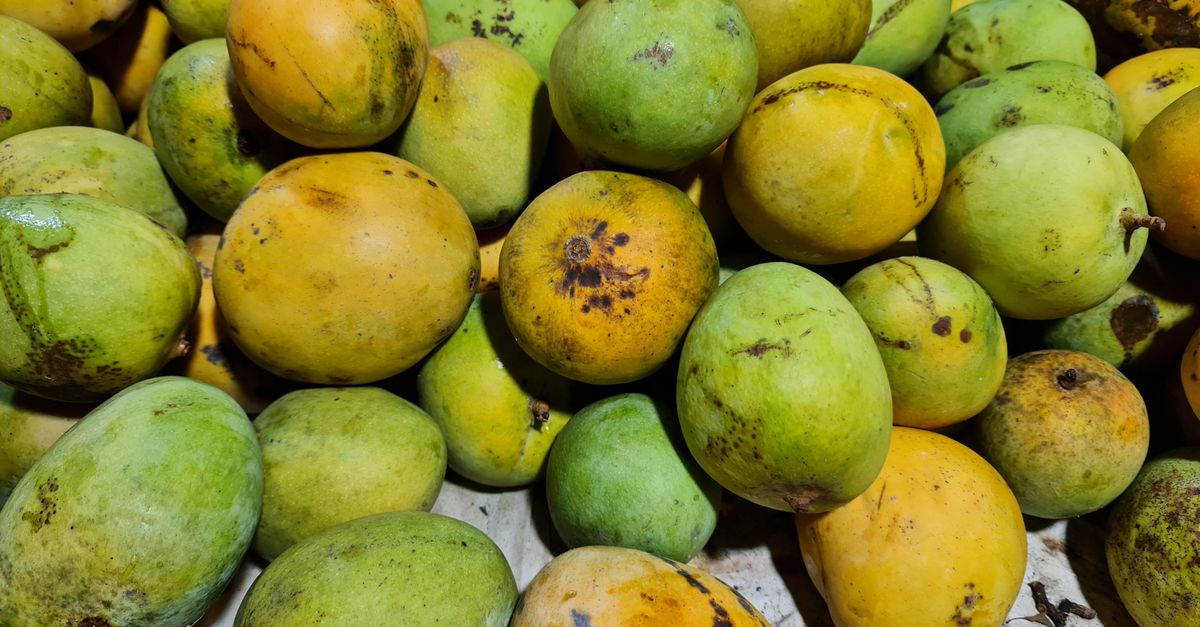
Dasheri (Dashehari) is the main mango of the Lucknow belt in Uttar Pradesh: ICAR-CISH reports more than 30,000 ha of GI-tagged Dashehari in the Kakori-Malihabad region alone. It is an old, reliable variety for the subtropical plains, but it bears heavily in alternate years and, because most of the belt ripens at the same time, growers there often get poor prices in a glut season.
A new orchard takes years to pay, so the real decisions are planting density, how you control tree size, and who buys the fruit.
Where it grows and the GI tag
- Home area: Malihabad and Kakori near Lucknow. The mother tree of Dashehari still stands in Kakori, and ICAR-CISH was set up there in 1972 as the Central Mango Research Station.
- GI registration: the registered name is "Malihabadi Dusseheri", covering Malihabad, Mal, Kakori and Bakshi ka Talab along the Gomti river in Lucknow district (GI application no. 125). The GI legally protects registered growers and authorised users from unauthorised use of the name. Dashehari grown outside this area is not covered by it.
- Elsewhere: Dashehari is also planted widely across North India. Confirm local suitability with your KVK before planting outside the Lucknow belt.
Planting systems and what they yield
| System | Spacing and trees | Reported Dashehari yield |
|---|---|---|
| Traditional | 10 x 10 m or 12 x 12 m: 100 to 70 trees per hectare (40 to 28 per acre) | 2 to 3 t/ha (0.8 to 1.2 t per acre) in an ICAR-CISH comparison; late bearing |
| High density | 5 x 5 m: 400 trees per hectare (about 160 per acre) | 6 to 7 t/ha (2.4 to 2.8 t per acre) in the 5th year; good fruiting from year 3 |
- ICAR-CISH reports that after 4 to 6 years high-density yields run 10 to 12 times those at standard spacing, and that the dwarfer Amrapali can be planted as close as 2.5 x 2.5 m (1,600 trees per hectare).
- High density needs yearly pruning and canopy control; yield and quality fall as trees crowd and shade each other.
- For comparison, India's average mango productivity quoted by ICAR-CISH is 9.7 t/ha.
Planting and training
- Material: grafted plants from an accredited nursery such as ICAR-CISH's. Plant in July to August with the monsoon.
- Pits: 1 m x 1 m x 1 m, dug in May to June, left a month, then refilled with topsoil, 10 kg farmyard manure, 2 kg vermicompost, 250 g bone meal, 250 g neem cake and 100 g di-ammonium phosphate per pit (CISH demonstration orchard). Support young plants with a bamboo stake.
- Training: for high density, keep 3 to 4 scaffold branches at 45 to 60 cm height, spaced 10 to 15 cm apart along the stem, and head back shoots so branching increases. Dashehari forms a compact, semi-spherical canopy. After 2 to 3 years the canopy fills its space.
- Pruning: light pruning and thinning after harvest (done in July to August in the CISH orchards described).
Nutrition and irrigation
- High-density orchard, 3-year-old trees (ICAR-CISH): after harvest 120 g N, 60 g P, 75 g K; before flowering 75 g N, 60 g P, 60 g K; flowering to fruit set 60 g N, 30 g P, 75 g K; fruit development 45 g N and 90 g K, per tree. That is about 300 g N, 150 g P and 300 g K per tree per year, or at 400 trees per hectare about 120 kg N, 60 kg P and 120 kg K per hectare (48, 24 and 48 kg per acre). The stage doses can be split into six weekly fertigation doses.
- Drip: a CISH demonstration orchard used two 4 litre-per-hour drippers per tree, applied on alternate days. Rain supplies 30 to 40% of water need from June to September; October to May needs 60 to 70% from irrigation. See drip irrigation.
- Flowering control: shoots made after pruning may stay unproductive for a year. ICAR-CISH describes soil-applied paclobutrazol at 4 g per tree (3.2 ml per metre of canopy diameter), in 15 to 20 litres of water, in a ring 1.5 to 2 m from the trunk, 90 to 100 days before flowering (September), followed by light irrigation. Use only on advice from your KVK.
- Pest and disease control is recommended by CISH on a schedule; ask your KVK for the current spray advice for hoppers, powdery mildew and malformation, and see pests.
Harvest and yield
- Grafted high-density trees begin bearing in year 2, with good crops from year 3. CISH reports Dashehari fruit weight of about 220 to 260 g.
- Dashehari alternates between heavy and light years; CISH names it, with Langra, Chausa and Lucknow Safeda, as an alternate bearer. Pruning, nutrition and flowering management aim to even this out.
- Dashehari ripens earlier than the late varieties Amrapali and Mallika, which mature from late July to August.
💡 Tip: If you plant in the Malihabad belt, put part of the orchard under late or coloured varieties (Amrapali, Mallika, Arunika, Ambika, all from ICAR-CISH) so that fruit does not all reach the market in the same fortnight as everyone else's Dashehari.
Cost and returns
- CISH demonstration orchard: a Lucknow farmer planted Amrapali, Arunika, Ambika and Mallika at 3 x 3 m (about 1,100 trees per hectare) with CISH support. Trees gave 10 to 15 fruits (1.5 to 2.5 kg) in year 2, 6 to 8 kg in year 3 (7.5 t/ha), and 13 to 15 kg at 6 to 7 years (14 to 16 t/ha). Reported income was ₹1.5 to 2 lakh per hectare in year 3 and ₹3.5 to 4 lakh per hectare from year 7 (about ₹0.6 to 0.8 lakh and ₹1.4 to 1.6 lakh per acre). These are not Dashehari trees and are from one farm.
- Arithmetic for Dashehari at 5 x 5 m: 6 to 7 t/ha in year 5 means 6,000 to 7,000 kg per hectare, or about 2,400 to 2,800 kg per acre. Multiply by the rate you are offered, then subtract plants, drip, fertiliser, pruning labour, bagging, picking and transport.
- Rates swing with crop size, weather damage and arrivals. Check mandi bhav and ask your buyer in writing.
- Planting subsidy and drip support vary by state; see the subsidy finder and KCC.
Market and selling
- ICAR-CISH notes that Malihabad is predominantly Dashehari and the market floods at the same time, so growers get poor returns in the peak. Spreading harvest dates through variety choice is its main advice.
- Malihabad ships mango to other parts of India and abroad. Exporting needs registration and packhouse standards; see export buyers.
- GI-tagged fruit can fetch a premium only if the buyer recognises and trusts the label, which needs authorised use of the name and honest origin. Sell as a group through an FPO where possible.
- Related guides: Amrapali mango and Mallika mango, both with Dashehari as a parent.
Sources
- Indian Horticulture, July-Aug 2021: Increasing mango productivity through high density planting (ICAR-CISH)
- Indian Horticulture, July-Aug 2024: Transforming conventional mango orchard to high-density planting, Malihabad (ICAR-CISH)
- Indian Horticulture, July-Aug 2021: Mango varieties with Geographical Indications in India
- Indian Horticulture, March-April 2026: From orchard to opportunity, ICAR-CISH profile