
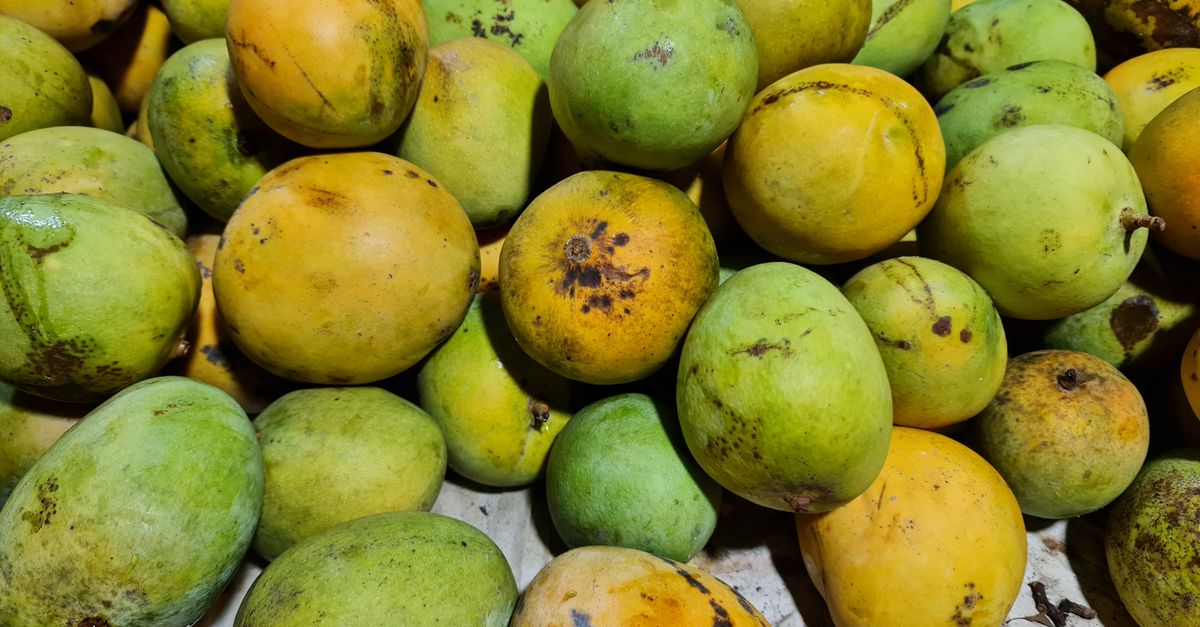
Langra (Banarasi Langda) works best in the Gangetic plains of Uttar Pradesh and Bihar, where it is an important mid-season mango. It needs several years of care before a worthwhile crop (TNAU keeps young trees from fruiting for the first three years), bears irregularly (a good year often followed by a lighter one), and earns well only if the fruit is picked at the right maturity and sold fresh within a short season.
Langra stays green when ripe, so its market depends on brand and buyer familiarity. The Langda mango of Varanasi received a Geographical Indication (GI) tag on 31 March 2023, which protects the name for fruit from the recognised area.
Where it grows in India
- States: a 2025 paper in the Indian Journal of Horticulture calls Langra a crucial cultivar of North and Eastern India and says it covers more area in Bihar than any other mango variety. Varanasi in Uttar Pradesh is its home district and the area covered by the GI.
- Climate: a subtropical climate with a warm, dry spell at flowering. Hail and unseasonal rain during flowering and fruit set reduce the crop and favour disease, so a site with a history of April to May storms carries extra risk.
- Soil: the Sabour (Bhagalpur, Bihar) trial below was on alluvial soil in a semi-arid, hot-summer setting. Choose deep, well-drained land and avoid sites where water stands.
Variety traits
| Trait | Langra | Source |
|---|---|---|
| Season | Mid-season | Indian Journal of Horticulture, 2025 |
| Bearing | Biennial tendency | Indian Journal of Horticulture, 2025 |
| Fruit weight | 250 to 350 g | Indian Journal of Horticulture, 2025 |
| Quality | High pulp, firm lemon-yellow flesh, thin peel, little fibre; pulp 70 to 77% of fruit and TSS 18.6 to 21 °Brix in the Sabour trial | Same paper |
| Keeping quality | Moderate to good | Same paper |
- Plant only grafts from a nursery that can name the mother plant and is registered with the state horticulture department. TNAU stresses disease-free planting material because of mango malformation.
Spacing and planting
- TNAU's mango guide (written for Tamil Nadu) lists conventional planting at 7 to 10 m either way, and 5 m x 5 m (400 trees per hectare, about 160 per acre) for high-density planting. The Sabour trial used old trees at 10 m x 10 m, which is 100 trees per hectare (40 per acre).
- Dig 1 m x 1 m x 1 m pits, fill with topsoil mixed with about 10 kg FYM, and plant in the rainy season; TNAU gives July to December for Tamil Nadu, so ask your KVK for the local window.
- Remove flower panicles for the first three years so the tree builds its frame (TNAU). Short legumes and vegetables can be grown between young trees.
Nutrition, irrigation and canopy
- Young trees (TNAU): year 1 gets 10 kg FYM, 0.2 kg N, 0.2 kg P and 0.3 kg K per tree. Each year the dose rises by the same amounts, reaching 50 kg FYM, 1 kg N, 1 kg P and 1.5 kg K per tree a year from year 6 onwards.
- Bearing Langra trees (Bihar trial): the Sabour trial on 35-year-old Langra trees used 1,000 g N, 500 g P and 500 g K per tree per year as the standard, applied in a ring 30 cm deep and 1.5 m from the trunk in August. Half that dose plus 50 kg FYM and 250 g Azospirillum gave 174.91 kg per tree and 590 fruits, the best result in the trial, against lower fruit sugars and higher acidity under the full chemical dose alone. This is one trial on old trees, so treat it as a guide, not a guarantee.
- Irrigation: TNAU advises regular watering until the trees are established and weekly irrigation under conventional methods. See drip irrigation and fertilizers.
- Canopy: remove crossing and diseased branches in August to September, and prune 20 cm of the annual terminal growth after harvest (TNAU).
Pests and diseases
- Hoppers: TNAU advises a first spray at panicle emergence and a second two weeks later; ask your KVK for the registered product and the right timing for your area.
- Powdery mildew: wettable sulphur is the common option; check the label for dose.
- Anthracnose and stalk-end rot: pre-harvest fungicide sprays at 15-day intervals (three sprays) are advised by TNAU.
- Malformation: use disease-free grafts, prune diseased shoots with a 15 to 20 cm healthy base and destroy them.
- Mealybug and fruit fly: band the trunk with polythene sheet against mealybug; use methyl eugenol traps and collect fallen fruit for fruit fly.
- Chemical choices change as old products are restricted. Use only products registered for mango, follow the label and the waiting period, and ask your KVK. See pests.
Harvest and yield
- TNAU gives a yield of 8 to 10 tonnes per hectare (3.2 to 4 tonnes per acre) up to 15 years of age and 15 to 20 tonnes per hectare from 15 to 20 years. These are Tamil Nadu figures for mango in general; Langra in the north can differ, and the Sabour trial recorded up to 174.91 kg per tree on 35-year-old trees.
- Langra is a mid-season variety. Because it stays green when ripe, do not judge maturity by colour; ask CISH Lucknow or your KVK for the maturity test used in your area, and grade by size before packing.
- Heavy fruit drop and irregular bearing are the main limits, and a stormy April or May can take most of the crop.
💡 Tip: Mango returns hinge on the weather at flowering and on the price in a short selling window. Plan loans and spending so that one failed crop does not sink the orchard.
Cost and returns
- Langra farm-gate prices and orchard costs vary widely by season and district, so run the arithmetic below with your own local numbers.
- Example: at 40 trees per acre and a modest 60 kg per tree, the harvest is 2,400 kg per acre. At ₹30 per kg that is ₹72,000 per acre; at ₹50 per kg it is ₹1.2 lakh. At the TNAU yield of 3.2 to 4 tonnes per acre the same prices give ₹96,000 to ₹2 lakh. These prices are assumptions, not market data; check live rates on mandi bhav.
- Subtract orchard care (pruning, manure, sprays, irrigation, labour, picking and packing, transport and commission) and spread the cost of the non-bearing early years over the orchard's life. If you sell the crop to a contractor before harvest, get the price, picking responsibility and payment dates in writing.
Market and selling
- Fruit goes to local and distant mandis, orchard contractors and retailers. The Varanasi GI is meant to help branding; use the GI name only for fruit grown in the recognised area.
- Because the crop arrives in a few weeks, prices fall in glut weeks. Staggered picking, grading and cooling help. See cold storage subsidy, export buyers and FPO for group sales. Crop insurance is covered under PMFBY, which may be notified in your district for mango; confirm with the agriculture office.
- For planting support under MIDH, ask your district horticulture office; subsidy finder helps you check schemes. No current subsidy rate for mango is quoted here because it varies by state.