
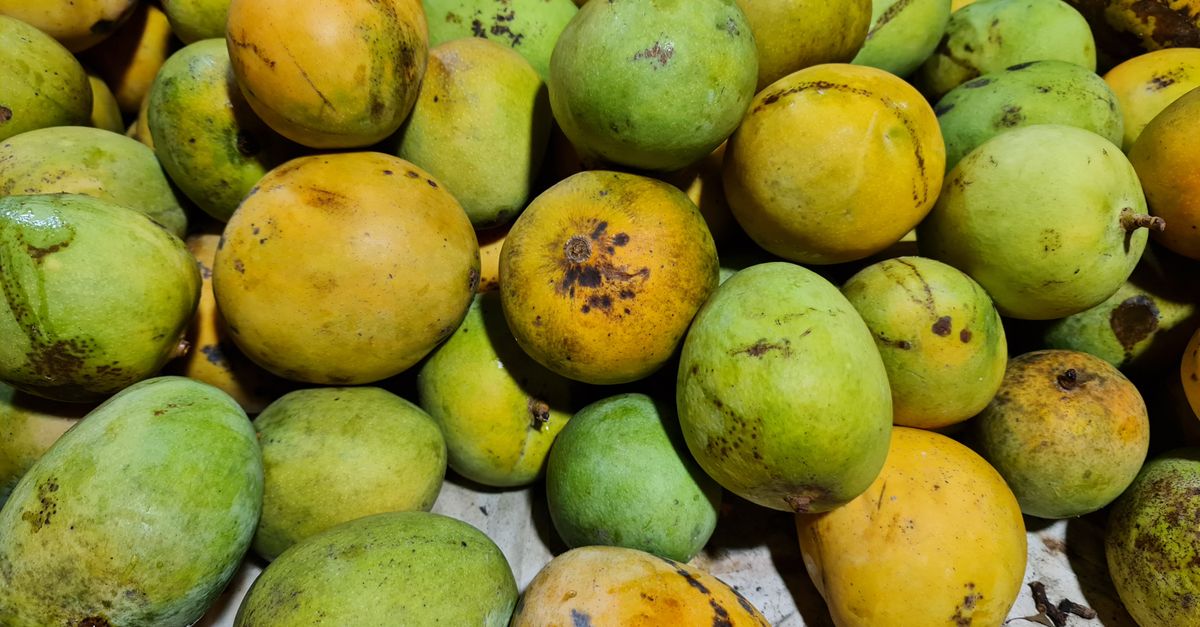
Mallika is a fibreless, large-fruited mango hybrid (Neelum x Dashehari) released by ICAR-IARI, New Delhi, and it is a late-maturing variety: fruit ripens from late July into August in the plains, and in the low hills of Himachal Pradesh it is ready in the second to third week of August. It suits farmers who want to extend their mango season; ask your KVK for local yield records before planting many trees.
Late maturity is its main selling point; the price you get will depend on local demand for a late, large, fibreless mango.
Where it grows in India
- ICAR-IARI says large-scale multiplication and planting of hybrids began with Mallika and Amrapali in the 1970s, and that Mallika is cultivated in several agro-ecologies and has become popular in Karnataka and parts of south India.
- In Himachal Pradesh it is a newly introduced cultivar of the low-hill Shiwalik region (400 to 1,000 m), where trials near Hamirpur ran in 2004 to 2007 and growers valued it because the fruit matures after most of the country's mangoes are over.
- Soil and climate: TNAU's mango package gives pH 6.5 to 8.0 and well-drained red loamy soil as best, which suits Mallika too. Avoid waterlogged land.
Variety facts
| Trait | Reported value | Source |
|---|---|---|
| Parentage and institute | Neelum x Dashehari, ICAR-IARI, New Delhi | NHB; ICAR Indian Horticulture |
| Fruit | Large, oblong-elliptical, yellow to orange, fibreless, good keeping quality, firm flesh, mostly a table fruit | NHB; ICAR Indian Horticulture |
| Fruit weight | 350 to 480 g; about 417 g at the second week of August in the Himachal trial | ICAR Indian Horticulture; Indian J. Hort. 2010 |
| Maturity | Late July to first week of August; second to third week of August in low Himachal hills | ICAR Indian Horticulture; Indian J. Hort. 2010 |
| Tree and bearing | Semi-dwarf, suited to high-density planting; described as a prolific and regular bearer | ICAR Indian Horticulture; Indian J. Hort. 2010 |
- The bearing-habit claim comes from ICAR and Himachal university descriptions; Ask your KVK or a nearby grower how it has cropped in your area before planting many trees.
- Buy grafts from an ICAR institute, state agricultural university or accredited nursery; ask for the label and the mother-tree source.
Planting and spacing
- Conventional: TNAU gives 7 to 10 m each way and pits of 1 m x 1 m x 1 m with 10 kg farmyard manure and 100 g phosphorus per pit. At 10 m x 10 m that is 40 trees per acre (100 per hectare).
- High density: TNAU gives 5 m x 5 m (400 per hectare, about 162 per acre). ICAR's Indian Horticulture article describes 5 m x 5 m as high-density planting for northern India and says regular-bearing, dwarf varieties that respond to pruning are suited to it; it names Mallika as semi-dwarf and suitable for high density.
- High-density orchards need regular pruning and canopy control, since crowding and shade reduce yield and quality as trees age. Ultra-high density (2.5 m x 2.5 m) is described for Amrapali, not Mallika.
Nutrition, flowering and water
- Manure and fertiliser (TNAU, per tree, conventional spacing): in the first year 10 kg farmyard manure, 0.20 kg N, 0.20 kg P and 0.30 kg K; add the same each year up to six years; from year six, 50 kg manure, 1.0 kg N, 1.0 kg P and 1.5 kg K. Adjust by soil test; see fertilizers.
- Flower induction: Indian Horticulture notes that shoots made after pruning may stay unproductive for a year, so paclobutrazol (4 g per tree to the soil, dissolved in 15 to 20 litres and applied in the ring 1.5 to 2 m from the trunk, about 90 to 100 days before flowering, in September) is used. Use only on KVK advice and follow the label.
- Irrigation: rain supplies about 30 to 40% of water needs from June to September, and 60 to 70% must come from irrigation from October to May; drip is the best method where water is short. See drip irrigation.
- Pests and diseases: hoppers, mealy bug, fruit fly, powdery mildew and anthracnose are the usual mango problems; TNAU lists wettable sulphur for powdery mildew. Follow your KVK's spray schedule and the label, and see pests. Malformation is a known problem of Dashehari, one of the parents; ask your KVK about local risk.
Harvest and yield
- Time: trees under high density start bearing in the second year, with good fruiting from the third year (ICAR).
- Harvest stage: in the Himachal trial, fruit weight and TSS stopped rising meaningfully after the second week of August at lower altitudes; fruit picked then reached about 20 degrees Brix after 16 days of ripening, while earlier picks stayed lower.
- Yield: no verified per-tree or per-hectare yield for Mallika was found. For comparison, Amrapali under high density gave 3.5 to 14 kg per tree in years 3 to 5 (5.6 to 22.4 t per hectare), and Dashehari gave 6 to 7 t per hectare in the fifth year at 5 m x 5 m against 2 to 3 t at 10 m x 10 m, according to ICAR. TNAU's general mango yield is 8 to 10 t per hectare up to 15 years of age. Treat these as the range for planning, not as a Mallika promise.
💡 Tip: Plant a small block first and record yield and price for three seasons before extending, and sell through a buyer or FPO who has taken late-season mango from you before.
Cost, returns and market
- No orchard cost or Mallika price could be verified, so none is given. Track late-season prices at mandi bhav in July and August and ask local traders what they pay for large fibreless mangoes.
- How to estimate: trees per acre x kg per tree x price per kg, less labour, inputs, irrigation and the years of no income before bearing. For example, 162 trees x 20 kg x your local price is the starting figure; replace 20 kg with what neighbouring Amrapali or Mallika orchards actually give.
- Late maturity is the main advantage, because harvest comes when many other mangoes are gone; harvest falls in the rainy season. See export buyers for export enquiries; no verified Mallika export volume was found.
- For support with new orchards, check the subsidy finder; no current per-hectare MIDH rate for mango was verified.
Sources
- National Horticulture Board, Mango varieties
- Srivastava, Kumar and Rajan, Increasing mango productivity through high density planting, Indian Horticulture (ICAR)
- Rajan and Yadav, Mango hybrids and improved cultivars, Indian Horticulture (ICAR)
- Sharma, Studies on harvest maturity of Mallika and Amrapali mango, Indian Journal of Horticulture 2010
- TNAU Agritech Portal, Mango