
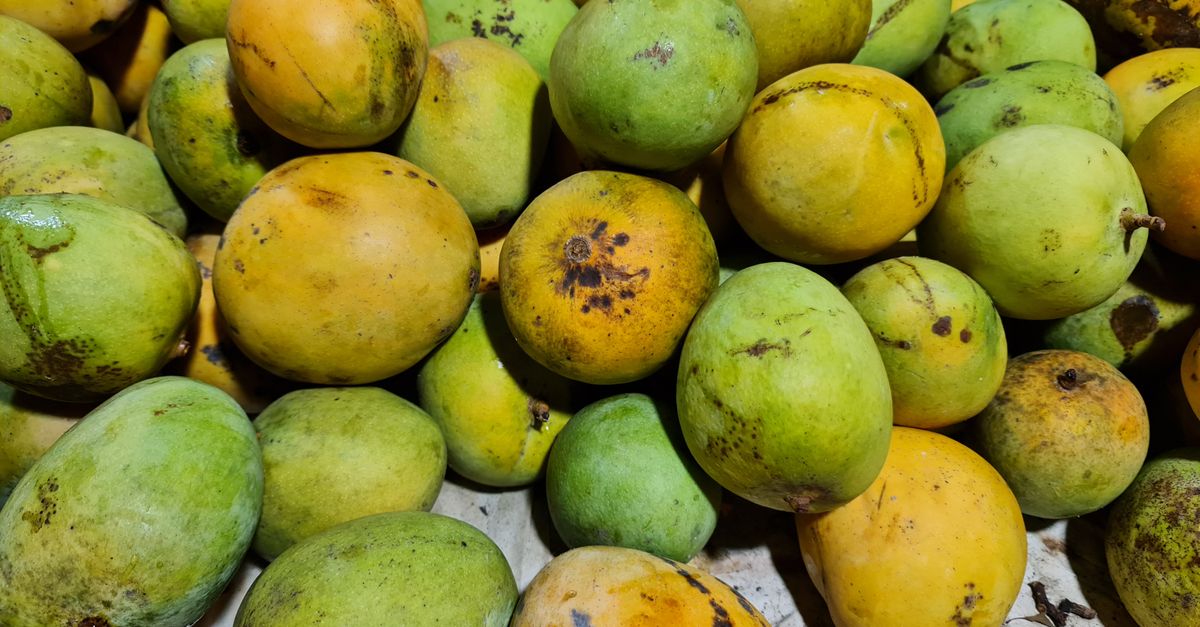
Kesar mango works best in the dry, hot Saurashtra belt of Gujarat (Junagadh, Gir Somnath, Amreli, Bhavnagar), where it holds a GI tag as Gir Kesar, and it is also grown in Marathwada and other parts of Maharashtra, Madhya Pradesh and Rajasthan. A grafted orchard takes 4 to 5 years to start bearing, and the real constraint is not the tree but the weather at flowering: unseasonal rain, cloud and cyclones have cut the crop in several recent years.
The average yield in the Sorath region was reported at about 7 tonnes per hectare (2.8 t per acre) in 2025, far below the 15 to 20 t/ha that high density planting is said to reach. Plan with the regional average, not with brochure yields.
Where it grows in India
- Saurashtra, Gujarat: 29,245 hectares of mango orchards were reported in the Sorath region, with about 1.97 lakh tonnes produced in the previous year. Older reports put Kesar at roughly 20,000 to 25,000 hectares across Junagadh, Gir Somnath, Amreli and Bhavnagar, with an average season output of about 2.5 lakh tonnes.
- GI tag: Gir Kesar was registered as a Geographical Indication in 2011 for fruit grown in the Girnar foothills (Junagadh and Amreli districts). Kesar grown outside that area, for example in Marathwada, is sold as plain Kesar and cannot carry the Gir name.
- Maharashtra and other states: a Mahatma Phule Krishi Vidyapeeth (MPKV) paper describes Kesar as the most popular variety in Maharashtra, with area also rising in Gujarat, Madhya Pradesh and Rajasthan.
- Climate: hot, dry summers and a dry spell around flowering suit the crop. Junagadh Agricultural University (JAU) notes that Kesar needs comparatively low heat accumulation to mature. Rain, hail and sharp swings between day and night temperature at flowering cause the heavy losses.
- Soil: deep, well drained loam or medium black soil; JAU advice notes that Kesar stone rootstock tolerates irrigation water salinity up to EC 2.0 dS/m. Waterlogged patches should be avoided.
- Weather risk: production fell 25 to 30% in the 2023 season compared with 2022 after day-night temperature swings and unseasonal rain, and Cyclone Tauktae in May 2021 destroyed much of the crop in Saurashtra.
Variety, planting material and spacing
- Variety: Kesar is itself the variety. In the MPKV trial at Rahuri, Kesar fruits weighed about 241 g with 70% pulp and TSS of 19.5 degrees Brix under good nutrient management. Fruits are harvested mature green and ripened after harvest.
- Grafts: use grafts from a registered nursery and insist on a Kesar scion from a known tree. JAU recommends Kesar stone as the rootstock for Gujarat nurseries.
- Spacing: TNAU lists 7 to 10 m either way for conventional planting (about 40 to 80 plants per acre, 100 to 200 per hectare), 5 x 5 m for high density (400 plants per hectare, about 162 per acre) and a double hedge row system (266 plants per hectare). High density orchards rely on regular pruning and canopy management, and JAU has trial work on canopy management in high density Kesar.
- Planting time: start of monsoon, in pits filled with compost and topsoil.
Nutrition, irrigation and flowering
| Tree age | FYM per tree | N, P, K per tree |
|---|---|---|
| Year 1 | 10 kg | 0.2, 0.2, 0.3 kg |
| Each year after | add 10 kg | add 0.2, 0.2, 0.3 kg |
| Year 6 onward | 50 kg | 1.0, 1.0, 1.5 kg |
- The table is the TNAU general schedule for mango, not a Kesar-specific one. A commonly quoted alternative for adult trees is 1.5 kg N, 0.5 kg P and 1.0 kg K plus 40 to 50 kg FYM, half the nitrogen at monsoon onset and the rest at flowering. Test the soil and follow your KVK.
- For rejuvenated (pruned old) Kesar orchards in South Saurashtra, JAU advises from the 4th year after rejuvenation 150 kg FYM with 562.5 g N, 240 g P and 562.5 g K per tree as basal dose, and another 562.5 g N and 562.5 g K in February, together with paclobutrazol at 7.5 g active ingredient per tree in mid July applied to the soil (JAU recommendation, 2020).
- JAU also recommends two cycocel sprays at 1,000 ppm, in October and a month later, on rejuvenated Kesar orchards for better flowering (2023), and salicylic acid at 1,500 ppm at flowering and two weeks after fruit set in high density Kesar (2025). These growth regulators need correct dosing and timing, so use them only on KVK or university advice.
- In the MPKV trial at Rahuri, splitting the fertiliser into smaller doses timed to peanut, marble and egg stages of fruit growth gave larger fruit, more pulp and better sweetness than the standard two-dose schedule.
- Drip with mulching is common in water-short Saurashtra.
Pests and diseases
- Hopper: the main flowering pest. TNAU lists acephate 75 SP at 1 g per litre or phosalone 35 EC at 1.5 ml per litre, sprayed at panicle emergence and again two weeks later. Never spray open flowers while bees are visiting.
- Powdery mildew: wettable sulphur 0.2% at panicle stage, especially in cloudy, cool weather.
- Fruit fly: methyl eugenol traps, about 10 ml per trap and 25 traps per hectare (10 per acre), plus picking up and burying fallen fruit.
- Malformation: prune out affected panicles and shoots and spray carbendazim 0.1%.
- Chemicals are named here only as listed by TNAU, whose page is dated; some older mango chemicals (such as carbaryl and tridemorph) have been restricted or proposed for a ban in India, so confirm that any product is currently registered before buying. Follow the label and your local KVK, and observe the waiting period before harvest, which matters for export fruit.
Harvest and yield
- First fruit: grafted trees begin bearing around year 4 to 5 and reach good crops around year 7 to 8; high density trees come into bearing earlier.
- Season: Talala APMC auctions opened on 19 April in 2026, a week earlier than 2025, and last year's season ended on 8 June after 44 days.
- Yield: TNAU gives 8 to 10 t/ha up to 15 years and 15 to 20 t/ha afterwards for mango in general. Regional data for Sorath is lower, at about 7 t/ha in 2025, because of alternate bearing and weather losses.
- Fruit is picked mature green. JAU found that mature Kesar kept at 14 degrees C and 90% humidity holds quality for up to 25 days.
💡 Tip: Before planting a Kesar orchard outside Saurashtra, check that your area has a dry spell at flowering. A site with regular March or April rain will lose its crop often, whatever the spacing.
Cost and returns
- Price evidence: in 2025 about 449,450 boxes of 10 kg were traded at Talala APMC at an average of ₹560 per box (₹56 per kg), worth ₹25.17 crore to farmers. In April 2026, 10 kg boxes were reported at ₹1,200 to ₹1,500 in Junagadh early in the season; this is an early-season price and not a season average.
- Arithmetic (illustration): at the regional yield of 7 t/ha, a bearing hectare gives 7,000 kg x ₹56 = ₹3.9 lakh (₹1.6 lakh per acre at 2.8 t per acre). At 15 t/ha and ₹56 per kg the gross is ₹8.4 lakh per hectare, but that yield is a target of well managed orchards, not an average.
- Costs: no verified current cost of cultivation for Kesar was found. Main items are grafts, pits, drip, manure, sprays, pruning, harvest labour and boxes. Get a local estimate from your KVK or horticulture department.
- Gestation: there is no mango income for roughly 4 to 5 years.
Market and selling
- Domestic: fresh fruit through APMC yards such as Talala, plus pulp and aamras processors. Check mandi bhav before the season.
- Export: Gujarat exported 689 tonnes of mangoes in 2025 according to a report, with Kesar sent to the UK, USA, Qatar, Canada and Australia. Export fruit needs washing, grading, hot water treatment and, for the US shipment reported, irradiation. In 2026, 675 farmers from the Sorath region had registered with APEDA. Air freight cost about ₹600 per kg in April 2026 against ₹400 the year before, which squeezes export margins.
- Gir label: only fruit from the GI area can be sold as Gir Kesar. Verified origin earns a premium; selling outside fruit under the Gir name goes against the GI.
- Insurance: see PMFBY where mango is notified in your district, drip irrigation for subsidy, and export buyers for export routes. A current MIDH subsidy rate for mango was not verified.
Sources
- Junagadh Agricultural University, fruit science recommendations (mango, Kesar)
- TNAU Agritech Portal, mango cultivation (general mango schedule)
- Plant Archives 2024, nutrient management in Kesar under high density planting (MPKV Rahuri)
- DeshGujarat, Talala market yard Kesar season (April 2026)
- DeshGujarat, Gir Kesar prices, exports and area (April 2026)
- FreshPlaza, Gujarat climate change and mango yield (March 2023)
- Gir Kesar (GI 2011, area and region; secondary source)