
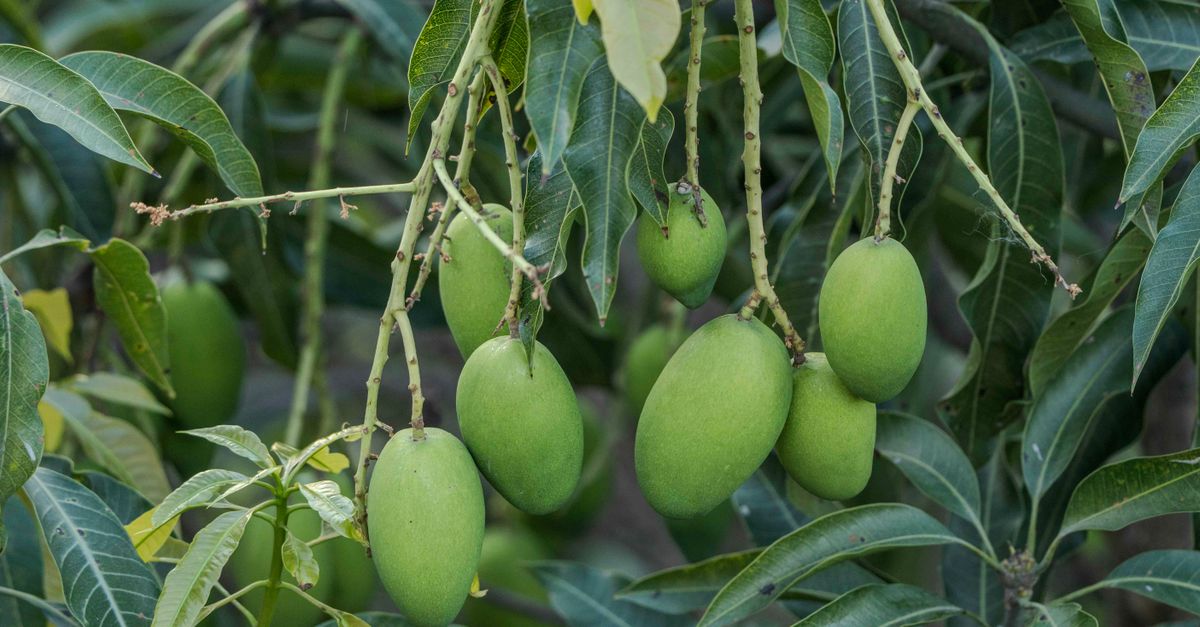
Amrapali is a dwarf, regular-bearing mango hybrid that works in most mango-growing parts of India, and its main use is close planting: 400 trees per hectare (162 per acre) at 5 x 5 m, or 1,600 per hectare (about 648 per acre) at 2.5 x 2.5 m under tight pruning. It needs a frost-free site, a dry spell at flowering and a grower who is ready to prune every year, because crowded trees stop paying if they are left alone.
It is a cross of Dasheri and Neelum made at IARI, New Delhi, and released in 1971. The fruit is small, deep orange-fleshed and rich in carotene, and it ripens late, from about the third week of June. The trade-offs are small fruit size and a shorter shelf life than other commercial mangoes, so the plan should include where and how fast the crop will be sold.
Where it grows in India
- Trial and orchard evidence: Amrapali spacing trials are on record from Gujarat (Central Horticultural Experiment Station, 1997 to 1999), Chhattisgarh (IGKV Raipur, 2015-16) and Mizoram (ICAR Research Complex for NEH Region, sub-humid warm tropical climate). It is also grown in Uttar Pradesh, Bihar and West Bengal, where the first plants were raised in Nadia district.
- Soil: TNAU describes red loam with good drainage as ideal for mango, pH 6.5 to 8.0. Avoid waterlogged or shallow soils.
- Climate: warm, with a dry, clear spell at flowering. Frost and rain during flowering cut fruit set and raise powdery mildew and anthracnose, whichever variety is planted.
Variety facts and related selections
| Item | Source | What is reported |
|---|---|---|
| Amrapali | IARI, New Delhi (Dasheri x Neelum), 1971 | Dwarf, regular bearer, small fruit in clusters; TSS about 21 degrees Brix and carotenoids 5.9 to 9.1 mg per 100 g in papers on the variety; fruit about 100 to 210 g across studies |
| Ambika | ICAR-CISH, Lucknow (Amrapali x Janardan Pasand) | Yellow fruit with red blush, about 250 g, 21 degrees Brix, firm and fibre-scarce; reported about 80 kg per tree |
- Fruit weight for Amrapali varies a lot between papers (the Raipur study recorded 212 g under its best treatment), so size depends on crop load, pruning and nutrition.
- Buy grafted plants from a government or ICAR-linked nursery with a written variety guarantee. Plants from a roadside seller are the usual way to end up with the wrong mango.
Spacing and planting
| System | Trees per hectare | Trees per acre |
|---|---|---|
| 5 x 5 m (high density, TNAU) | 400 | about 162 |
| 2.5 x 2.5 m (ultra high density, north India trials) | 1,600 | about 648 |
| Double hedgerow (CHES Gujarat trial) | 3,556 | about 1,439 |
- The Gujarat trial (1997 to 1999) tested square (1,600), hedgerow (2,670), paired (2,133), cluster (2,844) and double hedgerow (3,556) layouts and found the highest yield per unit area in double hedgerow, followed by cluster and hedgerow. Crowded layouts need regular canopy cutting to stay productive, which is the point of the pruning trial cited below.
- The Mizoram trial (2.5 x 2.5, 3 x 2.5 and 2.5 x 1.5 m) found the 1,600-tree layout gave the best growth, yield and quality per unit area over years 2 to 4, and a denser 2,666-tree layout did not do better.
- Pits: TNAU suggests 1 m x 1 m x 1 m pits filled with topsoil and farmyard manure.
- Plant at the start of the rains with protection from hot winds and water until established.
Nutrition and irrigation
- TNAU lists per-tree doses rising each year, from 10 kg farmyard manure, 0.2 kg N, 0.2 kg P and 0.3 kg K in year 1 to 50 kg FYM, 1.0 kg N, 1.0 kg P and 1.5 kg K from year 6, applied in September to October, 45 to 90 cm from the trunk. These doses are for conventionally spaced trees; for 2.5 x 2.5 m orchards, base the dose on a soil test and the KVK recommendation.
- The IGKV Raipur study found 80% of the recommended fertiliser dose plus cow dung slurry gave the best net return, so adding organic matter can let fertiliser use come down.
- Irrigation: TNAU gives weekly watering under conventional irrigation and notes that micro-irrigation uses about one-third of the water. See drip irrigation.
- Training: remove flowers for the first three years (TNAU) so the frame grows strong. Prune after harvest each year to keep the canopy open; a pruning-by-spacing trial (Phytojournal, 2018) found pruning intensity changed yield per unit area at 2.5 x 2.5 m.
Pests and diseases
- Hoppers: TNAU lists acephate or phosalone, two sprays at flowering. Follow the label and ask the KVK before spraying in flower, since bees pollinate.
- Powdery mildew: wettable sulphur at 0.2%, applied at flowering.
- Anthracnose and stalk-end rot: mancozeb (2 g per litre) or carbendazim (1 g per litre), three sprays at 15-day intervals, per TNAU.
- Fruit fly: methyl eugenol traps, with fallen fruit removed, are the first line. See pests.
- Mealybug and stem borer: TNAU lists chlorpyriphos or release of the beetle Cryptolaemus montrouzieri for mealybug, and a swab or granule treatment into borer holes for stem borer. Check current chemical registrations and doses with the KVK.
- Malformation: remove deformed panicles and use disease-free grafts.
Harvest and yield
- Season: Amrapali is late, with fruit from about 20 June in north India. Harvest at maturity, not colour, and handle gently because of the short shelf life.
- Bearing: as a regular bearer it does not skip years the way many traditional mangoes do. The first crop after about 3 years is small and TNAU recommends removing early flowers; a Lucknow farmer under CISH guidance reported income in year 3.
- Yields reported: 11.84 t per hectare (about 4.8 t per acre) at IGKV Raipur in 2015-16; an average of 16 t per hectare (about 6.5 t per acre) on Wikipedia, a secondary source; and 349 quintals per hectare as the top treatment (2.5 x 2.5 m with 50% pruning) in a pruning trial, which is an ideal-conditions result and not a planning figure.
- For comparison, TNAU puts general mango at 8 to 10 t per hectare up to 15 years of age.
Cost and returns
- Trial arithmetic: the IGKV Raipur paper reports gross returns of ₹2,36,800 and net returns of ₹1,67,647 per hectare at 11.84 t, which implies about ₹20 per kg and about ₹69,000 per hectare of annual costs (about ₹28,000 per acre). This is a 2015-16 price; today's price will differ.
- Same yield at other prices: 11.84 t x ₹15 per kg = ₹1.78 lakh gross per hectare; at ₹30 per kg = ₹3.55 lakh. Subtract about ₹69,000 for running costs of a bearing orchard, as a rough guide only.
- Field example: a Malihabad (Uttar Pradesh) farmer under CISH guidance reported ₹1.5 to 2.0 lakh per hectare in year 3 and ₹3.5 to 4.0 lakh per hectare in year 7 from high-density mango. The source does not say Amrapali.
- Not included: plants, pits, drip, fencing and the labour of establishment in years 1 to 3, when there is little or no crop. No verified current establishment cost for Amrapali was found.
Market and selling
- The late season means fruit meets the tail of the mango glut and the monsoon. Check current mandi prices for the mango grades in your market in late June and July.
- Small fruit and short shelf life count against it in long-distance trade, while the colour and sweetness suit local retail, processing (pulp) and direct sales. No confirmed Amrapali buyer contract or pulp-processor price was found, so line up a buyer before planting.
- Planting under a horticulture mission or MIDH scheme may carry support; rates differ by state, so ask the district horticulture office or see the subsidy finder. No verified rate is quoted here. Group sales through an FPO help with transport and grading.
Sources
- Indian Journal of Agricultural Sciences 71(6), High density planting system in Amrapali mango (CHES Gujarat)
- Indian Journal of Horticulture, Mango under high density planting: a case study from North East India (Mizoram)
- TNAU Agritech Portal, Mango cultivation
- Journal of Pharmacognosy and Phytochemistry, organic, inorganic and biofertilizers on yield and economics of mango cv. Amrapali (IGKV Raipur)
- Effect of planting space and pruning intensity in mango cv. Amrapali
- Indian Journal of Horticulture, Transforming conventional mango orchard to high-density planting (ICAR-CISH)
- Office of Principal Scientific Adviser, CISH Ambika mango
- Wikipedia, Amrapali (mango) (secondary source)