
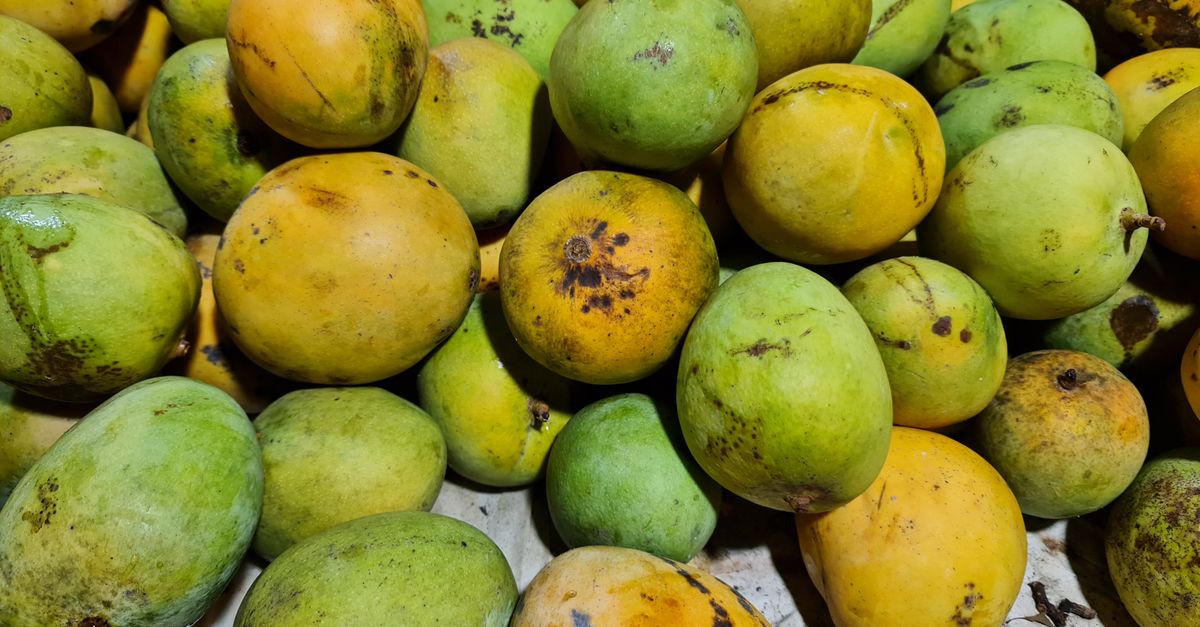
Chausa (listed by NHB as Samarbehisht Chausa) is a late-season table mango that works in the mango belt of Uttar Pradesh, Bihar and Punjab, where its extremely sweet fruit sells after the Dashehari and Langra crop is over. It takes a big, widely spaced tree, patience of several years before real income, and a plan for alternate bearing, so it suits farmers with land and a nearby market rather than quick returns.
Published Indian data specific to Chausa yield and economics is thin. The figures below for spacing, nutrition and general mango yield come from TNAU and ICAR-CISH and apply to mango in general; check them with your KVK before planting.
Where it grows in India
- States: the National Horticulture Board lists Chausa for Uttar Pradesh and Punjab; it is also grown in Bihar. Within Uttar Pradesh it is a standard cultivar of the Lucknow, Malihabad and western UP orchard belts.
- Climate: a subtropical, frost-free-at-flowering climate with a dry spell before bloom. It does not suit humid coastal belts.
- Soil: deep, well-drained loam; avoid waterlogged or saline patches. Dig 1 m x 1 m x 1 m pits.
What makes Chausa different
- Late maturity: NHB notes that harvest maturity comes about 12 weeks after fruit set in Dashehari and Langra, but about 15 weeks in Chausa and Mallika. In north India the overall mango harvest runs from June to August.
- Fruit: large, ovate to oval-oblique, light yellow, extremely sweet, with medium keeping quality, grown for table use and processing. NHB describes the flesh as fibrous, so do not market it as fibreless.
- Alternate bearing: ICAR-CISH names Chausa, along with Dashehari, Langra and Lucknow Safeda, as a variety with a heavy crop one year and a poor or no crop the next. NHB adds that it shows apical dominance.
- Tree size: it makes a large tree, so the dense 3 x 3 m systems CISH demonstrated with dwarfer varieties (Amrapali, Arunika, Ambika, Mallika) are not a ready option for Chausa.
- Eating quality: an ICAR study of nine cultivars reported that Chausa from Uttar Pradesh ripened well with good sensory scores even when picked early.
Spacing and planting
| System | Spacing | Plants per hectare | Plants per acre |
|---|---|---|---|
| Conventional (CISH) | 10 x 10 m | 100 | about 40 |
| Conventional (CISH) | 12 x 12 m | about 70 | about 28 |
| Higher density (TNAU) | 5 x 5 m | 400 | about 160 |
- CISH's method for the pit: dig in May to June, refill after a month with topsoil, 10 kg farmyard manure, 2 kg vermicompost, 250 g bonemeal, 250 g neem cake and 100 g DAP, and plant grafts after the monsoon starts (July to August). Stake the young plant.
- Buy grafted plants of true Chausa from a government or ICAR-approved nursery. Seedling trees vary in fruit quality.
- Closer spacing than 10 m needs pruning and canopy management for a tall, spreading variety. Ask CISH or your KVK before trying it.
Nutrition and irrigation
| Tree age (TNAU, per tree per year) | FYM | N | P | K |
|---|---|---|---|---|
| 1st year | 10 kg | 0.20 kg | 0.20 kg | 0.30 kg |
| 6th year onward | 50 kg | 1.0 kg | 1.0 kg | 1.5 kg |
- Intermediate ages step up between these two rows; TNAU's full table has them. At 10 x 10 m (40 trees per acre) a mature tree at the 6th-year dose means about 40 kg N per acre (100 kg per hectare), and the same for P and 60 kg K per acre.
- TNAU's irrigation advice is weekly watering under conventional systems, and drip uses about one-third of the water. Stop irrigation in the weeks before flowering so the tree flowers, and resume after fruit set. See drip irrigation.
- Flowering and fruit set: TNAU lists a 20 ppm NAA spray at flowering and a February spray of 0.5% urea or 1% potassium nitrate. For alternate bearing, TNAU lists paclobutrazol on non-bearing trees in the first fortnight of September; the dose depends on tree size, so take it from your KVK.
- Soil-test first and follow the result; see fertilizers.
Pests and diseases
| Problem | TNAU-listed control |
|---|---|
| Mango hopper | Acephate 75 SP at 1 g per litre, two spray rounds around flowering |
| Powdery mildew | Wettable sulphur 0.2% |
| Anthracnose | Mancozeb 2 g per litre or carbendazim 1 g per litre, three sprays at 15-day intervals |
| Malformation | NAA 100 to 200 ppm in October, then carbendazim 0.1%; destroy malformed panicles |
| Stone weevil, mealybug, fruit fly | Insecticide choice and timing from your KVK; TNAU's older list includes products that may now be restricted |
Always follow the label and current state recommendations. Check pests for identification help.
Harvest and yield
- First fruit: grafted mango trees at conventional spacing take several years; TNAU's yield schedule for mango starts with 8 to 10 t per hectare (3 to 4 t per acre) over the first 15 years, rising to 15 to 20 t per hectare (6 to 8 t per acre) in years 15 to 20. This is a general mango schedule, not a Chausa measurement, and alternate bearing will make it swing.
- Maturity: pick about 15 weeks after fruit set at the green mature stage, when the pulp turns cream to light yellow and the stone hardens (NHB). Leave a 10 to 20 cm stalk to limit latex stain, and keep fruit in shade in boxes of no more than 25 kg.
- Shelf life: NHB lists medium keeping quality, so plan sale within days of ripening.
Cost and returns
No verified Indian cost-of-cultivation figure for Chausa alone was available. Use this method with your own local numbers:
- Yield per acre (mature) x share of fruit sold at grade x price. For example, 6 t per acre x ₹30 per kg would be ₹1.8 lakh, but that price is an assumption for illustration, not a quote; check current rates at mandi bhav and with local traders.
- Subtract orchard upkeep, spraying, labour, packing and transport, and spread the early unproductive years across the later crops.
- For reference, a farmer who adopted CISH's dense planting of other varieties (3 x 3 m, planted 2017) is reported at ₹1.5 to 2.0 lakh per hectare in year 3 and ₹3.5 to 4.0 lakh per hectare in year 7. That is a single case with different varieties, not a Chausa forecast.
Market and selling
- Chausa arrives after Dashehari and Langra, so late-season supply is thinner; this timing is the main commercial reason to grow it.
- Sell to local and regional wholesale markets, direct to retail or through an FPO. Medium keeping quality limits long-distance shipping unless fruit is picked at the right maturity and cooled.
- Risk: alternate bearing means income varies year to year, and storm or hail in the May to June fruit-growth window can hit a whole crop. Consider PMFBY if mango is notified in your district.
- Credit for orchard setup may be available through a Kisan Credit Card or MIDH schemes; use the subsidy finder and ask the district horticulture office for current rates.
Sources
- TNAU Agritech Portal: Mango cultivation
- National Horticulture Board: Mango varieties
- National Horticulture Board: Mango harvesting
- Indian Horticulture (ICAR): Transforming conventional mango orchard to high-density planting
- Journal of Agricultural Engineering (ICAR): Maturity parameters of Indian mango cultivars