
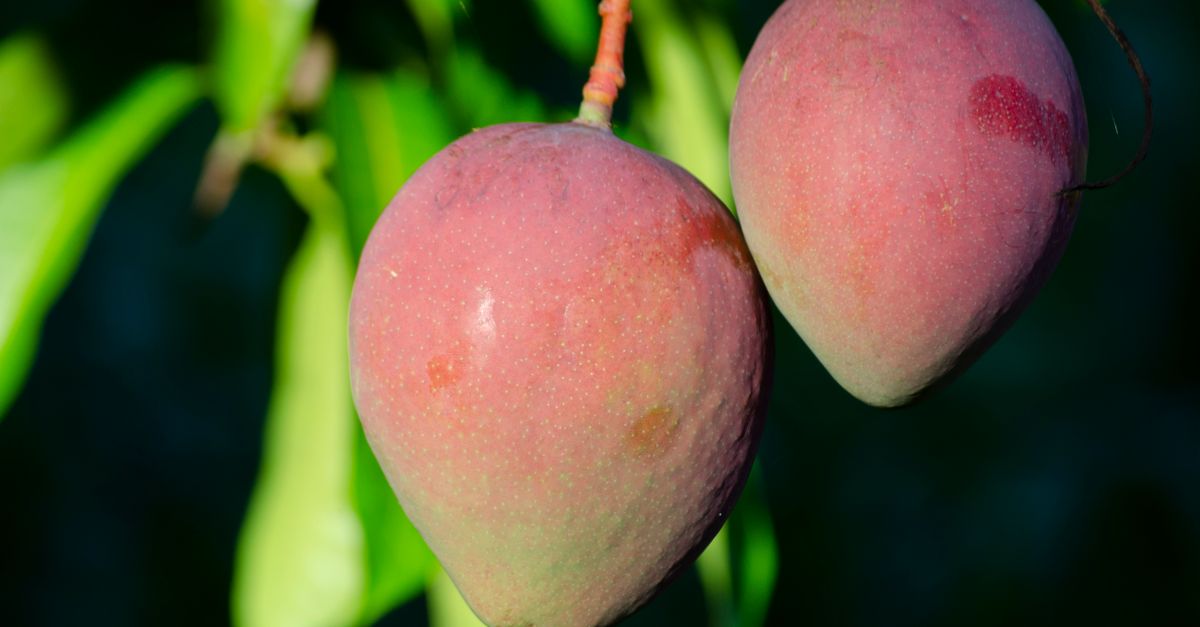
Miyazaki mango can be grown in India, but only as a small experiment, and the headline price of ₹2 to 3 lakh per kg is not what Indian growers receive. "Miyazaki" is the Japanese brand name for the Irwin variety grown in Miyazaki Prefecture, Kyushu, and "Taiyo no Tamago" (Egg of the Sun) is the top grade inside that brand. A grower in India needs a frost-free, dry-flowering mango climate, a plan for fruit bagging and pest control, and a buyer lined up before planting a single tree.
Irwin is an ordinary mango cultivar that originated in Florida (1949, a Haden x Lippens cross). What makes the Japanese product expensive is the grading and the growing system, not a special plant. Japanese growers raise it in greenhouses, hang each fruit from a string, wrap it in mesh and use reflective sheets for colour. Only a small share of fruit passes the "Egg of the Sun" test, which requires a fruit of at least 350 g, uniform dark red colour, a flawless skin and sugar content of 15 degrees or above. Fruit that misses the grade sells for far less, even in Japan.
Where it grows in India, and what has actually happened
Indian planting is scattered and mostly recent: news reports describe small orchards in Madhya Pradesh (Jabalpur), Uttar Pradesh (Malihabad, Ayodhya), Rajasthan (Kota), Tripura, Maharashtra and Karnataka. No ICAR institute or state agricultural university trial data was found for Irwin or "Miyazaki" in India, so there is no tested package of practices, no recommended rootstock and no measured Indian yield for this variety. Everything in the care sections below is therefore ordinary mango practice, not Miyazaki-specific advice.
The Jabalpur orchard, widely reported in 2021 after the owners hired guards and dogs against theft, grew from a single sapling given by a traveller. Reports say the saplings were obtained informally, and no independent check of the variety's identity was found. This matters for buyers: many "Miyazaki" saplings sold in India come without any certificate of origin.
What the market has delivered so far
A July 2025 report in FreshPlaza from Malihabad (Uttar Pradesh) is the most useful reality check. An orchardist with four bighas of Miyazaki trees called the famous price "pure myth", reported selling at about US$6 per kg, and said the fruit sold at the same level as Tommy Atkins or Ambika. Traders and a researcher quoted there said the deep red colour appeared but the Japanese eating quality did not carry over, buyers resisted the premium price, and prices fell as more people planted. Saplings were reported at roughly US$12 each. Separate news items quote ₹1,500 per kg in Tripura, but these are single-sale anecdotes, not market prices.
Climate and soil limits
Use the same limits as any mango: warm, frost-free, a dry spell at flowering and well-drained soil. High humidity or rain during flowering causes powdery mildew, anthracnose and poor fruit set, so coastal and high-rainfall tracts are poor choices. Deep, well-drained loam or sandy loam is best. Red colour needs bright light, so a dense canopy shades the fruit and reduces colour.
Planting and spacing
TNAU lists conventional mango spacing of 7 to 10 m and a high-density option of 5 m x 5 m (400 plants per hectare, about 160 per acre). Pits are 1 m x 1 m x 1 m, filled with topsoil and 10 kg farmyard manure. Because this is a hobby or trial crop, plant 10 to 20 trees first. At 10 m x 10 m you will fit about 40 trees per acre (100 per hectare). Use a grafted plant from a nursery that will name the mother tree.
Nutrition and irrigation
TNAU's general mango schedule, per tree per year: year 1 gets 10 kg FYM, 0.2 kg N, 0.2 kg P and 0.3 kg K; each dose rises yearly by the same amount until the sixth year onward, when it is 50 kg FYM, 1 kg N, 1 kg P and 1.5 kg K. Irrigate young trees weekly in summer. Stop watering for about 2 months before expected flowering and resume at fruit set. Soil-test and adjust with your local KVK.
Pests and diseases
| Problem | Standard mango control (TNAU) |
|---|---|
| Mango hopper | Two sprays at flowering, for example acephate 1 g per litre |
| Powdery mildew | Wettable sulphur 0.2% |
| Anthracnose | Mancozeb 2 g or carbendazim 1 g per litre, three sprays at 15-day intervals |
| Fruit fly | Methyl eugenol traps; bag fruit |
| Malformation | NAA 100 to 200 ppm in October, remove affected panicles |
Follow the label and ask your KVK for current recommended chemicals. Fruit bagging is how Japanese-style premium fruit is protected from blemish, and it is the practical step that separates a premium-grade fruit from an ordinary one. Bag fruits early after fruit set, and expect to spend labour on it.
Harvest and yield
A grafted mango usually starts bearing in the 3rd to 5th year. There is no Indian yield figure for Irwin. For ordinary mango TNAU gives 8 to 10 tonnes per hectare (about 3.2 to 4 tonnes per acre) up to year 15, so do not assume more. Remember that premium-grade fruit is a small slice of any crop: even in Japan, only a minority qualifies for the top label.
Cost and returns
No verified Indian cost-of-cultivation or income record for Miyazaki was found, so no profit figure is given. What can be said is how the arithmetic works. At 40 trees per acre and a cautious 40 kg of marketable fruit per tree, an acre gives about 1.6 tonnes (1,600 kg). Every ₹100 per kg you actually receive is therefore ₹1.6 lakh per acre per year. The Malihabad grower's report that Miyazaki sold at the level of ordinary red mangoes means you should plan on ordinary-mango prices (see mandi rates) and treat any premium as a bonus you have a written buyer for. Bagging every fruit adds labour and material cost that an ordinary mango does not carry.
Market and selling
- There is no organised Indian market for "Miyazaki" as a grade. Sales so far are direct to curious urban buyers, social media and hotels, in small lots.
- Export to Japan needs plant-health approvals and Japanese-grade quality; no record of an Indian grower doing this was found.
- The main profit in this field has been selling saplings, which is a nursery business, not a fruit business, and is vulnerable to the price collapse that reports describe.
- Do not buy on a buy-back promise from a sapling seller. Get any agreement in writing and verify it.
Subsidy and insurance
Mango is a MIDH-supported fruit, so a general mango planting may qualify through your state horticulture department; there is no scheme specific to Miyazaki. Check the subsidy finder and your district horticulture office. For comparison against a proven option, see ordinary export-quality mango varieties at your KVK.