
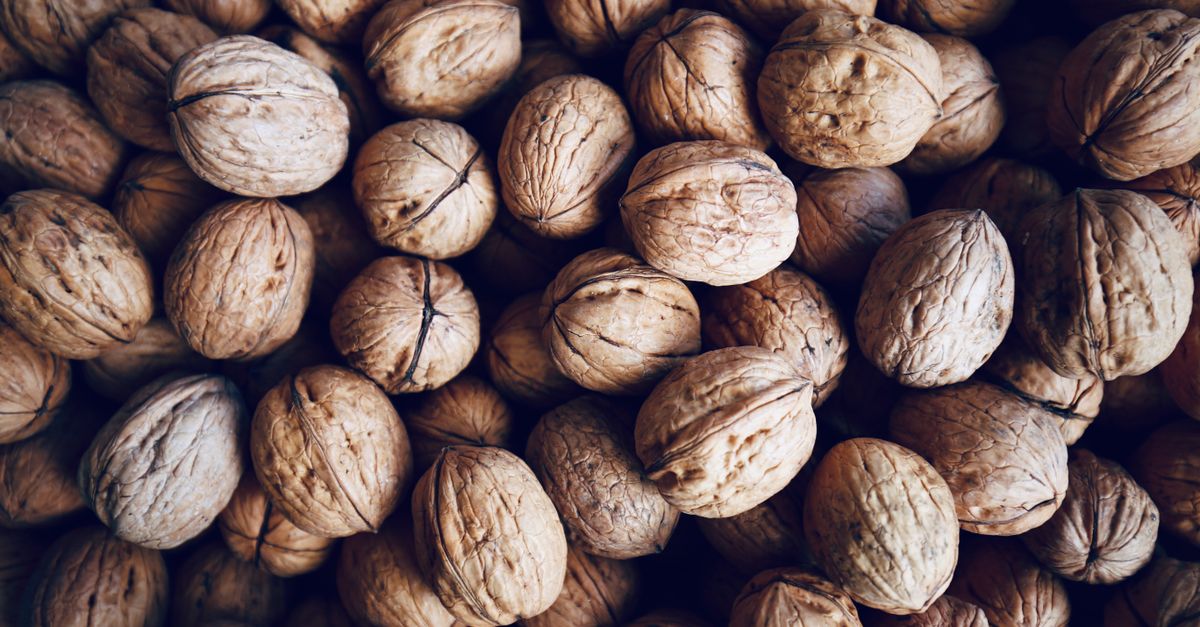
Walnut (Juglans regia) is a realistic orchard crop only in the temperate Himalayan belt, mainly Jammu and Kashmir, plus Uttarakhand, Himachal Pradesh and Arunachal Pradesh; it needs a cold winter, deep soil and a site low enough to escape late spring frost, and it takes many years to pay back. National Horticulture Board figures (2023) quoted in Indian Farming give about 103,550 hectares and 298,290 tonnes of production, with Jammu and Kashmir contributing over 85% of the national output.
Most Indian orchards are seedling trees with a long wait to bearing and uneven nuts. The main constraint for a new grower is getting genuine grafted plants of a named variety, not land or climate.
Where it grows in India
- Jammu and Kashmir: the main walnut producer. Important Kashmir districts are Anantnag, Pulwama, Kupwara, Budgam, Baramulla and Srinagar; in the Jammu region Doda, Kishtwar, Poonch and Udhampur lead, with smaller plantings in Rajouri and Kathua (ICAR-CITH).
- Altitude: the tree grows from about 900 m to 3,500 m, but commercial orchards are not advised above 2,500 m because late spring frost can destroy the flowers and cause heavy loss or complete crop failure.
- Tree and flowering: a large deciduous tree up to 25 m tall. Male catkins and female flowers sit on the same tree, and male flowers usually open before female ones, so growing more than one variety with overlapping flowering helps nut set.
- Not suited to plains or warm regions. Do not plant walnut at low, warm sites on the strength of a nursery promise.
Varieties
| Variety | Source | Notes |
|---|---|---|
| Hamdan, Sulaiman | SKUAST-Kashmir | Released for better nut and kernel quality and shelling percentage than seedling types |
| CITH-W selections (CITH-W-1 to 20 and others) | ICAR-CITH, Srinagar | Selections from Indian seedling germplasm, grouped by fruit maturity (early, mid, late) and nut traits; ask CITH for plant availability |
| Franquette, Nugget and other introduced cultivars | Introduced; evaluated at CITH Srinagar | Check local performance with your university or KVK before planting in numbers |
- Variety performance depends on altitude and frost pattern. Ask SKUAST-Kashmir, SKUAST-Jammu, YSPUHF Nauni (Himachal) or the state horticulture department which variety suits your elevation.
- Nut types sold in the Indian trade are grouped as hard-shelled, medium-shelled, thin-shelled and paper-shelled; thin-shelled nuts with light, full kernels fetch the best price.
Planting material
- Walnut is hard to propagate vegetatively because the tissue browns quickly at wounds and callus forms poorly. Quality grafted plants are in short supply.
- Grafting results (ICAR-CITH, Srinagar): wedge grafting of the middle part of one-year-old scion wood on 15 March in a polyhouse gave 90% graft success. Averaged over all treatments, open-field graft success was only about 14% against about 43% in a polyhouse. Grafting is therefore best done by a nursery with polyhouse facilities.
- Chip budding: an extension article from YSPUHF-linked authors reports 81% success for chip budding on one-year-old seedling rootstock, using buds taken in June from current-season growth.
- Buy plants only from an ICAR, state university or state horticulture department nursery, with the variety name and grafting date written on the bill. Seedling trees are slow and variable.
Planting and spacing
- One extension presentation on walnut production technology gives 10 x 10 m square planting, which is 100 trees per hectare or about 40 per acre, in pits about 1.25 m on each side filled with topsoil, about 50 kg farmyard manure and some phosphorus and potash. Winter planting (December to January) is given for the hills.
- CITH evaluates genotypes at 6 x 6 m in its gene bank, which is closer, but that is a research planting. Wide spacing leaves room for intercropping young orchards with legumes or vegetables.
Nutrition and irrigation
- The same presentation gives nitrogen at roughly 100 to 400 g per tree a year for years 1 to 4, 500 to 600 g for years 5 to 9, and about 900 g from year 10, with phosphorus and potash by soil test. Treat this as a starting point and follow your KVK or university recommendation and a soil test.
- Give irrigation during dry spells in young orchards and at nut filling in summer; mulch the tree basin. Avoid waterlogging. See fertilizers for product options.
Pests and diseases
- Anthracnose: brown to black spots on leaves, shoots and husks; premature leaf fall in wet years.
- Walnut blight (bacterial): water-soaked spots on fruit and leaves; copper-based sprays are recommended in the literature.
- Codling moth and husk fly: damage the husk and kernel.
- Collect and destroy infected leaves and fallen nuts, prune for airflow, and use only chemicals and doses on your state package of practices and label. See pests and ask your KVK.
Harvest and yield
- First crop: seedling trees have a long juvenile period. The presentation above gives 6 to 10 years to commercial bearing, and grafted trees come earlier than seedlings, though exact years depend on variety and site.
- Yield: a study of seedling trees in the Jammu region recorded mean dried-nut yield of about 21 kg per tree at 15 to 30 years, about 31 kg at 31 to 50 years, about 42 kg at 51 to 70 years and about 63 kg above 70 years. Do not use claims of 100 kg or more per tree for planning.
- Per acre: 40 trees per acre at about 20 kg per tree is about 800 kg dried nuts per acre (about 2,000 kg per hectare) from trees 15 to 30 years old. Younger trees give much less. This is arithmetic from the per-tree study above, not a published orchard average.
- Harvest time: August to September in Himachal, September in Kashmir, when the husk splits and turns yellowish and the partition inside the nut has browned. Remove the husk, wash and dry the nuts promptly to avoid mould.
Cost and returns
- The cost is mostly up-front: plants, pits, fencing, labour and about 8 to 10 years before meaningful income. Interest on that waiting period is the biggest hidden cost.
- Walnut prices swing year to year. Check the current in-shell and kernel rates in Srinagar, Jammu and Delhi dry fruit markets before doing your sums, and use mandi bhav as a guide. Income per acre = kg per acre x price per kg, minus yearly running costs.
- Walnut timber is also valuable, but felling and transport rules for trees vary by state; check with the forest department before cutting.
Market and selling
- Most buyers are traders in the Kashmir and Jammu dry fruit markets and Delhi wholesale markets; kernels are separated from shells by cracking units.
- Quality grading by nut size, shell thinness and kernel colour drives price; sun-damaged or mouldy nuts sell cheap.
- FPOs can crack, grade and pack to reach better buyers; see FPO. Mission for Integrated Development of Horticulture support for new orchards varies by state; ask your state horticulture department for current rates.
💡 Tip: Visit an orchard of the same variety at your elevation that has already fruited before you order plants.
Sources
- Chip budding techniques for walnut, Indian Farming, June 2025 (ICAR)
- Standardization of efficient propagation technique for walnut, Indian Journal of Horticulture 2016 (ICAR-CITH)
- Morphological characterization of walnut genotypes, Indian Journal of Horticulture 2018 (ICAR-CITH)
- Advanced production technology of walnut (extension presentation)
- Genetic diversity of walnut from Jammu region, Indian Journal of Agricultural Sciences