
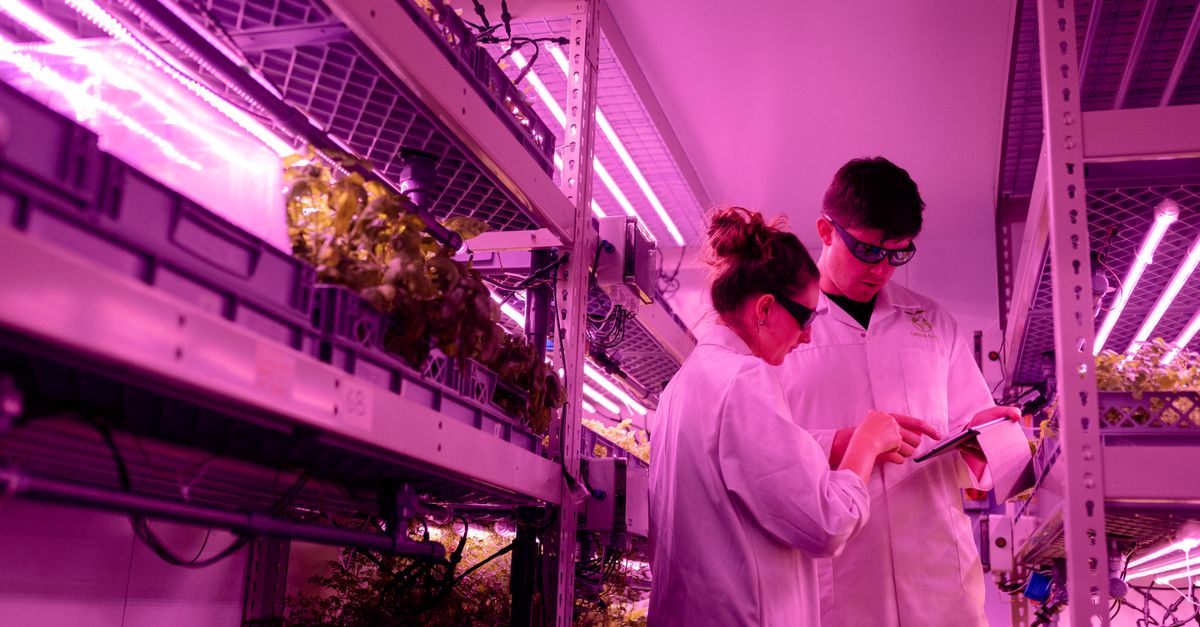
Vertical farming can work in India only for leafy greens, herbs and microgreens sold to a buyer who pays a premium, and only if electricity, cooling and capital are planned before the first tray goes in. For staple crops such as wheat, rice and pulses it does not work at current electricity prices. Fully indoor LED farms are the hardest version; stacked hydroponics inside a polyhouse using sunlight is the lower-risk way to start.
No Indian peer-reviewed cost data for vertical farms was found, so the figures below come from international studies and are marked as such. Several well-funded vertical farms abroad have gone bankrupt, mainly because of energy and equipment debt.
What it is, and the three versions
| Type | Light | Where it fits | Main risk |
|---|---|---|---|
| Stacked hydroponics in a polyhouse or net house | Mostly sunlight, some fans or cooling | Lettuce, herbs, spinach near a city | Heat in summer; lower shelves get less light |
| Indoor farm with LED lights | Full LED, full cooling and dehumidifying | Leafy greens, herbs, microgreens for premium buyers | Power bill and capital cost |
| Towers, walls and rooftop containers | Sunlight or LED | Small-scale herbs and salad for home or local sale | Small volume; hard to cover costs |
See also hydroponic lettuce, microgreens and hydroponics.
What the numbers say
- Electricity: a 2025 analysis by Lovat, Noor and Milo puts a commercial vertical farm at about 10 kWh of electricity per kg of lettuce, and about 250 kWh per kg of dry plant matter. For dry staples such as wheat and rice the electricity alone costs about $10 per kg against under $1 at the farm gate, so staples are not viable. Lettuce and tomatoes are only marginally competitive on electricity, and that excludes labour and equipment.
- Cost share: another review reports electricity at 25 to 30% of total vertical farm operating cost, with lighting about 80% of the electricity, cooling about 16% and other equipment about 4%.
- Yield: reviews report 100 to 150 times more output per unit of floor area than field farming, and up to 200 to 250 times with 10 layers. That is per square metre of floor, not per rupee.
- Water: about 10 litres per kg of lettuce in the Lovat analysis (field lettuce uses several times more), and one review gives 1 litre against 250 litres per kg in the field. Water saving is real, but it does not offset the power cost.
- Crops: only high-value leafy crops and culinary herbs (high harvest index, short cycle) are viable. Heavier crops such as grains, legumes and potatoes are not.
Cost arithmetic for India (illustration)
- At 10 kWh per kg and an assumed commercial tariff of ₹6 to ₹10 per kWh (check your DISCOM), electricity is about ₹60 to ₹100 per kg of lettuce.
- If electricity is 25 to 30% of total cost, the full cost is about ₹200 to ₹400 per kg, before loan interest on the equipment. Compare that with your local wholesale price on mandi bhav and your buyer's written offer.
- A review gives a European reference of €321,763 per growing unit and a payback of 3 to 6 years at a wholesale price of €6.36 per kg or more. An Indian equivalent was not found.
- A Nigerian study found small-scale greenhouse hydroponics (not stacked indoor LED farms) viable, with payback near one year and low electricity use. It shows that simple hydroponics can pay in the right market, but local prices decide it.
Why vertical farms fail
- Reviews list high debt from automation, lighting and dehumidification energy, and produce prices too low to cover them. The 2025 EMBO Reports review notes a slew of bankruptcies.
- Examples named in a secondary source: Podponics (US) went bankrupt in 2016, and Jones Food Company (UK), opened in 2024 with renewable power, entered administration in April 2025.
- Power cuts are the Indian-specific risk: lights, pumps and cooling fail together, and a crop can be damaged quickly. Plan a backup before you plan trays.
Growing basics
- Crops: lettuce, basil, mint, spinach, coriander, rocket and microgreens. A stacked system has no soil, so nutrient solution, pH and temperature are all managed by you.
- Light: in a polyhouse, upper tiers get most of the sunlight, so shelves need rotation or supplementary LED. In an indoor farm, plan lighting hours, dehumidifying and cooling from the start.
- Site: reliable power, clean water and a clean controlled space matter more than the local climate. Consider solar only after working out the full load; lighting needs far more power than pumping.
- Cleanliness: disease spreads quickly in recirculating systems, so sanitation, a clean entry and tested water are standard.
💡 Tip: Get a written offer from a hotel, retail chain or restaurant at a fixed price per kg before buying equipment, and start with one rack in a polyhouse to measure real yield and power use.
Market and subsidy
- Likely buyers are hotels, restaurants, salad and herb retail chains, and quick-commerce or home-delivery sellers in metro cities. Volumes are small and prices depend on freshness, so contract before scaling.
- Polyhouse construction has subsidy support; see polyhouse subsidy. Whether a stacked vertical hydroponic unit qualifies in your state could not be verified; ask your horticulture department and check the subsidy finder.
- For loans, see KCC, and talk to your bank about project finance; lenders will ask for buyer contracts and a power plan.
Sources
- Vertical farming limitations and potential demonstrated by back-of-the-envelope calculations (Lovat, Noor and Milo, 2025)
- How energy innovation in indoor vertical farming can improve food security, sustainability, and food safety? (Avgoustaki and Xydis, 2020)
- Food for thought: Perspectives on the current state of Vertical Farming (Harbinson and Taylor, EMBO Reports, 2025)
- Empowering vertical farming through IoT and AI-driven technologies: a comprehensive review (Heliyon, 2024)
- The economic viability of commercial-scale hydroponics: Nigeria as a case study (2023)
- Vertical farming (Wikipedia, secondary source)