
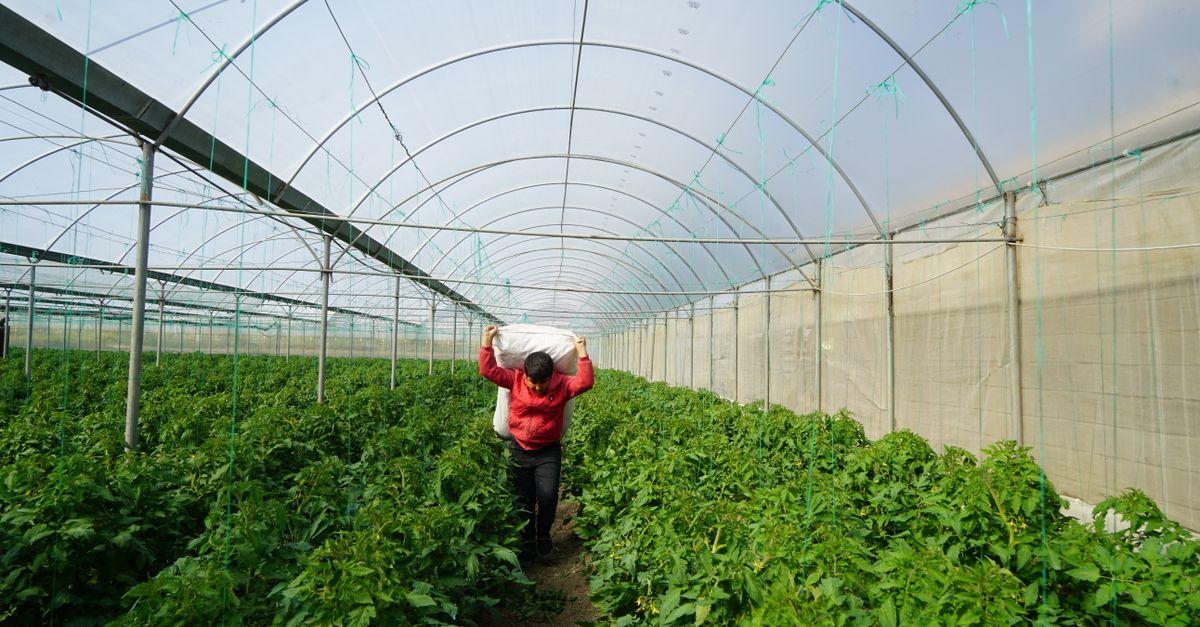
A naturally ventilated polyhouse can pay for itself in India, but only for a few crops (coloured capsicum and parthenocarpic cucumber have the best Indian evidence), only with drip, fertigation and trained labour, and only if there is a market within a day's reach. It is a capital-heavy business, and yields published by research stations and yields in a typical farmer's first season are far apart.
Open-field vegetable farming loses crops to rain, frost and pests. A polyhouse reduces that risk and allows off-season production, but it adds a structure to repay, heat and humidity problems in summer and a faster spread of disease inside the house.
Where it works and which structure
- Naturally ventilated polyhouse: the common choice for farmers. Side and roof vents let heat out without fans. It suits the plains of north India (winter crop, September to March), hill regions and the plateau, where nights are cool. Very hot, humid coastal sites need more cooling and have more disease.
- Fan and pad house: costs much more to build and run (the NHB cost norm is ₹1,400 per m2 against ₹844 for a naturally ventilated tubular house). It is justified only for a high-value crop in a hot dry climate with a firm buyer.
- Shade net house (NHB norm ₹710 per m2 for tubular structure) is a cheaper option for nursery raising and for crops that mainly need shade and insect protection, not rain cover.
- Capsicum grows best at 25 to 30°C by day and 18 to 20°C at night; fruit set suffers above 35°C or below 12°C, according to the sources cited by an MPUAT trial. Check your site's temperature range with the weather page and local KVK before choosing crop and sowing date.
Crops and varieties with Indian evidence
| Crop | Variety or hybrid | Source | Reported result |
|---|---|---|---|
| Parthenocarpic cucumber | Pusa Seedless Cucumber 6 (Pusa Parthenocarpic Cucumber 6) | ICAR-IARI, for north Indian plains | 180.61 q per 1,000 m2 (about 18 kg per m2) with 15 September planting and 30:22:31 kg NPK per hectare, in a naturally ventilated polyhouse trial; first harvest in 40 to 45 days |
| Parthenocarpic cucumber | Hilton, NVH-2-26, Isatis, Phule Prachi | CCS HAU Hisar winter trial | 22.8, 20.5, 21.2 and 16.1 kg per m2 respectively |
| Capsicum | Swarna Atulya (open pollinated); hybrids Rehana, Huntington | ICAR-IIVR demonstration, Varanasi | 2,864 kg from 0.25 acre over 15 pickings in 7 months, net ₹1.27 lakh |
| Tomato | Tomato (hybrids not specified) | IIHR economic study (2009) | Judged not feasible in a medium-cost polyhouse because breakeven price exceeded the market price |
- Use seed or seedlings from a registered source and raise nursery plants in pro-trays under insect-proof net. Parthenocarpic cucumber needs no bees for fruit set, which is why it suits closed houses.
- Capsicum and cucumber are the better-supported crops. Treat tomato in a polyhouse as a gamble unless local prices are consistently high; the only economic study found rated it unviable.
Planting, irrigation and nutrition
- Research polyhouses use drip irrigation and fertigation, with raised beds and plastic mulch. In an MPUAT trial on capsicum (variety Indra) under a naturally ventilated polyhouse, drip at 80% of crop evapotranspiration gave the best benefit-cost ratio, and 60% cut returns to a loss.
- The ICAR-IARI trial used 30:22:31 kg N:P2O5:K2O per hectare (about 12:9:12.5 kg per acre) for cucumber, trained vertically on jute thread after pruning and pinching of side shoots. Nutrient need depends on the crop, soil test and fertigation schedule; get the schedule from your KVK or the hybrid's seed company.
- Train and prune climbing crops weekly; this is a daily-labour business.
Pests, diseases and house management
- Insect-proof net on vents, a double-door entry, footbath, and clean tools keep out whitefly, thrips, aphids and mites, which enter and multiply fast in a warm closed house. Yellow and blue sticky traps give early warning.
- Humidity brings fungal diseases such as powdery mildew and botrytis; ventilate, avoid wetting leaves and remove infected plants. Soil-borne disease builds up when the same crop is grown repeatedly in the same soil, so rotate crops and consider soil solarisation between crops.
- Choose chemicals only on the label and on local KVK or plant protection advice, and observe the waiting period before picking. See pests for identification.
Yield: research versus reality
- A review in the MPUAT paper, citing earlier work, puts greenhouse capsicum at 100 to 120 t per hectare against 20 to 40 t in open field. That equals 10 to 12 kg per m2.
- The ICAR-IIVR demonstration, run with scientists monitoring every operation, gave 2,864 kg from a 0.25 acre house (about 1,012 m2), roughly 2.8 kg per m2. The farmer's own first crop had failed before the scientists' schedules were applied.
- Cucumber trial yields of 16 to 23 kg per m2 came from research stations. Expect your first year to land well below station figures.
💡 Tip: Before building, grow the same crop in a 4 to 6 month low-cost net tunnel or trial plot, fix your buyers, and visit a polyhouse that has run three or more seasons in your own district.
Cost and returns
- Structure cost: NHB cost norms list ₹844 per m2 for a naturally ventilated tubular polyhouse (₹970 for hilly areas), ₹540 for a wooden structure and ₹450 for bamboo, plus ₹140 per m2 for planting material and cultivation of high-value vegetables. These norms are older figures used for subsidy, so get current quotes. A 1,000 m2 tubular house at the norm is about ₹8.4 lakh for the structure.
- Return illustration: the IIVR demonstration reported ₹1.27 lakh net per 7-month capsicum crop on 0.25 acre. At that figure, an unsubsidised ₹8.4 lakh structure takes about 6.6 such crops to repay, which is over 3 years even with two crops a year, before interest, repairs and film replacement (the film has to be replaced periodically). This is an illustration from one demonstration, not a forecast.
- An IIHR study (2009 prices) found capsicum highly feasible, with a benefit-cost ratio of 1.80, a payback under 2 years and NPV of ₹3.23 lakh per 500 m2. Costs and prices have changed since then, so recompute with your own numbers.
- Subsidy: NHB lists 50% credit-linked back-ended assistance for commercial projects above 2,500 m2, and states run MIDH schemes for smaller units. Rates and area limits are revised; check the polyhouse subsidy page, the subsidy finder and your district horticulture office before you sign a contractor. Get the approval in writing before paying a contractor.
Market and risks
- Buyers are city wholesalers, hotels, supermarkets and retail chains. Coloured capsicum and seedless cucumber are premium products; prices fall when many nearby farmers harvest together. Track local rates on mandi bhav.
- Common failure causes: poor structure quality, no drip or fertigation know-how, wrong sowing date, whitefly-borne virus, and no buyer arranged. A heavy storm can also destroy film and frames, so insure the structure and use KCC or term-loan finance carefully.
- Related guidance: drip irrigation, solar pump, FPO for joint selling.
Sources
- ICAR, IIVR-led success in protected cultivation of vegetables (Varanasi capsicum demonstration)
- ICAR-IARI, Pusa Seedless Cucumber 6: planting date and fertiliser under polyhouse (Indian J. Agricultural Sciences)
- CCS HAU Hisar, parthenocarpic cucumber hybrids under polyhouse (Indian Journal of Horticulture)
- IIHR, Economic feasibility of vegetable production under polyhouse: capsicum and tomato (J. Horticultural Sciences, 2009)
- MPUAT, deficit irrigation and plastic mulch for capsicum in a naturally ventilated polyhouse (2019)
- National Horticulture Board, cost norms for protected cultivation