
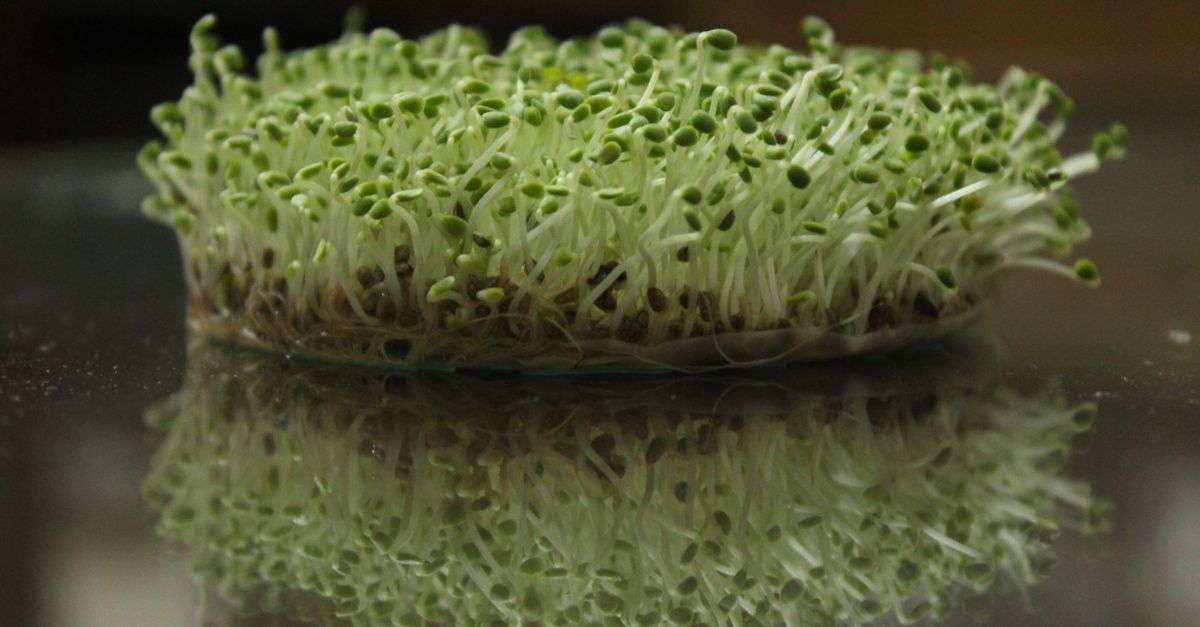
Microgreens work anywhere in India because they are grown indoors on trays in 1 to 2 weeks, with no farmland needed. What it takes is a clean room, a steady supply of seed and a reliable buyer, because the product spoils in days and the volumes are small. This is a small-scale, market-limited business, not a farming crop you scale by acreage.
The guide below separates what Indian university trials have measured (growing media, seed density, days to harvest) from what comes from business blogs (prices, set-up costs), which are not verified.
Where and how it is grown
- Grown indoors in a room, shed, balcony or on racks, in any state. Sunlight through a window or simple grow lights both work.
- An Indian university trial of six microgreen species found the best harvest window to be roughly day 6 to day 13 after sowing, at about 24 to 28 degrees Celsius, cut at the stage when the two seed leaves (cotyledons) are fully open. Keep the room clean, ventilated and not hot.
- Sikkim University and Assam Agricultural University researchers have published an organic production method for the cold desert Himalaya zone in Indian Horticulture (2024), aimed at remote high-altitude places such as Mangan, Lachen and Lachung with poor fresh-produce supply.
Crops, growing medium and seed density
| Crop | What the Indian study found |
|---|---|
| Radish | Fastest germination of 16 species tested: 2.3 days, 94.1 percent germination (Punasia et al., IJAS 2026) |
| Broccoli | Longest stems, 10.2 cm; celery was shortest at 3.93 cm |
| Fenugreek | High chlorophyll and phenol content among the 16; best on cocopeat at 25 g seed per tray, yield about 7.2 kg per square metre (SKUAST-K, IJAS 2026). Raising seed to 30 g per tray lowered performance because of crowding. |
| Lettuce | Scored low on taste in the 9-point sensory test |
- Cocopeat gave better germination, vigour and yield than sawdust and soil in the fenugreek trial. Soil with vermicompost at high seed density showed the highest nitrate level.
- The trial yield is a research number from a controlled setting; the tray size used is not stated here, so do not plan commercial output from it without your own test batches.
- Seed rates for other crops (mustard, sunflower, pea, coriander, amaranth, beetroot) must be found by your own trial; no verified Indian figure for them was found.
Daily routine
- Sow thickly and evenly on a thin layer of damp, clean medium. Larger seeds such as sunflower and pea are usually soaked first.
- Keep trays covered or dark for the first days, then give light. Water from the bottom or mist gently, so that the leaves stay dry; over-wet trays cause mould and damping-off.
- No fertiliser is needed for a 1 to 2 week crop in a medium with some nutrients; soilless mats rely on the seed reserves.
- Sow a few trays every day or two to keep a constant supply.
Food safety (the main hidden risk)
- Microgreens are eaten raw with no kill step. Studies abroad found Salmonella, E. coli and Listeria can travel from seed, growing medium or irrigation water into the edible part. No confirmed outbreaks have been linked to microgreens, but there have been recalls.
- A 2023 study (Frontiers in Sustainable Food Systems) tested 102 seed samples from 14 species bought online: 48 percent had coliforms, one onion sample had Salmonella and one carrot sample was presumptive Listeria positive. The best decontamination treatment tried was a 10-minute soak in 3 percent hydrogen peroxide followed by 60 degrees Celsius for 20 hours, which cut microbes by 1.2 to 3.4 log without hurting germination (92 to 96 percent). This was a US study; no India-specific results.
- Use food-grade seed meant for sowing (not treated agricultural seed), clean drinking-quality water, new or sanitised trays and medium, and wash hands. If you sell packaged food, check current FSSAI registration or licence rules with your district food safety office; the thresholds are not verified.
Cost and returns
- Business blogs quote set-up costs of Rs 30,000 to Rs 1,00,000 (seeds, trays, racks, lights, packaging), prices of Rs 150 to Rs 500 per 100 g in urban markets and a 3 to 6 month break-even. These are unverified and come from advisory and loan-company websites, not research, so use them only as a starting question for your own quotes.
- Illustration with blog figures: a blog states a 4-tray setup gives 400 to 600 g per week; at Rs 300 per 100 g that is Rs 1,200 to Rs 1,800 a week (blog arithmetic). Subtract seed, medium, packaging, power and the time spent delivering. Selling that little rarely pays unless you have fixed buyers.
- Test your own yield per tray and your own seed cost on two crops for a month before buying racks.
Market and selling
- Buyers are restaurants and hotels, juice and salad bars, premium grocers, gyms and some households. Demand is concentrated in big cities.
- Shelf life is short; radish microgreens are said to keep up to about 5 days in a refrigerator (blog source). Cut to order where possible.
- Be blunt about the income-story videos promising lakhs a month: they assume a large, fixed set of buyers. Sign up two or three chefs or shops before scaling. Competition from other small growers has risen.
💡 Tip: Start with radish or mustard: radish germinated fastest in the Indian trial. Record sowing date, harvest date, weight per tray and the buyer's price for a month, and work out your real cost per 100 g.
Polyhouse or shed set-ups may qualify under state horticulture schemes, but nothing specific to microgreens was found; check polyhouse subsidy and subsidy finder.
Sources
- Mushtaq et al., fenugreek microgreens: growing media and seed density, Indian Journal of Agricultural Sciences 2026
- Punasia et al., sixteen herbs as antioxidant-rich microgreens, Indian Journal of Agricultural Sciences 2026
- Sherpa et al., Organic Microgreen production for Cold Desert Himalaya Zone, Indian Horticulture 2024
- Microbiological quality of microgreen seeds and seed decontamination, Frontiers in Sustainable Food Systems 2023
- Kanakkupillai, microgreens business in India (commercial blog; cost and price figures unverified)