
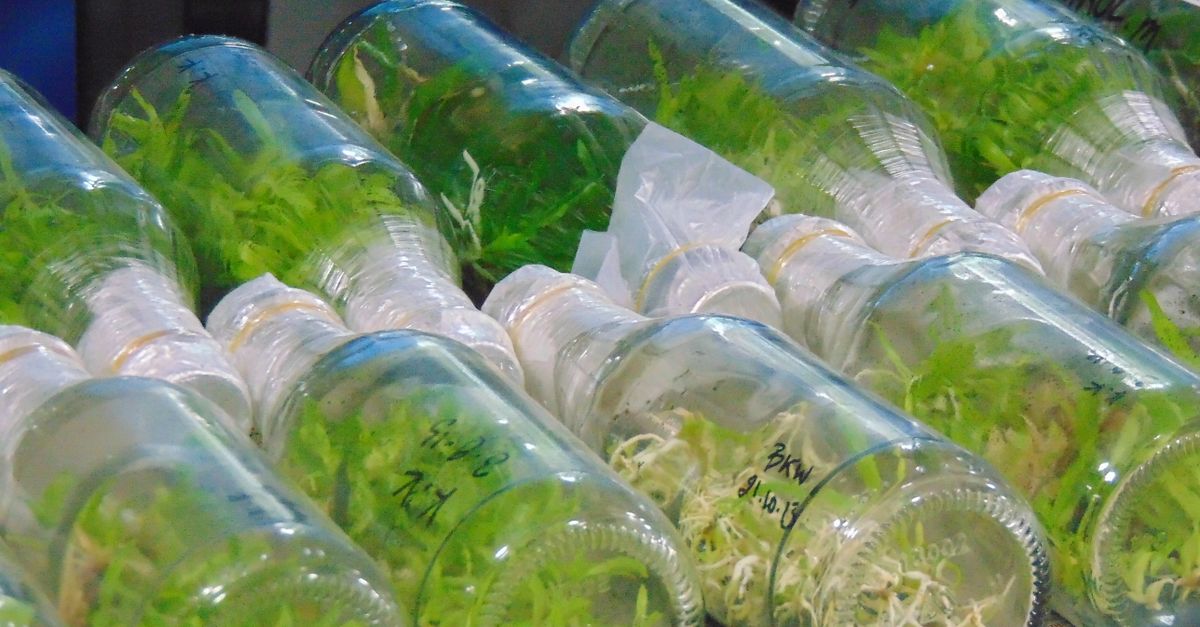
A plant tissue culture lab is a factory, not a farm: it multiplies plants from tiny tissue pieces on sterile nutrient gel, and it only pays if it runs at high capacity with low contamination and has orders booked before the plantlets are made. Indian banana is the biggest market, and the sector has a record of failures as well as successes, so an entrepreneur should plan around buyers and trained staff before buildings and equipment.
A 2024 review in Plant Tissue Culture and Biotechnology reports that more than 30 of the roughly 90 commercial micropropagation units set up in India earlier had closed, mainly because of high unit costs and plant losses at hardening. Another review reports that about 200 commercial units operate with a combined capacity near 500 million plantlets a year, with only 50 to 60% of capacity typically in use.
What a commercial lab consists of
- Media preparation room: balances, pH meter, autoclave and a store for chemicals and glassware.
- Transfer (inoculation) room: laminar airflow benches where tissue is cut and transferred under sterile air. This is where most contamination starts, so technician discipline matters more than the bench brand.
- Growth room: shelves with controlled light, temperature and humidity, running day and night, which makes electricity a major running cost.
- Hardening and primary and secondary nursery: greenhouse, shade house and mist or fog systems where plantlets are weaned off the gel. Losses here decide profit.
- Stock plants and mother-plant source: disease-free, true-to-type mother plants of each variety, with records.
Which crops make sense
- Banana: the largest commercial crop for tissue culture in India. The Government of India has recognised 99 tissue culture units with a combined capacity of 187 million banana plants a year, so competition is heavy and prices are driven down by large labs.
- Other crops: sugarcane, potato (minitubers), date palm, pomegranate, orchids, anthurium, gerbera and some forest and medicinal species are produced commercially. Each needs a validated protocol for the specific variety, and a protocol that works for banana does not carry over.
- Choose crops where growers in your region already buy planting material every season, and ask the state horticulture department which varieties are being promoted.
Certification: NCS-TCP
- The Department of Biotechnology (DBT) runs the National Certification System for Tissue Culture Raised Plants (NCS-TCP), set up under a Ministry of Agriculture notification of 10 March 2006, to certify tissue culture plants as virus-free and true to type.
- A production facility of any ownership, with minimum capacity of 0.5 million plants, can apply for recognition.
- For banana, four viruses matter: banana bunchy top virus, banana streak Mysore virus, cucumber mosaic virus and banana bract mosaic virus. Tissue culture does not always remove them, so mother plants and batches are tested by PCR, RT-PCR or ELISA at accredited test laboratories.
- Many buyers and state schemes prefer or require NCS-TCP recognised suppliers, so recognition is close to a market requirement for banana.
Cost and returns
- Where the money goes: reviews of Indian micropropagation report that labour is usually 40 to 50% of production cost and electricity 20 to 30%, with equipment, chemicals, glassware and greenhouse making up the rest.
- Hardening loss: reported mortality at acclimatisation is about 5 to 8% in well-run units; poorly run units lose far more. Every lost plant carries the full lab cost.
- Project cost: depends on capacity and building. No single reliable per-plantlet cost or selling price for India is published by an official source; get a project report from your state horticulture mission, NHB or a bank, and test its prices against quotations from at least three banana growers or distributors.
- Break-even logic: annual fixed cost (loan instalments, salaries, power) divided by margin per plant gives the number of plants you must sell. If that number is above what you can realistically sell at 50 to 60% utilisation, the project does not work.
Staff and skills
- A trained plant tissue culture scientist or technologist must run the lab; the owner cannot learn this on the job.
- Technicians need weeks of supervised practice before handling production batches.
- ICAR institutes such as NRCB (banana) offer variety-specific protocols and training; ask them before buying a protocol from a private vendor.
Market and risks
- Selling is the harder half: growers judge a supplier by field performance and virus-free plants, and one bad batch spreads by word of mouth.
- Plantlets must be delivered within days of hardening, so most sales are within a few hundred kilometres. Book orders by season, with an advance.
- Large labs sell banana plants cheaply; a small lab needs a niche such as a regional variety, ornamental or forest species.
- Do not buy a "turnkey lab" from a seller who also promises buy-back of your plants. Verify any such offer in writing with the state horticulture department.
Subsidy and finance
- Under the Mission for Integrated Development of Horticulture (MIDH), assistance for setting up new tissue culture units is listed at 40% of cost for the private sector, up to ₹250 lakh per unit (100% for the public sector). Rules and cost norms change, so confirm the current rate and eligibility with your state horticulture mission or NHB before spending.
- Plan a term loan with your bank as well; see subsidy finder for other schemes.
Sources
- Banana Cultivation and Micropropagation in India: Challenges and Future Prospects (Biotechnology Asia)
- Plant Tissue Culture and Biotechnology 34(1), 2024 (BAPTCB)
- DBT: National Certification System for Tissue Culture Raised Plants
- Vikaspedia: NCS-TCP
- National Horticulture Board: MIDH Operational Guidelines