
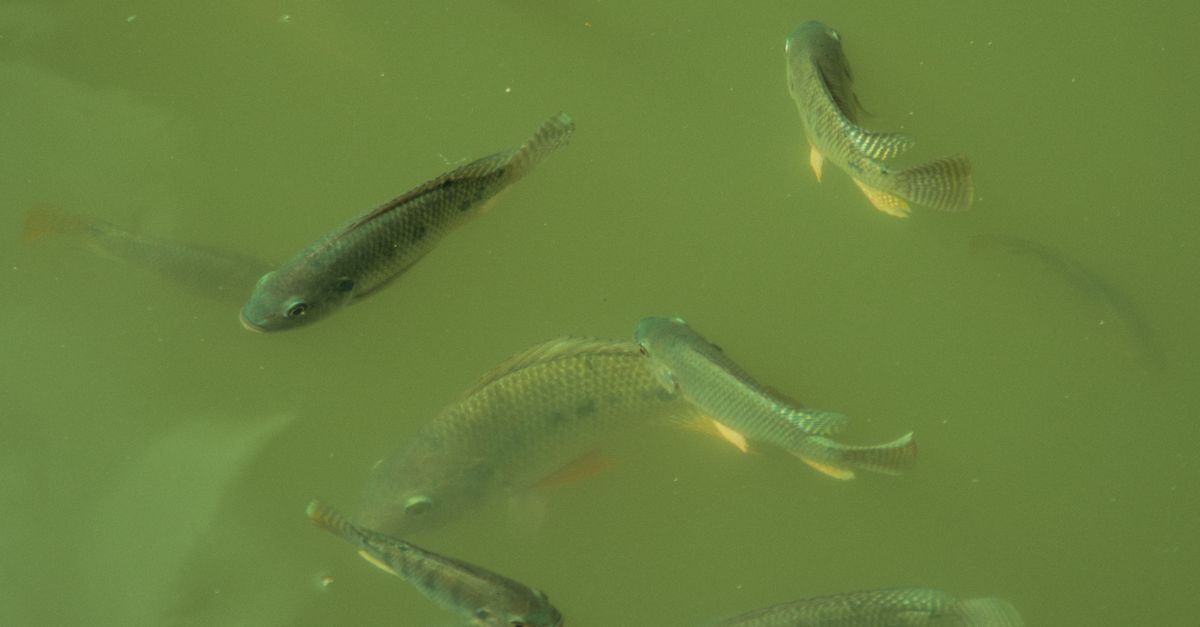
Tilapia farming works in India, but only with licensed, all-male (monosex) seed of an improved strain such as GIFT, from an approved hatchery, and it pays only where people eat the fish or a processor buys it. National farmed output was only about 30,000 tonnes in 2019-20, of which GIFT was about 2,000 tonnes of plate-size fish, so the market is still being built and varies sharply by state.
The fish itself is easy: it grows fast on pelleted feed and reaches 700 to 800 g in 6 to 9 months in a well-run pond. The hard parts are legal permission, reliable seed, the cost of feed, and finding a buyer at a price that covers it.
Rules and seed
- Licence: tilapia is an introduced species, and farming it is regulated. In Odisha, the district fisheries officer issued tilapia farm licences to demonstration farmers under the guidelines for responsible tilapia farming. Contact your district fisheries office before buying seed, since rules are administered by states.
- Monosex seed: males grow faster and more evenly than females, and a mixed-sex pond breeds freely and fills with small, unsellable fish. Nile tilapia matures at about 3 to 6 months and spawning begins at about 24 °C. Buy only all-male seed.
- Strains: GIFT (genetically improved farmed tilapia, a Nile tilapia strain) is the main improved strain; Chitralada and Golden tilapia are also produced. In 2019-20, 11 licensed hatcheries produced 94 million fry in India, only about 10 million of them GIFT monosex fry, so ask the hatchery for its licence and the sex ratio guarantee.
- Source of seed: Odisha's programme used GIFT fry from the breeding centre at Vijayawada run with RGCA. The WorldFish business case assumes fry at about ₹1.50 each; hatcheries quote ₹1 to ₹2 per fry.
Where and how it is farmed
- Systems: earthen ponds (usually 0.05 to 2.5 acres), reservoir cages, backyard biofloc tanks and recirculating systems. Grow-out takes 4 to 8 months to a plate size of 0.4 to 1 kg.
- States: production is rising in West Bengal, Maharashtra, Madhya Pradesh, Chhattisgarh, Bihar, Jharkhand and Kerala, mainly through backyard biofloc tanks and reservoir cages. Odisha had about 300 farmers on about 300 acres and about 600 tonnes a year in 2022. In Andhra Pradesh, the big aquaculture state, local tilapia consumption is low, so farmers there struggle to sell.
- Tamil Nadu: the Krishnagiri district fisheries office runs a scheme that supplies GIFT seed from the government fish seed farm to farmers enrolled with the District Fish Farmers' Development Agency (DFFDA), mainly for short-season farm ponds. Check your own state for similar schemes.
- Nile tilapia is a tropical fish that prefers shallow water. The ICAR-published research reviewed did not give a temperature limit for winter survival, so ask your fisheries department about cold months in your area.
Stocking, feed and growth (numbers from Indian sources)
| Item | Odisha farm programme (2022) | WorldFish/CII semi-intensive model (2022) |
|---|---|---|
| Stocking | 6,000 fingerlings per acre | 22,000 per hectare (about 8,900 per acre) |
| Survival | 90 to 92%, reported by farmers | 60% assumed |
| Size at harvest | about 800 g in 6 to 7 months; 700 to 800 g in 9 months for some | 750 g, two harvests a year |
| Feed | about 3.5 t of feed for 3 t of fish (after plankton in early weeks) | feed conversion 1.3; feed at ₹38 per kg |
| Yield | about 2 t per acre per crop; one farmer reported 3 t from 1 acre | 10 t per hectare (about 4 t per acre) per harvest |
- Pond preparation, liming, aeration and water testing are not covered by the sources used. Follow the hatchery's and your district fisheries officer's advice, and keep records of feed, mortality and water quality.
- Consumers in Odisha preferred fish of at least 500 g. Fish above 0.75 kg suit fillets and processing; smaller fish are sold whole.
💡 Tip: Fix the buyer and the price before stocking. Tilapia is cheap per kg and feed is the main cost, so a pond that cannot sell its harvest quickly loses money fast. Start with one pond and sell the first crop before adding more.
Cost and returns
- Price: Odisha farmers reported about ₹110 per kg wholesale and ₹160 to ₹170 per kg retail (The Fish Site, June 2022). The WorldFish model assumes a farm-gate price of ₹95 per kg. Check the current price in your nearest fish market.
- Odisha-style arithmetic, one acre (illustration): 2 t of fish x ₹110 = ₹2.2 lakh. Feed for 2 t at a feed conversion of 1.3 is 2.6 t, which at ₹38 per kg is about ₹99,000. Fry at 6,000 x ₹1.50 is ₹9,000. That leaves about ₹1.12 lakh before labour, electricity, aeration, pond lease, medicines and interest. At 3 t from an acre the gross is ₹3.3 lakh, but 2 t per acre is the more usual figure.
- WorldFish/CII model: a modelled farm of at least 2 ha needs about ₹8.5 lakh per ha capital and ₹6.5 lakh per ha working capital, producing about ₹2.73 lakh net per ha per year in year 1 rising to ₹3.59 lakh by year 7, with two crops a year and 95% of fish saleable. In year 1 the first crop alone made only about ₹12,000 net per ha after depreciation and interest. This is a planning model by WorldFish and the Confederation of Indian Industry, not a record of farm results, and it assumes cheap loans and power at agricultural tariffs.
- Odisha reported initial investment of about ₹1.5 to ₹6.7 lakh and returns of ₹3 to ₹8.5 lakh across farms, but with wide variation by farm size.
Market and risks
- The Fish Site's Odisha report lists the main constraints as consumer preference for marine or brackish-water fish, limited market links, no processing facilities and transport difficulty.
- Selling channels are local fish markets and traders, hotel and restaurant buyers, and, where available, processors making frozen whole fish or fillets. The WorldFish report says larger pond and cage production could supply fillet processors, with Africa named as a whole-frozen-fish export market, but exports need consistent quality and volume that small ponds seldom reach.
- Seed that is not truly monosex, feed that is expensive or poor, and a lack of a nearby buyer are the main reasons farms lose money.
- For finance see Kisan Credit Card (fisheries farmers are eligible through banks) and subsidy finder. No current subsidy rate was verified, so ask the district fisheries office. A group of farmers selling together through an FPO can get better transport and buyer terms.
Sources
- WorldFish and CII, A Business Case for Scaling the Production of Tilapia in India (April 2022)
- The Fish Site, Can GIFT gain ground in eastern India (Odisha), 24 June 2022
- Krishnagiri District, Tamil Nadu: Multipurpose farm pond GIFT seed stocking scheme
- Patil, Hormone-free monosex Nile tilapia, Indian Journal of Veterinary and Animal Sciences Research 52(3), 2023