
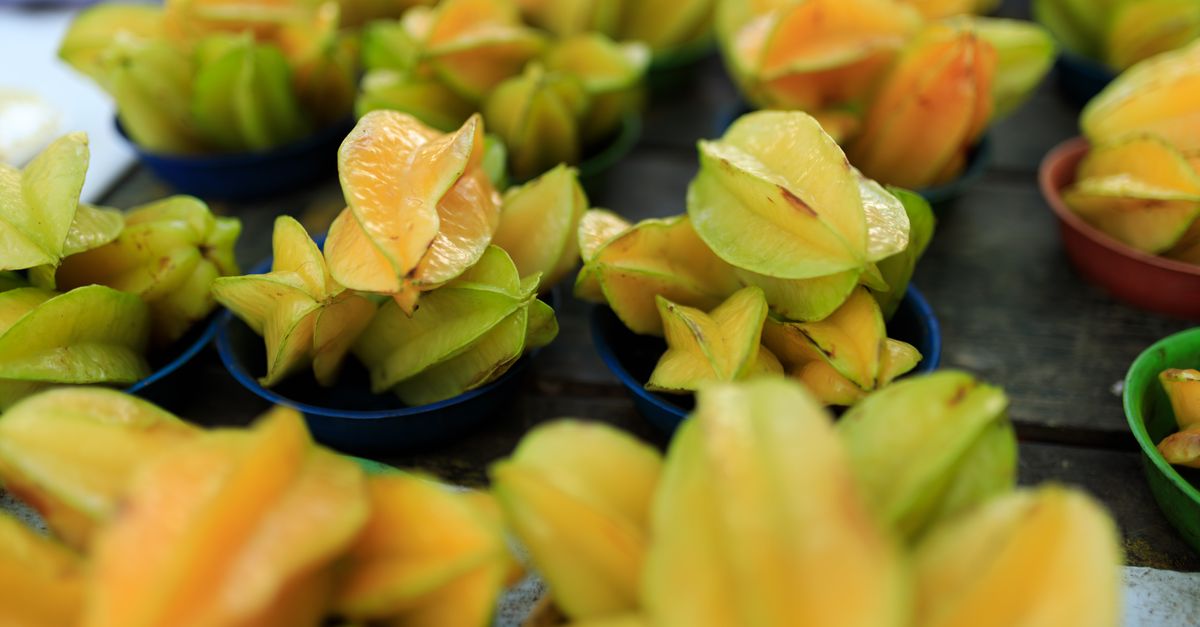
Star fruit (kamrakh) grows well in warm, humid, frost-free India, mainly the western coast, the Nilgiri foothills and the plains of the south and east, and it is easy to establish, but the market is thin and small, so it suits a few acres sold locally better than a large orchard. A grafted sweet variety bears in 2 to 3 years; the real work is finding buyers for a fruit that many shoppers do not know and that bruises easily.
Very little Indian trial data on yield and economics is published, so the numbers below come mostly from Florida extension guidance and a secondary Indian farming guide. Treat them as ranges to check against a nearby grower or your KVK.
Where it grows in India
- Regions: an Orissa University of Agriculture and Technology study (Das and Bal, Indian Journal of Horticulture, 2010) describes carambola as grown in western coastal India and on the Nilgiri hills up to about 1,200 m. Home-garden trees are common across Kerala, Tamil Nadu, Karnataka, West Bengal, Odisha and the Northeast.
- Climate: a tropical to warm subtropical tree. University of Florida guidance says it is highly sensitive to cold and wind, so choose a frost-free, sheltered site. Plant windbreaks in exposed places.
- Soil and water: deep, well-drained loam is best. The tree needs regular water from flowering to harvest, and root rot is a risk where water stands.
- Season: fruit takes about 60 to 75 days from set to maturity. Harvest peaks in January to February and September to October in South India (Das and Bal). Trees can flower two or three times a year with irrigation.
Varieties
| Variety | Origin | Traits | Notes |
|---|---|---|---|
| Arkin | Florida selection | Sweet type, the main commercial cultivar in Florida | Check availability of true grafted plants in your state |
| Kary | Florida selection | Sweet type, major cultivar in Florida | Less common in India |
| Fwang Tung, B-10 | Thai and Malaysian types | Listed as minor cultivars in Florida | Ask the nursery for fruiting proof |
| Local seedling types | Home gardens, Odisha, Northeast | Variable fruit quality | Taste the fruit before choosing mother trees; sour types suit pickle and juice |
- No ICAR-released carambola variety was found. Buy grafted or budded plants of a named sweet type from a state-recognised nursery; seedlings vary widely in sweetness.
Planting and spacing
- Florida practice: rows 20 to 25 feet (6 to 7.5 m) apart and trees 15 to 20 feet (4.5 to 6 m) in the row, which is 87 to 145 trees per acre (about 215 to 360 per hectare).
- Indian farming guide (secondary): 5 m x 4 m, which is 200 trees per acre (about 500 per hectare), or 6 m x 6 m for an open orchard.
- Plant in pits filled with topsoil and well-rotted manure, and protect young trees from wind.
Nutrition and irrigation
- University of Florida advice for trees of 7 years and older is about 4 lb (1.8 kg) of a 6-8% N, 2-4% P, 6-8% K and 3-4% Mg mixture per tree, four times a year, plus chelated iron and micronutrient foliar sprays. Young trees get proportionately less. These rates come from Florida limestone soils, so use your soil test and local KVK advice for the dose in India.
- Water regularly from flowering to harvest. Drip irrigation suits the crop and cuts water use.
Pests and diseases
- Fruit fly is the main pest named in Indian farming guides, and its larvae rot the fruit from inside. Collect and destroy fallen fruit and ask your KVK about traps.
- Florida reports stinkbugs and scale insects on leaves and twigs, and diseases such as anthracnose, leaf spots, red alga and root rot.
- For any chemical, follow the label and ask your KVK for current recommendations. See pests.
Harvest and yield
- Pick when the skin turns yellow with a slight orange tinge; handle gently because the ribs bruise.
- Florida: a mature tree (7 years and older) gives 250 to 350 lb (about 113 to 159 kg) a year, with many pickings.
- Indian farming guide (secondary): 15 to 25 kg per tree in years 2 to 3 and 40 to 80 kg from year 5, which is 8,000 to 16,000 kg per acre at 200 trees. Use the lower end for planning.
💡 Tip: Before planting more than an acre, line up a hotel, juice unit or retail chain that will take fruit weekly, and sell your first season locally to test prices.
Cost and returns
- Price: the secondary guide quotes about ₹20 per kg local wholesale and ₹60 to ₹80 per kg for retail or hotel supply. Check today's rate in mandi bhav and with local buyers.
- Arithmetic (illustration): 200 trees x 40 kg = 8,000 kg per acre. At ₹20 per kg that is ₹1.6 lakh; at ₹40 it is ₹3.2 lakh. At 15 kg per tree the gross falls to ₹60,000 to ₹1.2 lakh at those prices.
- Costs: the same guide puts organic inputs at about ₹50,000 per acre a year, before labour, picking and transport. Plants, pits and irrigation are extra in year 1.
- Bulk wholesale demand is small, so a few extra tonnes can push the price down quickly.
Market and health caution
- Buyers: local fruit markets, hotels and restaurants for garnish, juice and pickle makers, and organised retail. No national export trade for Indian carambola was found.
- Health warning: star fruit contains caramboxin and oxalate, and people with chronic kidney disease can suffer hiccups, confusion, seizures and death after eating it (PubMed review). Print a warning on packs sold fresh or as juice.
- Fruit bruises and spoils within days, so plan short supply chains. See FPO for group selling and subsidy finder for horticulture schemes. No carambola-specific subsidy rate was verified; ask your state horticulture department.
Sources
- University of Florida IFAS, Carambola growing guide (FE1079)
- Das and Bal, Studies on physico-chemical traits of local carambola germplasm, Indian Journal of Horticulture (2010)
- Organic Mandya, star fruit farming (secondary source)
- Why eating star fruit is prohibited for patients with chronic kidney disease (PubMed)