
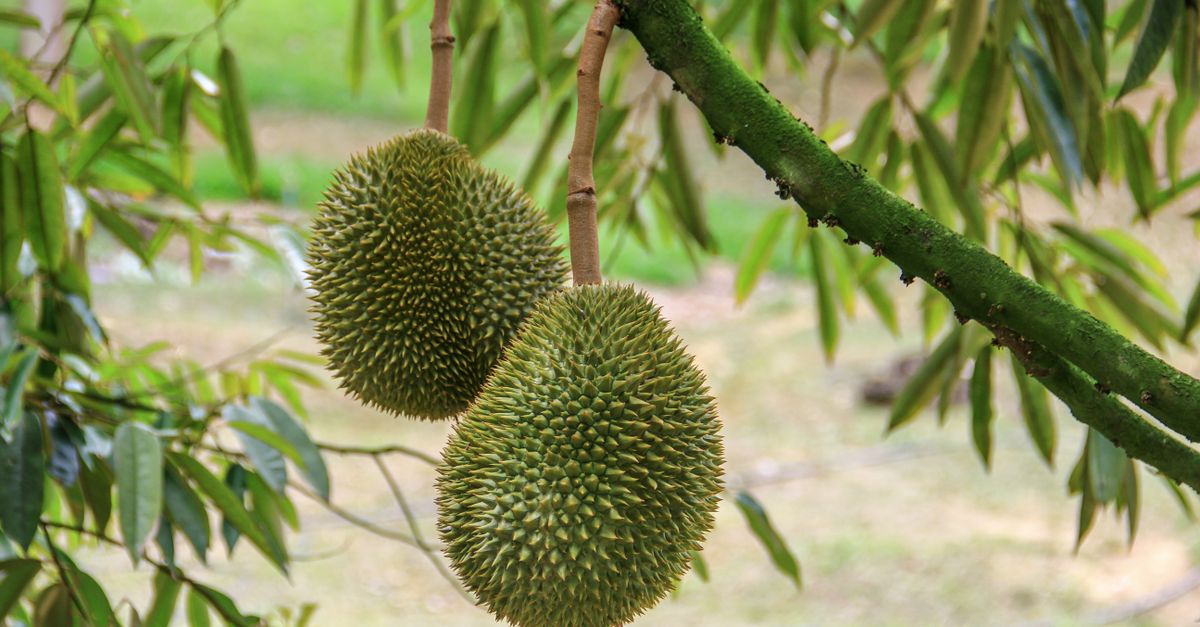
Durian can fruit in India, but only in a narrow belt: the hot, humid, high-rainfall hills and foothills of Kerala and the Tamil Nadu Nilgiris, with a handful of orchards elsewhere in the south. It needs 10 m of space per tree, 4 to 6 years of waiting for grafted trees, and it dies in waterlogged soil, so treat it as a small experimental planting, not a main crop.
The fruit sells for very high prices because supply of Indian-grown durian is tiny. No ICAR or state agricultural university package of practices for durian was found, so agronomy below comes from FAO's tropical fruit guidance and reports from the few Indian growers; ask your nearest KVK or horticulture department before investing.
Where it grows in India
- Known locations: farms at Burliar and Kallar in the Nilgiris (Tamil Nadu), where trees were reported fruiting as early as 2015, and farms in Kerala. Reports in 2026 say farmers in Kerala, Tamil Nadu and Karnataka are planting it, so most trees are still young.
- Harvest months: June to August in Kerala. At Kallar in the Nilgiris trees fruited February to April, and at Burliar July to September, so timing differs by elevation and local rain.
- Climate: FAO describes durian as needing a hot, humid climate with at least 1,500 mm of annual rainfall. A relatively dry spell helps to bring trees into flower together. Trees are reported to be damaged below about 8°C.
- Soil and site: deep, well-drained, light soil; heavy soil only if drainage is good. A sheltered site matters because heavy fruit on branches suffers in wind.
Varieties and planting material
| Variety | Origin | Notes |
|---|---|---|
| Monthong | Thailand | The grafted variety Kerala farmers are mostly planting; grafted saplings usually begin bearing in 4 to 5 years |
| Musang King, Ochee (Black Thorn), KOB, Sultan, D101, Red Prawn | Malaysia and neighbouring countries | Offered by nurseries; no Indian performance data found, so performance in your location is unproven |
- Seed-grown trees give fruit of uneven quality and take longer; Thailand relies on grafted plants for consistency, and grafted plants are the sensible choice.
- Buy from a nursery that can show the mother tree and variety identity. Sapling demand is high because each fruit has only a few seeds, which makes mislabelled plants a real risk.
Spacing and planting
- FAO gives 10 x 10 m as the standard, with 8 to 16 m used in practice. At 10 x 10 m that is 40 trees per hectare (about 16 per acre).
- Plant on raised mounds with a drainage channel, and keep the collar above the soil level. Provide a windbreak.
- Coconut grove owners were among early buyers of saplings; if you interplant, keep the durian root zone drained.
Nutrition, irrigation and disease
- No Indian fertiliser schedule for durian was found. Base doses on a soil test and ask the KVK or your state horticulture department; apply well-rotted manure around the drip line and split fertiliser into 2 to 3 doses a year, once after harvest.
- Irrigation: regular water for young trees. For bearing trees, a short dry spell encourages flowering, then keep moisture steady during fruit growth.
- Root and patch canker (Phytophthora palmivora): FAO calls it the most serious disease of durian, worst in waterlogged soil. Signs are gumming and dark patches on the trunk base. Prevention is drainage, planting on mounds, keeping the trunk base dry and clean, and removing infected tissue; fungicide choice and dose should come from the local plant protection office.
- Peach moth is the main insect pest listed by FAO. Follow the label and local KVK advice for any spray.
Harvest and yield
- Grafted trees: first fruit in about 4 to 6 years, and full cropping later, often from around year 8. Seedlings take longer.
- Fruit matures about 4 months after flowering and drops to the ground, so harvest means collecting dropped fruit (use nets under trees to avoid damage). Fruit weight ranges from 750 g to 3.75 kg, and shelf life after dropping is short, about 4 days in one Indian report.
- FAO notes a healthy mature tree can bear 100 or more fruits of up to 3 kg in a season in tropical Asia. No orchard-level Indian yield data was found; one old Nilgiris tree produced 180 fruits in 45 days, but a single tree is not a basis for a budget.
- Trees live 60 years or more if disease free.
💡 Tip: Start with 5 to 10 grafted trees at your site and watch two full monsoons for waterlogging and cold before planting an acre.
Cost and returns
- Price (July 2026): Onmanorama reports ₹350 to ₹2,500 per kg, with Musang King type fruit at ₹1,200 to ₹2,500 per kg, mostly imported. In 2015 retail in the Nilgiris was ₹1,000 to ₹1,200 per kg.
- Arithmetic (illustration only): 16 trees per acre x 50 fruits x 2 kg = 1,600 kg; at ₹400 to ₹800 per kg the gross is ₹6.4 lakh to ₹12.8 lakh per acre, but only from about year 6 to 8 and only if trees reach that crop. The fruit count is an assumption, not an Indian orchard record.
- Costs for grafts, mounds, drainage, drip and 5 or more years of upkeep before the first crop have not been published for India; get quotes from a nursery and your KVK.
Market and risks
- Buyers are premium supermarkets, fruit stores and consumers who pre-book fruit. Because fruit keeps only a few days, local sale or a nearby cold chain is essential.
- Main risks: long wait for first fruit, Phytophthora loss in monsoon, mislabelled saplings, cold in the hills and the unproven yield in India.
- See drip irrigation, subsidy finder and FPO. No MIDH subsidy rate specific to durian was verified.