
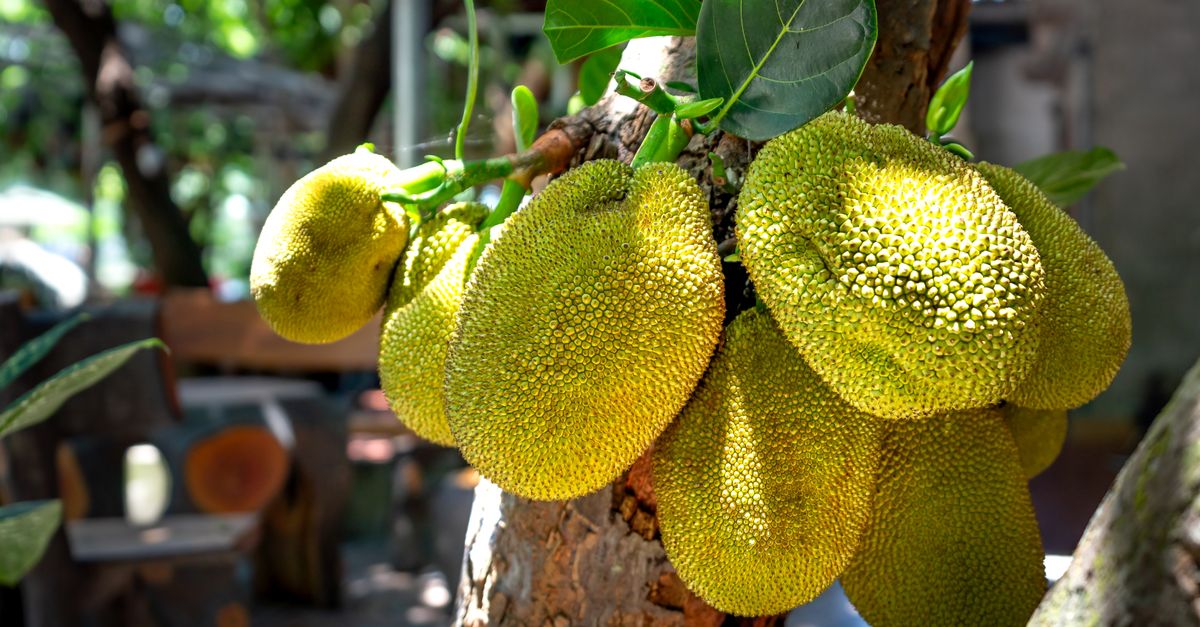
Jackfruit is a sound orchard crop for humid peninsular India, the Western Ghats belt, the east coast and the north-east, where it already grows widely, but a grafted tree takes about 5 years to start bearing and the farm-gate price for raw or ripe fruit is low unless you can reach processors or retail. Return depends on variety, tree count and a buyer more than on any "boom".
The tree is native to India and grows on poor, even gravelly or lateritic, soils, but it does not tolerate waterlogging or long drought. Use grafts of a named variety, plant at the right spacing, and check the local mandi rate before planning an acre.
Where it grows in India
- Region: Kerala, Karnataka, Tamil Nadu, Maharashtra (Konkan), Andhra Pradesh, West Bengal, Assam and Tripura grow it in quantity. Wikipedia lists jackfruit as the state fruit of Kerala and Tamil Nadu, and India as the largest producer worldwide (about 1.44 million tonnes in 2024, FAO-based figure).
- Climate: the Agroforestry Database gives a biophysical range of 0 to 1,600 m altitude, 16 to 22 degrees C mean annual temperature and 1,000 to 2,400 mm rainfall. TNAU says it grows in the plains up to about 1,200 m. The tree wants a warm, humid climate with evenly spread rain and will not tolerate drought or flooding.
- Soil: deep, well-drained alluvial, sandy loam or clay loam of medium fertility, pH 5 to 7.5. TNAU gives a target pH near 5.5 and says deep well-drained soil is necessary. It grows even on poor soil, but a shallow or waterlogged pit gives a short-lived tree.
Varieties
Many trees in India are seedlings that vary widely in fruit size, flake quality and bearing. Named clones from TNAU and ICAR-IIHR give uniform trees.
| Variety | Source | Traits (as reported) | Suited to |
|---|---|---|---|
| PLR 1 | TNAU (1992), clone from Panikkankuppam, Panruti (Cuddalore district) | Medium height, less spreading, suits high-density planting; bears April to June and again November to December; about 80 fruits of 12 kg average, around 900 kg per tree | Tamil Nadu and similar tropical areas |
| PPI 1 | TNAU (1996), clone from near Pechiparai | Crisp carpels with high TSS and vitamin C; 107 fruits, 1,818 kg per tree a year; bears twice a year | Kanyakumari area of Tamil Nadu and similar humid south |
| PLR (J) 2 | TNAU (2007), clone from Pathirakkotai local | Large fruit, good flakes, less pest and disease; 95 to 110 fruits, 1,600 to 1,950 kg per tree a year | Tamil Nadu |
| Siddu | ICAR-IIHR, CHES Hirehalli; selected from a 35-year-old farmer tree, Tumkur | Small fruit (2.44 kg), 25 to 30 coppery red flakes, 31 degrees Brix; 450 fruits on the parent tree, estimated 1,098 kg | Karnataka; IIHR calls it suitable for homesteads and commercial planting |
- These per-tree figures come from the best trees at the institutes. The TNAU package gives about 30 to 40 t/ha for a crop, which at 8 x 8 m spacing is far lower than 156 trees at 900 kg. Budget on the lower, crop-level figure.
- Kerala trade types such as Varikka (firm flakes) and Koozha (soft flakes) are local classes, not single varieties. Varieties from other sources (Swarna, Konkan Prolific and others) are named in farming guides but their origin and yield could not be verified here.
Planting material and spacing
- Propagation: TNAU recommends soft-wood cleft grafting in July to August on 4-month-old seedling rootstock. Seed is recalcitrant, so it loses viability quickly, and seedlings are variable.
- Season and pit: plant between June and December in pits 1 x 1 x 1 m filled with 10 kg farmyard manure and 1 kg neem cake (TNAU).
- Spacing: TNAU gives 8 x 8 m, about 156 trees per hectare or 63 per acre. The Agroforestry Database says trees need eventual spacing of 7.5 to 12 m, and crowded trees can die back. Dwarf or less spreading clones (such as PLR 1) allow closer planting.
- Young orchard: banana, groundnut or sweet corn can be intercropped in the early years (Agroforestry Database).
Nutrition and irrigation
| Tree age | FYM (kg/tree/year) | N (kg) | P (kg) | K (kg) |
|---|---|---|---|---|
| Year 1 | 10 | 0.15 | 0.08 | 0.10 |
| Each later year | add 10 | add 0.15 | add 0.08 | add 0.10 |
| Year 6 and after | 50 | 0.75 | 0.40 | 0.50 |
- TNAU splits the dose in two, May to June and September to October. At 63 trees per acre, a full-grown orchard takes roughly 47 kg N, 25 kg P and 31 kg K per acre a year (about 117, 62 and 78 kg per hectare), plus 3 tonnes of FYM per acre. Adjust with a soil test and see fertilizers.
- Irrigation: weekly until the graft is established, then as needed (TNAU). In dry-season orchards, drip irrigation helps young trees, but raise the soil at the base and keep drainage paths so water never stands.
- Pruning is light: remove dead interior branches so light reaches the fruit (Agroforestry Database).
Pests and diseases
- Die-back (Botryodiplodia theobromae): bark darkens, twigs wither from the base and leaves brown, with gum oozing. TNAU advises pruning diseased twigs, spraying carbendazim 0.1% or chlorothalonil 0.2%, and controlling shoot and shot-hole borers.
- Rhizopus fruit rot: TNAU recommends 1% Bordeaux mixture or copper oxychloride 2.5 g per litre, three sprays 15 days apart.
- Fruit borer: ask your KVK or state agriculture department for a currently registered product and follow the label. For spittle bug TNAU lists older organophosphate sprays, some of which are restricted in India; ask your KVK for a currently permitted option. Follow the label for any chemical and mind pre-harvest intervals.
Harvest and yield
- Bearing: grafts from the 5th year, seedlings from the 8th year (TNAU). Fruit matures 80 to 160 days after set, and a strong sweet aroma shows ripeness (Agroforestry Database).
- Season: March to July in the TNAU package; some clones bear again in November to December.
- Yield: TNAU gives about 30 to 40 t/ha (12 to 16 t per acre) for a mature crop. Early years give far less.
- Fruits grow on trunk and main branches and trees reach 18 m by 20 years, so harvest needs ladders, poles and trained labour. Latex stains and sticks on tools and hands.
Cost and returns
- Price (mandi listings, 2026): an aggregator showed Kerala ripe jackfruit near ₹2,300 to ₹2,600 per quintal (₹23 to ₹26 per kg) around mid-2026 and green (raw) jackfruit near ₹1,200 per quintal on 8 September 2026. These are single listings, not a market average, so check mandi bhav and local traders.
- Arithmetic (illustration): at the TNAU crop figure of 12 to 16 t per acre and ₹12 to ₹26 per kg, gross is about ₹1.4 lakh to ₹4.2 lakh per acre once the orchard is mature (12,000 kg x ₹12 = ₹1.44 lakh; 16,000 kg x ₹26 = ₹4.16 lakh). Income in years 1 to 4 is nil, apart from any intercrop.
- Costs: no verified Indian orchard cost sheet (grafts, pits, manure, labour, harvest) was found for this guide, so work out your own. Grafts are priced per plant locally and harvesting tall trees is a large labour item.
Market and risks
- Fruit is sold ripe to retail and traders, raw (tender) to vegetable sellers and caterers, and to units making chips, pulp, flour and canned jackfruit. Demand from the "meat substitute" trade is real but prices for raw fruit remain low in the mandi data above, so check an actual buyer before planting.
- Ripe fruit spoils in days and is heavy to move; large volumes without a nearby processor or trader depress prices in the main season.
- Be careful with nurseries or schemes offering fixed buy-back of fruit at high prices or "export contracts" for a plant purchase.
- Support: see subsidy finder for MIDH area-expansion support for fruit crops; current rates for jackfruit were not verified here. Farm credit via Kisan Credit Card. For crop insurance see PMFBY where jackfruit is notified in your district (not verified here).
Sources
- TNAU Agritech Portal, Horticulture: Fruits, Jack
- TNAU Agritech Portal, TNAU varieties, fruit crops, Jack
- TNAU Agritech Portal, Jackfruit die-back
- ICAR-IIHR, CHES Hirehalli jackfruit germplasm and varieties (Siddu)
- Agroforestry Database, Artocarpus heterophyllus (Orwa et al., 2009)
- Wikipedia, Jackfruit (secondary source, production and state-fruit status)
- Commodity Online, jackfruit mandi prices (aggregator, secondary source)