
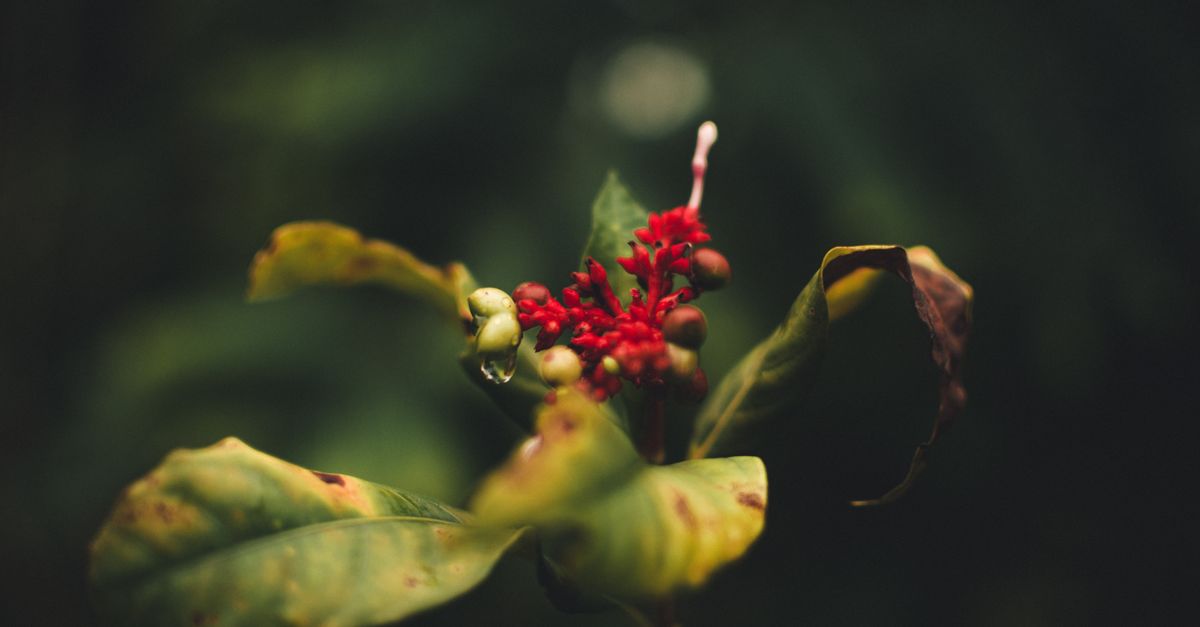
Sarpagandha (Rauvolfia serpentina) can be grown as a 2 to 2.5 year root crop in warm, humid parts of India, but the crop only makes sense with a documented seed source and a buyer who will take your dried root. It is a protected, endangered plant in the wild, wild export is banned, and roots are bought by weight at modest prices, so returns are slow and moderate.
The root is the product. Dry root is bought by Ayurvedic and pharmaceutical firms for its alkaloids, of which reserpine is the best known. Trial and handbook yields are around 0.75 to 1 tonne of dry root per acre after 30 months.
Where it grows in India
- Natural range: sub-Himalayan tracts up to about 1,000 m and the lower ranges of the Eastern and Western Ghats, plus the Andamans. FRLHT records it as fairly common in moist deciduous forest in Karnataka, Kerala and Tamil Nadu at 500 to 1,200 m, and rates it Endangered in those three states.
- Climate: a handbook source gives 10 to 30 degrees C, hot humid conditions and good rainfall with drainage; the north east is described as ideal.
- Soil: humus-rich sandy loam to red lateritic loam, slightly acidic (pH 4.6 to 6.5 in the same source). Waterlogged ground should be avoided.
- Agroforestry: it has been grown as an intercrop under subabul hedgerows, since it tolerates partial shade.
Planting material and nursery
- It is propagated by seed, and by stem or root cuttings.
- Seed: about 6 kg of seed sown in a 500 sq m nursery bed gives seedlings for 1 hectare (about 2.4 kg for an acre). The bed mix is one-third well-rotted manure and leaf mould and two-thirds silt loam. Seed germinates in 15 to 20 days and seedlings are ready to move in 40 to 50 days.
- Buy seed or cuttings only from a state forest department, State Medicinal Plants Board, ICAR or university source that can show where the stock came from. Roots of related species (R. tetraphylla, R. densiflora, R. micrantha) are often mixed into trade samples, so the correct species matters to the buyer.
- No named improved variety for sale was verified; ask your KVK or a state agricultural university.
Spacing and planting
| Spacing | Plants per hectare (acre) | Note |
|---|---|---|
| 30 x 30 cm | 80,000 to 1,00,000 (32,000 to 40,000) | Handbook recommendation |
| 60 x 45 cm | about 37,000 (15,000) | Best of three spacings in an agroforestry trial: 1.866 t/ha air-dried root |
- That trial also tested 45 x 30 cm and 45 x 45 cm; the widest spacing gave the highest root yield.
- Transplant at the start of the rains so seedlings establish without irrigation.
Irrigation and care
- It is normally grown rainfed. Where water is available, 4 irrigations in summer and 2 in winter at monthly intervals raise yield.
- No verified Indian fertiliser schedule was found for this crop. Use well-rotted farmyard manure as a base and ask your KVK for a dose based on a soil test.
- Keep the field weeded, especially in year 1.
Pests and diseases
- Root-knot nematode causes galls and stunted plants. Handbook sources also list pyralid caterpillars and cockchafer grubs.
- Older guides name granular nematicides and an organophosphate spray. Several such products are restricted, so use only what your KVK confirms is currently permitted, and follow the label.
- Do not plant after a crop that carries nematodes, and avoid poorly drained plots.
Harvest and yield
- Roots are dug about 30 months after planting. One older Indian-conditions report gives about 2,000 lb of air-dry root per acre from a 2-year plantation and 3,000 lb from a 3-year plantation on irrigated sandy clay loam (roughly 0.9 and 1.4 t per acre).
- A handbook gives 2,000 to 2,500 kg dry root per hectare (800 to 1,000 kg per acre). The agroforestry trial gave 1.866 t/ha (about 755 kg per acre).
- Dig carefully to keep the whole root, including fine roots, wash, and dry in shade or a dryer. Powdered root should carry above 0.15% total alkaloids as reserpine in the handbook specification, so buyers may test it.
💡 Tip: Before planting, get a written offer from a buyer, with moisture and alkaloid limits and payment terms, and confirm with your State Forest Department and State Medicinal Plants Board what permits apply to growing, digging and moving the root.
Cost and returns
- Price: FRLHT records Rs 110 to Rs 150 per kg for dry root. That figure is undated, so ask buyers for today's rate.
- Arithmetic: 2,000 to 2,500 kg per hectare x Rs 110 to Rs 150 = Rs 2.2 lakh to Rs 3.75 lakh per hectare, or about Rs 0.9 lakh to Rs 1.5 lakh per acre, earned once after about 30 months. The agroforestry trial yield of 755 kg per acre at Rs 110 gives about Rs 83,000.
- Seedling, labour and digging costs have to come out of that, and no verified Indian cost-of-cultivation figure was found. Treat the crop as a modest supplementary income over 2.5 years, not a quick earner.
Market and legal limits
- Rauvolfia serpentina is in CITES Appendix II and on India's export negative list. Export of the plant and derivatives from the wild (except formulations) is prohibited, so farmers sell to domestic Ayurvedic and pharmaceutical buyers.
- Wild collection is restricted by state rules. Growing it on your own land with documented seed is the safe route; check local transit rules before moving roots.
- Selling through a farmer producer organisation helps reach buyers. See the subsidy finder; National Medicinal Plants Board support for cultivation exists, but the current rate for Sarpagandha was not verified, so ask the State Medicinal Plants Board.
Sources
- FRLHT ENVIS, Rauvolfia serpentina
- Sarpagandha cultivation handbook summary (secondary source)
- Cultivation of Sarpagandha as intercrop under subabul based medicinal agroforestry system
- Indian Horticulture, Sarpgandha, a potential ayurvedic plant (ICAR)
- Rauvolfia serpentina, CITES and export status (secondary source)