
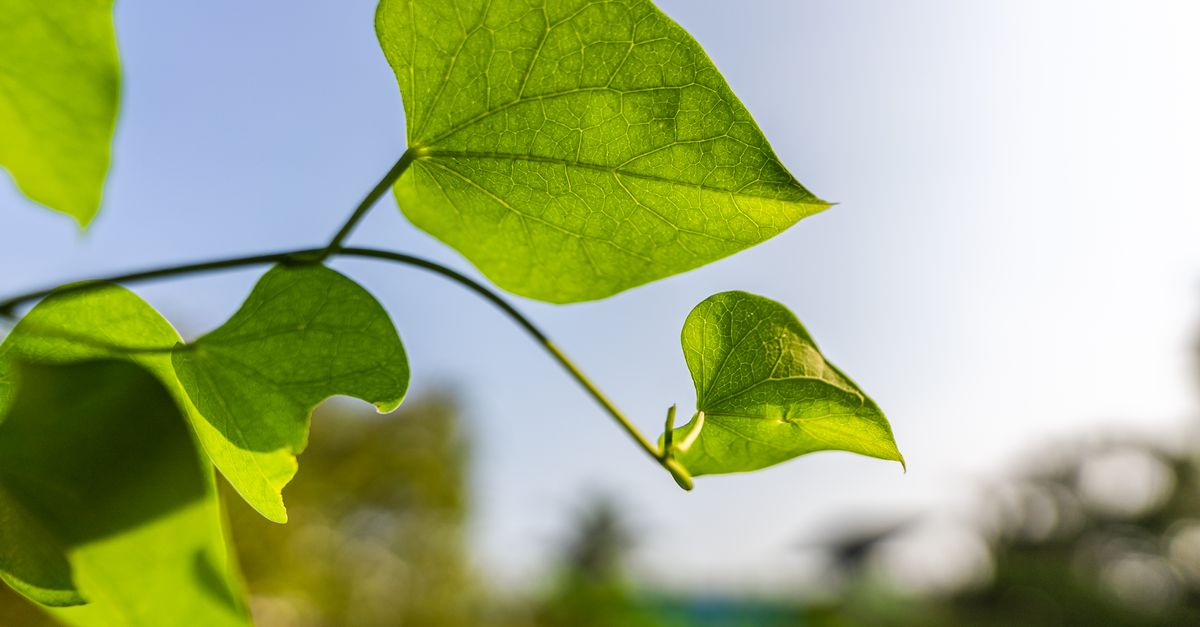
Giloy (guduchi, Tinospora cordifolia) grows in almost all soil types, but it is a low-price medicinal stem crop: the one mandi reporting on 29 September 2026 showed ₹30 per kg, and the same mandi was ₹5 to ₹33 per kg in July and August. It pays only with a standing buyer, low costs and a supporting tree or trellis already in place.
Published Indian yield figures differ by several times, so plan from a small plot of your own. The facts below come from Indian university trials under the AICRP and NMPB projects; no verified cost table or subsidy rate was available.
Where it grows
- Giloy is native to the tropical Indian subcontinent and, as a deciduous climber, grows in almost all soils and a wide range of climates. A Birsa Agricultural University paper describes the natural range as ascending to about 300 m, and its trial ran successfully at Ranchi (646 m, lateritic sandy loam, 23 to 38 °C, about 1,400 mm rain).
- Indian trials have been run in Jharkhand (Ranchi), Tamil Nadu (Annamalai University) and West Bengal (Visva-Bharati), so the crop is tested across eastern, southern and plateau conditions.
Planting material and genotypes
- Propagation: hardwood stem cuttings. The Annamalai University NMPB-project trial rooted cuttings in polybags and then planted them in the field; planting was in May to June.
- Support: the vine needs something to climb. The Annamalai paper says neem and mango trees are preferred supports, said to give better medicinal value (a reported belief, not a measured result).
- Genotypes: no named released variety was found; the Ranchi trial compared seven germplasm accessions allotted IC numbers by ICAR-NBPGR (from a set of 30 under AICRP on Medicinal and Aromatic Plants, sponsored by ICAR-DMAPR). Whether planting material of these is available to farmers is not verified; ask BAU Ranchi or ICAR-DMAPR.
| Accession | Fresh stem per plant (g) | Giloy-satva (%) | Note |
|---|---|---|---|
| IC-0639899 | 1,319.6 | 4.74 | Best in the Ranchi trial (collar 32.1 mm) |
| IC-0639898 | 1,269.1 | 4.36 | Second best on both |
| IC-0639914 | 1,229.6 | 3.50 | Lowest satva |
| IC-0639896 | 1,221.6 | 4.06 | |
| IC-0639910 | 1,162.9 | 4.32 | |
| IC-0639890 | 1,152.7 | 3.56 | |
| IC-0639908 | 1,128.3 | 4.21 | Lowest stem weight |
Spacing
- The BAU Ranchi trial used 100 x 100 cm (10,000 plants per hectare, about 4,000 per acre). A trial cited in the same paper used 3 m x 3 m planted in mid-April and recorded 3.67% satva.
- Closer spacing means more cuttings and more supports; wider spacing suits growing on trees. Test one spacing on a small plot before scaling up.
Nutrition
- The Annamalai trial compared organic inputs: biodynamic compost at 5 t per hectare (2 t per acre) with a 3% vermiwash foliar spray gave the highest mature stem yield, 467 g per plant at 90 days after planting, against 219 g in the unfertilised control. FYM at 12.5 t per hectare (5 t per acre) with vermiwash gave 385 g.
- Dry matter in the stem was 24 to 46 g per 100 g in that trial, highest with the best treatment (46 g).
- For soil testing and any fertiliser, see fertilizers. Check whether your buyer sets residue or organic requirements.
- No Indian pest or disease package was verified here; ask your KVK and avoid chemical sprays on a crop sold for human use. See pests.
Harvest and yield
- Harvesting starts when stems exceed 2.5 cm in diameter, according to the Visva-Bharati paper. In the Ranchi trial the collar diameter was 19 to 32 mm depending on the accession.
- Fresh stem weight per plant in the Ranchi trial was 1,128 to 1,320 g. At 10,000 plants per hectare that is about 11 to 13 tonnes of fresh stem per hectare (4.5 to 5.3 t per acre), but the plant age at that harvest is not stated in the paper, so treat it as a ceiling.
- By contrast, the same literature repeats a much lower figure of about 1,500 kg fresh stem per hectare (Visva-Bharati) and 300 kg dry per hectare in two years (cited in the Ranchi paper). This gap of roughly eight times is why a small trial plot matters.
- Dry the stem pieces in shade before sale; dry stem weighed about a quarter to a half of fresh stem in the Annamalai measurements.
- Processors extract giloy-satva (stem starch); the Ranchi accessions gave 3.5 to 4.74%.
💡 Tip: Before planting an acre, ask your buyer in writing for the product form (fresh stem, dry stem or satva), the price and who pays transport. The only mandi price found for giloy was one market with 0.04 tonne, which is too thin to plan around.
Cost and returns
- Price (Agmarknet via ACROP): Neemuch APMC, Madhya Pradesh, ₹3,000 per quintal (₹30 per kg) on 29 September 2026, one mandi and 0.04 tonne. The same market showed ₹500 to ₹3,300 per quintal between 28 July and 31 August 2026. The product form is not stated.
- Arithmetic: each tonne of dry stem sells for ₹5,000 at ₹5 per kg and ₹30,000 at ₹30 per kg. At the trial-style 11 to 13 tonnes fresh and a dry fraction of a quarter to a half, dry stem could be roughly 3 to 6 tonnes per hectare, which is about ₹15,000 to ₹2 lakh per hectare across that price range. This is an upper-end illustration, not a yield guarantee.
- Costs: cuttings, polybags or nursery, supports or trellis (the main cost unless you use trees), manure, labour for training vines, cutting and drying. A verified Indian cost-per-acre figure was not available.
Market and risks
- Giloy stem is an official drug in the Ayurvedic Pharmacopoeia of India, and processors sell stem powder, satva, tablets, juice and tea.
- Price is the main risk: the stem is sold per kg at modest rates and one market swung from ₹5 to ₹33 per kg within weeks.
- Demand surged during COVID-19 as an immunity booster, but the Ranchi paper itself cites reports of liver injury in people who used giloy that way (Murkute et al., 2022). Treat the earlier demand peak as uncertain.
- Look for a written buy-back with an Ayurvedic manufacturer or a medicinal-plant FPO; see FPO, mandi bhav and subsidy finder. NMPB assistance for medicinal plants exists, but no current giloy rate was verified here.
Sources
- Growth and yield performance of selected giloy (Tinospora cordifolia) genotypes, Birsa Agricultural University, Ranchi (Plant Archives 26, Supplement 1, 2026)
- Influence of organic nutrients with foliar organics on yield parameters of sindil kodi (Tinospora cordifolia), Annamalai University, NMPB project (Plant Archives 20, Supplement 1, 2020)
- Organic Cultivation Methods for Maximizing Berberine Content and Quality of Giloy, Visva-Bharati (2025)
- ACROP, giloy mandi price (Agmarknet data)