
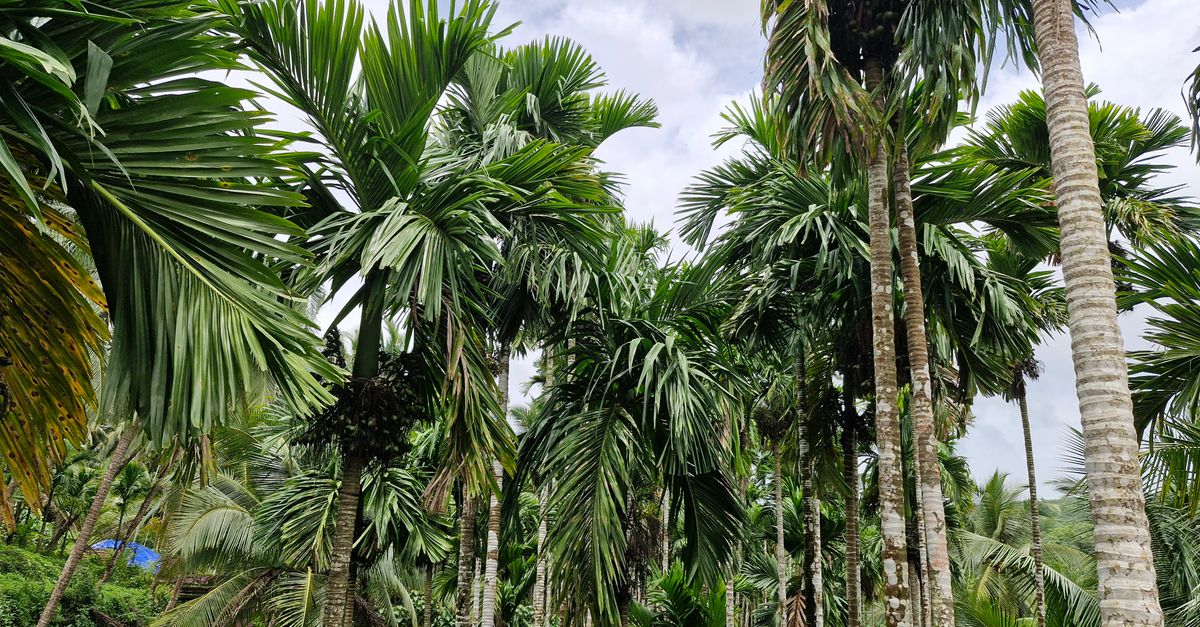
Arecanut (supari) is a long-term palm crop that works in the humid, high-rainfall belt of coastal and Malnad Karnataka, Kerala, Goa and parts of Assam and West Bengal, on well-drained deep soils up to about 1,000 m altitude. It needs steady irrigation in the dry months, years of waiting before full bearing, and the patience to ride out price swings; yellow leaf disease is a serious risk in Karnataka and Kerala.
In practice, "premium" arecanut comes from planting a recommended variety, managing nutrition and disease, harvesting at the stage the buyer wants and drying and grading cleanly. This page uses ICAR-CPCRI and Kerala Agricultural University (KAU) recommendations and Agmarknet prices of 3 October 2026.
Where it grows and what it needs
- Districts: in Karnataka the main producing districts are Shivamogga, Chikkamagaluru, Tumakuru, Uttara Kannada and Dakshina Kannada, with Shivamogga first in area and output. Kasaragod in Kerala and Assam are also major areas.
- Climate: temperature between 14 and 36 °C and annual rainfall of 750 to 4,500 mm; altitude up to 1,000 m above sea level.
- Soil: gravelly laterite and red loam suit it best, as do fertile clay loam and alluvial soils. Avoid sticky clay, sandy or brackish soils, and fields with a high water table.
Varieties
| Variety | Type and release | Chali yield, kg per palm per year | Notes |
|---|---|---|---|
| Mangala | Semi-tall, ICAR-CPCRI | 3.0 | Early bearing, more female flowers per spike, round small nuts; also named as more tolerant of yellow leaf disease |
| Sumangala | Tall, ICAR-CPCRI | 3.28 | Oval, medium-sized nuts |
| SAS-1 | Released 1995, Sirsi valleys, Karnataka | 4.60 | Suited to Sirsi-type valley conditions |
| Calicut-17 | Released 1995, Andaman and Nicobar Islands | 4.37 | Island conditions; check suitability for your area |
| Mohitnagar | Released 1991, West Bengal, Karnataka, Kerala | 3.67 | Recommended in three states |
- These are recommended or station yields. Farm yields vary with age, rainfall and care, so budget below them. Buy seedlings only from CPCRI, a state agriculture or horticulture university or a registered nursery, and ask your KVK which variety suits your valley.
Planting and spacing
- Spacing: 2.7 x 2.7 m, which is about 1,300 palms per hectare (about 526 palms per acre).
- Pits: 60 x 60 x 60 cm. Plant deeper (about 90 cm) in well-drained soil and shallower (about 60 cm) in heavy soil with a high water table.
- Intercrops: banana or cocoa between palms from the 4th year (2.7 x 5.4 m); black pepper or betel vine from year 6 to 8 on the palm rows. Intercrops lift income per acre while the palms are young.
Nutrition and irrigation
| Item | Per palm per year (full dose) | Per acre (526 palms) | Per hectare (1,300 palms) |
|---|---|---|---|
| Nitrogen | 100 g (about 220 g urea) | about 53 kg | 130 kg |
| Phosphorus (P2O5) | 40 g (about 200 g rock phosphate) | about 21 kg | 52 kg |
| Potash (K2O) | 140 g (about 235 g muriate of potash) | about 74 kg | 182 kg |
- By age: one third of the dose in year 1, two thirds in year 2, full dose from year 3. Farmyard manure is added every year; KAU states 10 to 12 kg per palm and CPCRI recommends 20 kg. See fertilizers for product choice and get a soil test first.
- Water: in the dry season irrigate about every 3 to 5 days at around 175 litres per palm. A west-coast schedule is every 7 to 8 days in November and December, every 6 days in January and February and every 3 to 5 days from March to May. Drip irrigation can cut water use.
Pests and diseases
- Koleroga (fruit rot): spray 1% Bordeaux mixture three times a year before and during the monsoon, or cover bunches with polythene. Remove and burn infected nuts.
- Yellow leaf disease: a phytoplasma spread by the insect Proutista moesta, severe in Dakshina Kannada, Shivamogga and Chikkamagaluru in Karnataka and Kasaragod in Kerala. Leaflets turn yellow from the tip and later dry. Recommended measures are removing diseased palms, extra potash and magnesium above the standard dose, choosing tolerant planting material such as Mangala, and, in early stages only, a tetracycline spray and drench on expert advice from CPCRI or your KVK.
- Bud rot and basal stem rot: remove affected tissue and apply Bordeaux paste for bud rot; isolate basal stem rot palms with trenches and drench with a labelled fungicide such as copper oxychloride.
- Insects: spindle bug (ask your KVK or state agriculture department for a currently registered product and follow the label) and root grub (chlorpyrifos drench in May and September to October). Follow the label and your KVK; see pests.
- Storage: the arecanut beetle bores into stored nuts; keep nuts dry and clean.
Harvest, product and yield
- Ripe nuts are harvested, dried and processed to chali (dry peeled nut); tender nuts are harvested for kalipak, a boiled and processed product. Buyers pay by product and grade, so ask your trader what they pay for each.
- Mature palms give about 2 to 4.6 kg chali per palm per year, depending on variety.
- Palms are long-lived and keep yielding for decades. No verified figure for years to first bearing was found; ask CPCRI or your KVK for the figure for your variety.
💡 Tip: Check for yellow leaf disease in the neighbourhood before planting. In an affected village, choose a tolerant variety such as Mangala and keep potash and magnesium adequate.
Cost and returns
- Price on 3 October 2026 (Agmarknet via ACROP): a national median of ₹37,578 per quintal across 20 mandis (463.7 tonnes arrived), with ₹31,070 per quintal for Karnataka (19 mandis), ₹38,750 for Kerala (4 mandis) and ₹38,200 for Goa. The lowest was ₹21,218 at Shikaripura and the highest ₹63,250 at Mumbai. These are modal prices across mixed varieties and grades, so your own price depends on product and grade.
- Arithmetic for a full-bearing acre (illustration): 526 palms x 3 kg chali = 1,578 kg. At ₹212 per kg (the lowest mandi) that is about ₹3.3 lakh; at ₹310 per kg (Karnataka median) about ₹4.9 lakh. Yields are station numbers, so real income is lower; subtract labour for harvest, boiling or drying, irrigation, manure and disease control.
- Price risk: arecanut prices have moved by large amounts over the years, so do not plan on today's level lasting. Get a cost-of-cultivation estimate from your KVK or horticulture office and add up your own labour and input rates.
Market and risks
- Nut is sold through APMC yards, cooperatives and traders. Demand comes mainly from the chewing and pan masala trade, so import policy and trade rules can shift prices.
- Main risks: price swings, yellow leaf disease, fruit rot in wet years, and water shortage in dry months. Intercropping and a second income source reduce reliance on one price.
- Check subsidy finder for horticulture support, Kisan Credit Card for loans, mandi bhav for daily prices and crop insurance. Confirm the current MIDH or state rate for arecanut with your horticulture office before relying on it.