
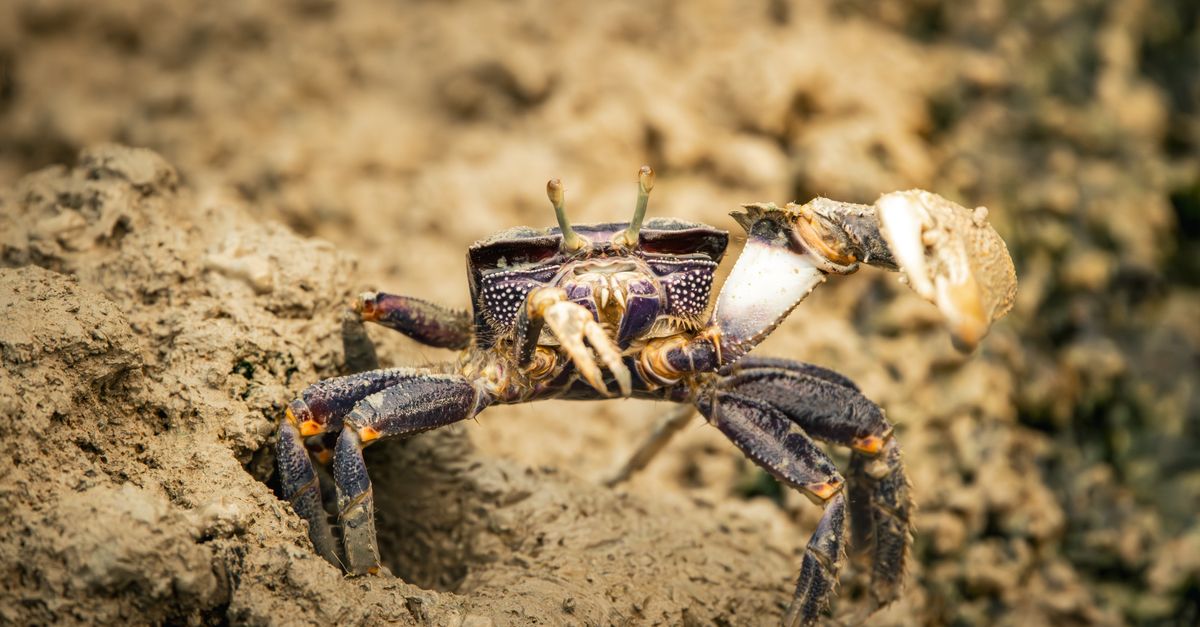
Mud crab fattening works on brackish tidal water, and the best-documented Indian cluster is the Sundarbans in North and South 24 Parganas, West Bengal. It means buying lean wild-caught crabs (soft-shelled, or females with undeveloped ovaries) and holding them 15 to 30 days in net enclosures, ponds or individual boxes until the shell hardens, meat fills out or the ovary ripens. It needs a tidal water source, a daily supply of cheap fresh fish, and a buyer in the live-crab export trade; there is no pellet feed to buy and no hatchery seed to wait for.
The risks are mortality in summer heat, sick or stressed stock bought from fishing boats, theft and price swings tied to flights out of Kolkata. All prices below are from a 2018 field study and CIBA material published in 2019, so check today's rates with a Kolkata exporter before putting money in.
Where it is done in India
- West Bengal Sundarbans: fattening, locally called "chamber chas", has been practised since the late 1990s in the brackishwater areas of North 24 Parganas, South 24 Parganas and Purba Medinipur, and it is the main form of crab farming there. Gosaba, Basanti, Minakhan, Hingalganj, Hasnabad and Sandeshkhali are named fattening areas.
- Species: the green mud crab Scylla serrata (can pass 1.5 to 2 kg) and the orange mud crab S. olivacea (maximum about 1.2 kg). ICAR-CIBA reports S. serrata as the more abundant species in India, followed by S. olivacea; S. olivacea dominates the Sundarbans fishery.
- Elsewhere: an older ICAR-CMFRI paper (2001) describes culture in the southern states of peninsular India and found fattening more remunerative than grow-out. Farm-level figures for other coasts are thin, so ask the local fisheries office for nearby fatteners to visit.
- Water and site: example farms sit on tide-fed water at the confluence of tidal rivers, so the tide renews the water daily. Plan for more crab deaths in summer.
Systems used
| System | How it works | Documented example |
|---|---|---|
| Earthen chambers | Tide-fed enclosures fenced with strong net and split bamboo screens, up to 1.8 m high from the bottom; males and females stocked separately | Nine chambers of 160 to 180 sq m, 1.2 m deep, 100 kg crabs per chamber; another farm uses chambers of 240 to 600 sq m with tidal exchange at 0.45 m depth |
| Individual boxes | One female per perforated plastic box on floating rafts in a pond, which prevents cannibalism and lets you watch each crab and feed individually | 3,000 sq m pond, boxes of 33.5 cm length at ₹200 each, 7,000 boxes in use; box life 6 to 7 years |
CIBA notes that box culture needs high capital, that boxes floating at the surface heat up and grow algae, and that crabs in boxes eat once a day against twice in open ponds. A pump-operated submersible box frame, developed to sink the boxes on hot days, is described by CIBA.
Selecting and buying crabs
- Buy live, whole crabs of 8 to 14 cm carapace width that the export trade will not accept because they are lean. Pick soft-shelled females with undeveloped ovaries and males that have just moulted and need to fill their shell.
- Typical 2018 purchase prices at Sundarbans markets: males ₹300 to ₹350 per kg for 100 to 150 g, ₹450 to ₹700 per kg for 400 to 500 g; females ₹350 to ₹450 per kg for 150 to 200 g and ₹500 to ₹600 per kg above 200 g.
- Avoid crabs that stayed on fishing boats for 3 to 4 days, because stressed crabs get infected more easily, and avoid damaged or claw-less crabs.
- Over-reliance on wild crabs is a threat to the wild population. CIBA notes hatchery seed exists but larval survival is variable, which is why farms still depend on wild stock.
Stocking, feeding and water
- Stocking in chambers: males of 200 to 500 g and females of 150 to 250 g, about 100 kg of crab per 160 to 240 sq m chamber (roughly 250 to 300 males or 450 females). That is about 0.4 to 0.6 kg per sq m.
- Stocking in boxes: one crab per box; females of 150 to 180 g in the Bengal box example.
- Feed: fresh trash fish such as Johnius, Setipinna, Coilia and sometimes tilapia, chopped, plus molluscs, at 5 to 10% of body weight a day (farm figures are 8 to 10%). Fish cost ₹20 to ₹40 per kg in 2018. Remove leftovers and do not use spoiled fish.
- Time to harvest: 15 to 16 days in the warm months and about 25 days from November to February or March in the chamber example; 20 to 30 days overall (CIBA); boxes took 25 days for Sundarbans crabs and 42 to 45 days for crabs brought from Gujarat.
- Weight gain: a 200 g crab gains 25 to 50 g in a month; chamber crabs gained 40 to 50 g; box females gained 25 to 30 g.
- Water care: exchange water with the tide (20% on full and new moon in one pond), apply lime or dolomite between crops, rake the bottom, and oxygenate if crabs crawl up the net. After two crops one farmer drains the chamber and mixes lime and zeolite into the soil to remove foul gases. Follow the advice of your fisheries officer or CIBA Kakdwip on products and doses. Check the weather before cyclones or heavy rain.
- Season: in the example farms fattening runs most of the year except April to June, about 9 to 10 months a year (CIBA). Winter prices are higher.
Harvest and survival
- Healthy, ready-for-market crabs are delivered early in the morning to the exporter. Fattened males in the example weighed 500 to 700 g and females 250 to 300 g.
- Survival of 90% was used in the chamber profit calculation and 80% in the box calculation; actual survival drops in summer.
- Disease treatments are not covered here: keep stock clean, remove dead crabs fast and consult CIBA Kakdwip or the fisheries office when mortality starts.
Cost and returns
Every figure below is from farm interviews in July to August 2018, not from a trial, and none includes land, labour or the cost of building chambers. Fencing, pond and box costs vary by site, so get quotes before you plan.
| Case (2018) | Inputs | Sale | Reported profit |
|---|---|---|---|
| Chamber, 100 kg stocked, 15 days | Crabs at ₹300 to ₹500 per kg | 90 kg at ₹650 to ₹800 per kg (₹900 in winter) | ₹9,000 to ₹24,000 per crop |
| Boxes, 500 females in 640 sq m, 45 days | Females of 150 to 180 g at ₹300 to ₹350 per kg | 80% survive to 180 to 200 g; income ₹57,600 | ₹22,600 net per crop |
Illustration using the chamber numbers: 100 kg bought at ₹400 is ₹40,000; feed at 10% of body weight for 15 days is about 150 kg of fish at ₹30, or ₹4,500; 90 kg sold at ₹700 is ₹63,000. That leaves about ₹18,500 before labour, lime and chamber costs, which is inside the ₹9,000 to ₹24,000 the farmer reported. Boxes are slower: 500 boxes at ₹200 each is ₹1 lakh before the pond. One box farmer reported ₹1,800 to ₹2,100 per kg for females in November to January, a peak figure that should not be used for planning.
Market and selling
- Fattened crabs go mainly to the export trade: in 2018 nine exporters were based around Kolkata, shipping live crab to Singapore, Malaysia and China. Many farms sell direct to exporters, sometimes through an auction point at Canning fish market, and some go through middlemen.
- Exporters set prices by grade from the current export market. CIBA reports, in US dollars per kg, about 22 to 24 for males over 1 kg and berried females over 900 g, 17 to 18 for over 700 g, 13 to 14 for over 500 g, 11 to 12 for over 400 g and 8 to 9 for over 300 g. Crabs missing a claw are often rejected.
- When flights from Kolkata are irregular, traders hold live crabs for 2 to 4 days and pay fatteners ₹150 to ₹200 per kg less.
- Do not sign up for any scheme that promises a fixed buy-back price or sells you boxes with a guaranteed return; ask for the exporter's grade list and an order in writing. A producer group (FPO) can negotiate better; see export buyers.
Finance and permissions
Credit may be available as Kisan Credit Card for fisheries, and the subsidy finder lists central schemes. Subsidy rates change, so ask the District Fisheries Officer about current support for crab fattening, and also whether your pond needs registration for brackishwater aquaculture and whether state rules limit size or berried-female collection.
Sources
- Fattening of mud crab Scylla serrata in estuarine region of south-eastern West Bengal, Subrato Ghosh, Aquaculture Asia, Jan-Mar 2019
- Mud crab farming: An alternative livelihood in the Indian Sundarban, ICAR-CIBA Kakdwip, Aquaculture Asia, 2019
- Optimisation of nursery rearing for megalopa of giant mud crab, ICAR-CIBA, Indian Journal of Fisheries, 2019
- The aquaculture of Scylla species in India, Marichamy and Rajapackiam, Asian Fisheries Science, 2001 (ICAR-CMFRI)