
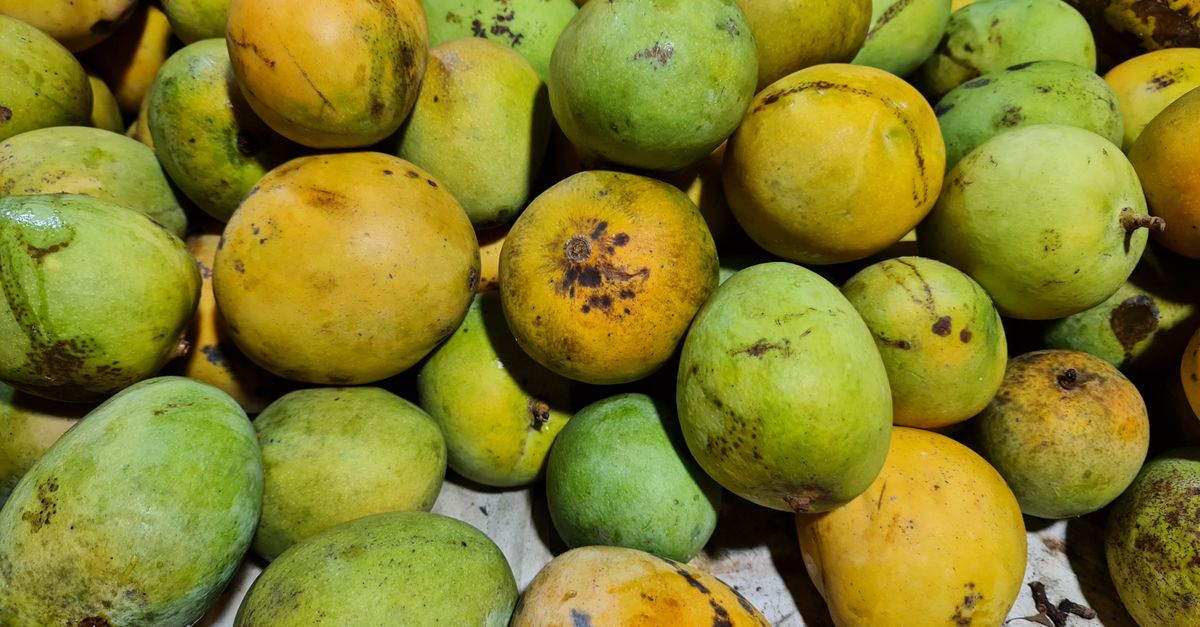
Banganapalli (also Benishan, Beneshan, Baneshan, Chappatai, Safeda) is a large, fibreless, golden-yellow mango from Banaganapalle, Panyam and Nandyal mandals of Kurnool district in Andhra Pradesh, and it holds a Geographical Indication (GI) registered in 2017. It does best in the dry, warm interior of Andhra Pradesh and Telangana, and TNAU also lists it as a processing and export variety for Tamil Nadu.
Planting grafts at 7 to 10 m (conventional) or 5 x 5 m (high density) and managing flowering, hopper and anthracnose well matter more than the name. TNAU gives about 8 to 10 t/ha for the first 15 years and 15 to 20 t/ha from 15 to 20 years, which is a slow build.
Where it grows and what the GI covers
- Home area: the GI covers Banganapalli, Panyam and Nandyal mandals of Kurnool district. The Andhra Pradesh government treats Rayalaseema and coastal Andhra as secondary centres of origin. It is also grown in Telangana districts, and under the name Safeda in northern markets.
- Share: a December 2023 FreshPlaza report says it makes up up to 80% of mango plantations in Kurnool district, with Imam Pasand, Dilpasand, Neelam and Totapuri forming the rest.
- Fruit: a large oblong fruit with a gleaming golden-yellow skin and prominent lenticels when ripe, sweet, firm and fibreless pulp, and a thin seed (ICAR Indian Horticulture on GI mangoes, and the GI application description).
- Keeping: fruit is reported to hold its quality in cold storage for up to three months, though this should be tested with your own handling and a local cold store.
- Climate: traditional growers in the GI area say the local climate and soil give the fruit its character. Heavy rain at flowering reduces fruit set and increases disease. Mango needs well-drained soil.
- The GI protects the name for fruit from the defined area. Mango sold elsewhere should not be labelled as GI Banganapalle.
Planting and spacing
| System | Spacing | Trees per hectare | Trees per acre |
|---|---|---|---|
| Conventional (TNAU) | 7 to 10 m either way | 100 to 204 | 40 to 83 |
| High density (TNAU) | 5 x 5 m | 400 | about 160 |
- Pits are 1 x 1 x 1 m, filled with topsoil, FYM and fertiliser before planting (TNAU).
- Buy grafts of true Banganapalli from a state horticulture department nursery or agricultural university. A wrong variety is only discovered when the trees fruit, years later.
Nutrition and irrigation
- Per tree per year (TNAU): in year 1, 10 kg FYM, 0.2 kg N, 0.2 kg P and 0.3 kg K; the dose is stepped up each year (by 0.2 kg N, 0.2 kg P and 0.3 kg K), and a mature tree from year 6 onward receives 50 kg FYM, 1.0 kg N, 1.0 kg P and 1.5 kg K. Ask your KVK for the yearly steps in between and match them to a soil test (see fertilizers).
- High-density fertigation: 1.0 : 0.5 : 1.0 kg NPK per bearing tree per year (TNAU).
- Irrigation: weekly irrigation under conventional systems, and micro-irrigation uses about one third of the water (TNAU). See drip irrigation.
- Flowering: if flowering has not started by February, TNAU lists a spray of 0.5% urea (5 g per litre) or 1% potassium nitrate (10 g per litre).
Pests and diseases
- Hoppers at panicle emergence, mealybug on trunks and shoots, and fruit fly near ripening are the main insects listed by TNAU. Chemicals and doses change, so follow the current label and ask the KVK.
- Anthracnose: TNAU lists mancozeb at 2 g per litre in three sprays at 15-day intervals. Powdery mildew: wettable sulphur at 0.2%. Observe the waiting period before harvest.
- See the pest guide.
💡 Tip: Flowering is the critical stage, since hopper and powdery mildew at panicle emergence can wipe out the crop. Time the sprays to panicle emergence and ask the KVK for the local schedule.
Harvest and yield
- TNAU gives the harvest season as March to June.
- Expected yield is 8 to 10 t/ha (3.2 to 4 t per acre) for trees up to 15 years old, and 15 to 20 t/ha (6 to 8 t per acre) from 15 to 20 years (TNAU).
- Harvest at the right maturity and handle gently, because the thin skin bruises. Grade by size and appearance before sale.
Cost and returns
- No verified current Indian cost of cultivation or farm-gate price for Banganapalli was found, so none is quoted. Prices change within a season, so check mandi bhav and your local buyers.
- Arithmetic to use: gross per acre = yield x price. At the TNAU yield of 3.2 to 4 t per acre in younger orchards, every ₹10 per kg is ₹32,000 to ₹40,000 per acre, and at 6 to 8 t per acre in mature orchards it is ₹60,000 to ₹80,000. Subtract grafts, FYM and fertiliser, irrigation, spraying, labour, and transport.
- Young orchards earn little for several years, so plan an intercrop or other income for the early years, and consider a KCC loan for the gap.
Market and selling
- Banganapalli sells as a table and gift mango in large domestic markets, and it is a processing variety that suits pulp and canning. TNAU lists it as a processing and export variety.
- Sell to wholesale mandis, pulp processors or exporters, or group through an FPO. For export, check buyers on export buyers.
- Cold storage widens the selling window; see cold storage subsidy, and check horticulture support through the subsidy finder. Crop insurance is at PMFBY where mango is notified in your district.