
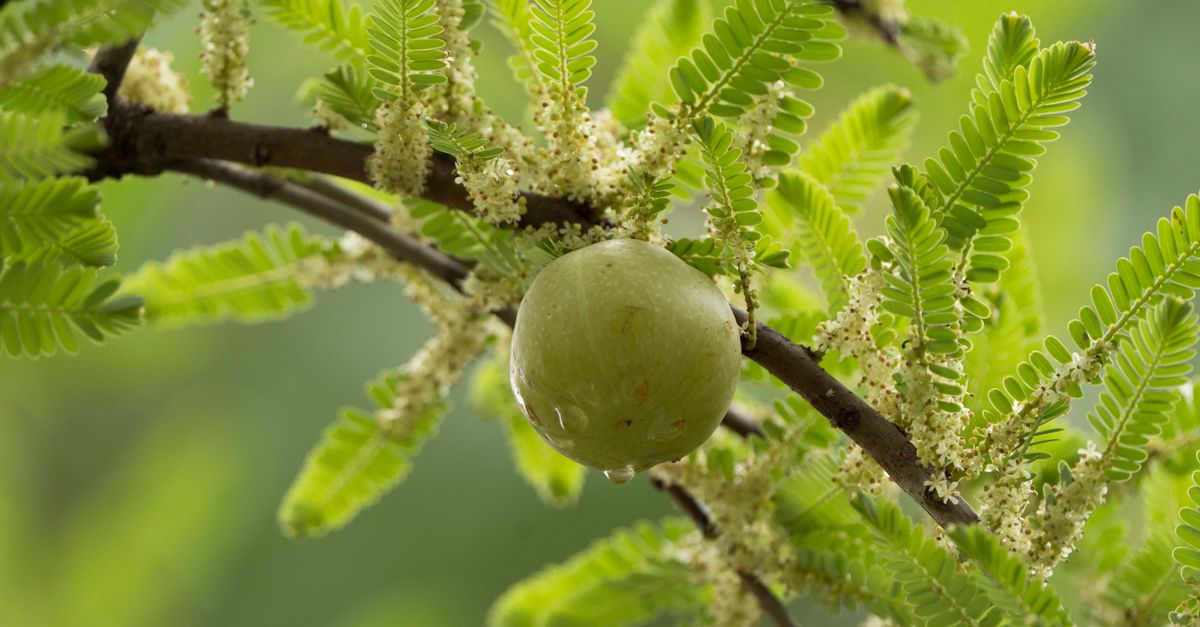
Aonla (amla, Indian gooseberry) is one of the few fruit trees that gives a dependable crop on dry, poor or salt-affected land in India, and it is grown commercially mainly in Uttar Pradesh, Gujarat and Rajasthan. It needs a grafted plant of a named variety, a dry subtropical climate, and a plan to sell to processors, because the fruit is mostly bought for candy, murabba, juice and powder rather than eaten fresh.
The tree is hardy and cheap to maintain, but it is a long-term orchard: plan for several years of establishment cost before a full crop, and check the current price before you plant.
Where it grows in India
- Main states: the National Horticulture Board (NHB) model project report lists Uttar Pradesh (about 15,750 ha), Gujarat (about 10,050 ha) and Rajasthan (about 5,000 ha) as the leading states, with notable belts around Varanasi and Agra (UP), Dewas and Hoshangabad (Madhya Pradesh) and Tirunelveli (Tamil Nadu).
- Climate: a dry subtropical climate suits it best. TNAU describes amla as a subtropical plant that prefers dry conditions. ICAR-CIAH Bikaner evaluated several varieties in a hot arid location and found NA-7, Chakaiya, NA-6 and Krishna promising there.
- Soil: NHB gives a soil pH range of 6.5 to 9.5, so mildly acidic to saline and alkaline soils are acceptable. TNAU also notes tolerance to salinity and alkalinity. Avoid land that stays waterlogged.
Varieties
| Variety | Notes from the sources | Where it fits |
|---|---|---|
| NA-7 (Neelum) | Listed by TNAU as market-preferred; promising in the CIAH Bikaner hot arid trial; tallest tree in that trial (3.46 m) | Dry and semi-arid areas; processing and fresh |
| Krishna (NA-5) | Largest fruit in the Bikaner trial (48.3 g); promising in the hot arid trial | Dry areas |
| Kanchan (NA-4) | Smallest fruit in the Bikaner trial (30.16 g) | Check local performance before planting |
| Chakaiya, NA-6 | Both rated promising in the hot arid trial | Dry areas |
| NA-10, Banarasi, BSR-1 | Named in NHB and TNAU lists; no trial figures were available | Ask your state horticulture department or KVK |
- Buy budded or grafted plants from a government or ICAR-recognised nursery. Seedling trees vary in fruit size and quality.
- Planting a mix of two or three varieties is sensible, since a market that wants one variety this year may want another next year.
Planting and spacing
- Season: July to August (rainy season), according to TNAU. NHB mentions February as a second window in some areas.
- Pits: TNAU gives 1 x 1 m or 1.25 x 1.25 m pits. NHB suggests filling each pit with rotted farmyard manure mixed with topsoil.
- Spacing: NHB recommends 4 to 5 m square layout; TNAU gives 6 x 6 m. At 5 x 5 m there are 400 trees per hectare (about 162 per acre); at 6 x 6 m there are about 278 per hectare (about 112 per acre). The NHB cash-flow model itself uses roughly 250 to 260 trees per hectare (101 to 104 per acre).
- Training: TNAU advises keeping main branches from 0.75 to 1 m above the ground (modified central leader) and pruning in March to April.
Nutrition and irrigation
- NHB's schedule starts at 10 kg farmyard manure, 100 g nitrogen, 50 g phosphorus and 100 g potassium per tree in year 1, increased every year up to year 10 and held constant after that. Ask your KVK for the exact yearly steps for your soil.
- Apply fertiliser after pruning, as TNAU advises. A soil test is the best guide in salt-affected land.
- Irrigation: water young trees well to establish them. NHB assumes irrigation every 15 to 20 days in the dry season; TNAU says no irrigation is needed in the rainy and winter months and that drip can save 40 to 45% of water.
- NHB's model assumes drip-irrigated trees give about 30 kg per tree by year 3, against about 20 kg per tree after 4 to 5 years under rainfed conditions. Details on drip irrigation and its subsidy are on the linked page.
Pests and diseases
- Insects: TNAU lists gall caterpillar and bark-eating caterpillar; NHB adds leaf-rolling caterpillar, shoot gall maker and mealy bug. TNAU suggests a dimethoate 0.03% spray against gall caterpillar and putting kerosene in bark-caterpillar holes.
- Rust: TNAU suggests mancozeb 0.2% in July to September when rust appears.
- Chemical approvals change; follow the label and ask your KVK before spraying. See pests for identification.
Harvest and yield
- Harvest fully developed fruit that has turned brown-coloured, picking in the early morning or evening hours (NHB).
- The NHB model assumes yield rising from 4 t per hectare in the early years to 8 t per hectare by year 5 of the project, and 15 to 20 t per hectare in mature trees. That is about 6 to 8 t per acre for a mature orchard. Treat these as model assumptions, not guarantees; actual yield depends on variety, irrigation and flowering.
Cost and returns
- Old costing: the NHB report prices a one-acre project at about ₹1.25 lakh in total, including irrigation (about ₹50,000), drip (about ₹20,000) and cultivation costs. This is an older costing, so plant, labour and pipe costs will be higher now.
- Old prices: the same model assumes ₹700 per quintal in year 1 rising to ₹1,000 per quintal by year 4. Current prices differ by market and fruit size; check mandi bhav and your local processors before you plant.
- Arithmetic: a mature yield of 6 t per acre is 60 quintals. At ₹1,000 per quintal that is ₹60,000 gross per acre; at ₹2,000 per quintal, ₹1.2 lakh. Replace the price with a written quote from your buyer. Subtract annual costs for manure, irrigation, pruning, labour and picking.
- Income starts after the young-tree years, so the early years carry cost without a full crop; fit the plan to your finances, including KCC credit if you use it.
💡 Tip: Before planting more than a few acres, ask a nearby processor in writing which variety and fruit size they buy and at what price band. Selling as a group through an FPO gives more bargaining power than a small lot.
Market and subsidy
- Buyers are candy, murabba, juice and powder processors, Ayurvedic and herbal manufacturers, and fresh-fruit traders. A processor contract spreads price risk better than selling a small lot loose.
- Support for orchards under the Mission for Integrated Development of Horticulture varies by state and year. No current subsidy rate was verified here; use the subsidy finder and ask your district horticulture office.
- Crop insurance for aonla depends on whether your state notifies it; ask your bank or agriculture office about PMFBY.