
Guggul (Commiphora wightii) can be grown on dry, rocky or sandy land in Rajasthan and Gujarat, where it is native, but it is a slow, long-gestation crop: plants are not ready for resin tapping for at least 5 to 6 years, and a report on Rajasthan populations puts it at about 10 years in dry conditions. It is a plant for patient landowners, forest departments and institutions with assured buyers, not a quick-income crop for a small farmer.
Wild stocks have been depleted by heavy tapping, so the species is treated as threatened. Check the rules of the state forest department and the State Medicinal Plants Board before planting, tapping or moving resin.
Where it grows
- Natural range: the arid tracts of Rajasthan and Gujarat, including the Aravalli hills and the Thar fringe. The Arid Forest Research Institute (AFRI), Jodhpur describes it as once prominent there and now close to extinction over much of its Indian range.
- Survey data: a survey of 604 sites in 20 Rajasthan districts found the plant at only 68 locations, at densities of 1 to 20 plants per tenth of a hectare in the districts where it was found. It grew with Acacia senegal, Euphorbia caducifolia, Grewia tenax, Acacia leucophloea and Boswellia serrata, and the invasive Prosopis juliflora was identified as a threat to its survival.
- Soil: sandy or sandy loam soil is best, in arid, rocky and sandy tracts. Avoid heavy, low-lying land, which is unlike its natural habitat.
Planting material
- Seed set and germination are poor; the Vikaspedia package of practices reports about 40% germination from black seed.
- Stem cuttings: leafless stem cuttings prepared in May are the usual method. AFRI notes that the Rajasthan and Gujarat forest departments have not been able to produce enough plants from seed and cuttings to meet their own planting demand.
- Air layering: from 5 to 8 year old mother plants in July to August (Vikaspedia).
- Tissue culture: AFRI Jodhpur has worked on tissue culture protocols to multiply plants faster, at a somewhat higher cost per plant. Ask AFRI or your State Medicinal Plants Board where authorised planting stock can be bought.
Spacing and planting
- The Vikaspedia package gives pits of 45 x 45 x 45 cm at 2 m x 2 m, which is 2,500 plants per hectare (about 1,010 per acre).
- For restoration in the wild, the Rajasthan survey authors suggest a far lower density of about 200 plants per hectare (about 80 per acre) in mixed plantations with canopy trees.
- Ask the forest department or KVK for the best planting time in your district and keep goats and cattle out while plants are young. See crop calendar and weather for local rain timing.
Care and irrigation
- Guggul is a desert plant that needs very little water once established; ask your KVK how much water young plants need in the first dry season, and use drip if you irrigate.
- No state package of fertiliser doses for guggul was found. Use farmyard manure in the pit and ask your KVK or AFRI before applying chemical fertiliser.
- Keep the plot free of Prosopis juliflora and other competitors.
Tapping and yield
- Age to tap: sources differ. Vikaspedia gives 5 to 6 years; the 2008 IUCN-supported report on Rajasthan says about 10 years under dry conditions. Do not tap until the stem is thick and healthy.
- Per-plant yield: Vikaspedia reports 250 to 500 g of gum resin per healthy plant in one season, rising from about 200 to 400 g from the sixth year. These are reported figures; no controlled Indian trial of per-acre farm yield was found.
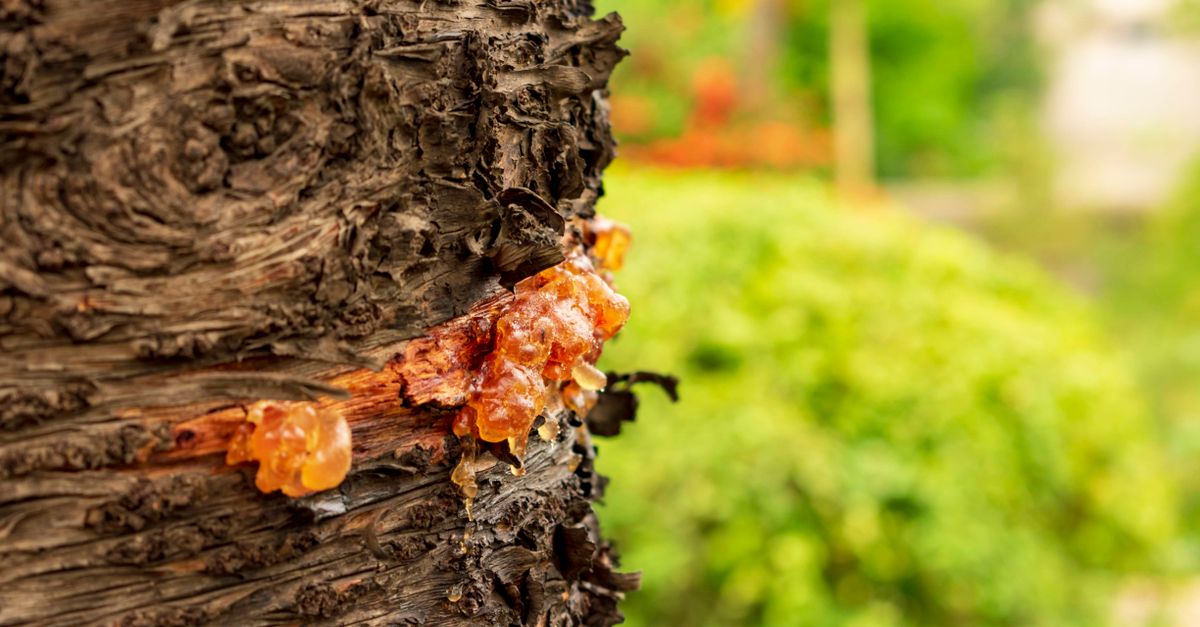
- Season: resin is tapped from November to January, with collection until May or June, by making a shallow nick in the bark.
- Do not over-tap: AFRI reports that a plant tapped by deep cutting usually dies within two to six months. Wild collectors have used deep incisions with copper sulphate paste or ethephon to get three to four times more resin, and the plants die. Tap lightly, rest plants between seasons and follow a forest department or NMPB protocol.
💡 Tip: Before planting, get a written offer or purchase agreement from an Ayurvedic manufacturer, and written permission from the forest department covering cultivation, tapping and transport of the resin.
Cost, returns and market
- Price: no current farm-gate price for cultivated guggul gum could be verified, so none is given here. Ask manufacturers and the State Medicinal Plants Board for a written rate before you plant.
- How to work out returns: plants per acre x grams of resin per plant x price per kg. For example, 1,000 plants x 0.3 kg is 300 kg a year from about the sixth to tenth year; multiply by the agreed rate and subtract five or more years of establishment, watering and fencing costs with no income.
- Demand: the 2008 report estimated domestic demand for guggul gum at about 300 tonnes a year against supply of about 75 tonnes, which is why shortage and over-collection are persistent problems. The buyers are Ayurvedic and herbal manufacturers.
- Medicinal-plant support may be available through the National Medicinal Plants Board and state boards; check through the subsidy finder. For group sales see FPO.
Sources
- Arid Forest Research Institute, Jodhpur, Biotechnological interventions to save Commiphora wightii (Guggal)
- Final project report, In-situ conservation of Commiphora wightii in Rajasthan (IUCN Sir Peter Scott Fund, 2008)
- Kumar and Kulloli, Effect of associated species on distribution of Commiphora wightii in Indian Arid Zone, Taiwania 2017
- Vikaspedia, Commiphora wightii package of practices