
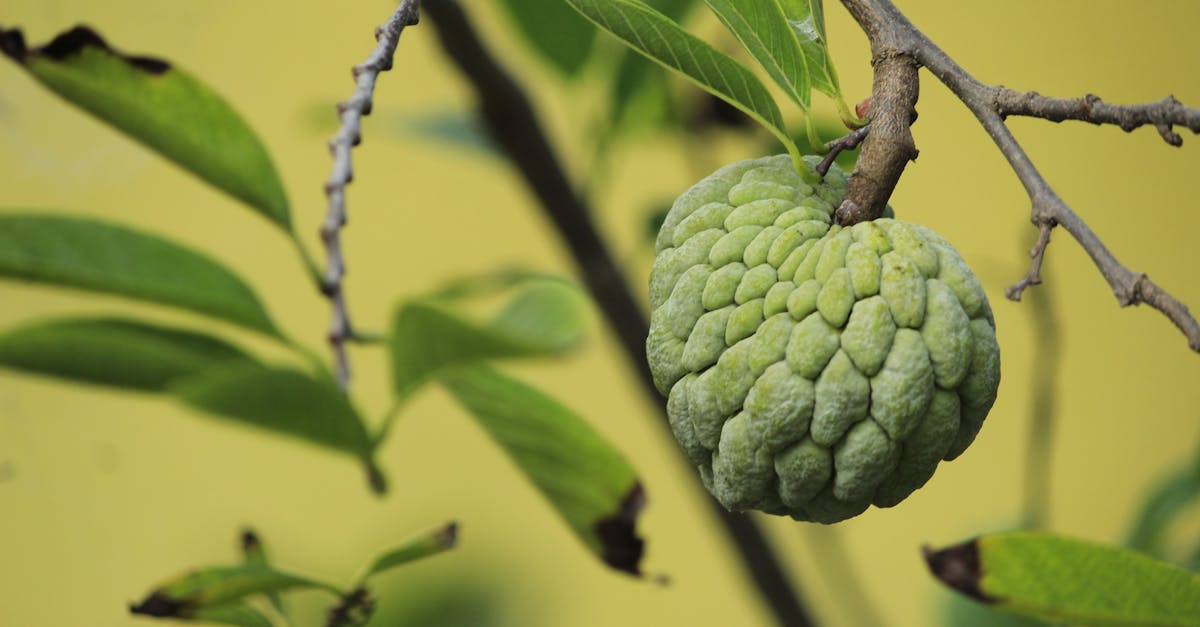
Custard apple (sitaphal, Annona squamosa) is one of the few fruit trees that works on poor, rocky, rainfed land in the dry belts of Maharashtra, Karnataka, Telangana, Andhra Pradesh, Madhya Pradesh, Rajasthan and Gujarat, with fruit in August to October. It needs 4 to 5 years to a worthwhile crop, careful handling because ripe fruit bruises and splits, and a market within a day or two of picking.
Published trial yields are 9 to 15 kg of fruit per plant, while farming websites quote 50 to 100 kg per tree. Budget on the trial numbers.
Where it grows and what it needs
- Area: about 55,000 hectares are reported under custard apple in India, mainly in Maharashtra, Madhya Pradesh, Rajasthan, Uttar Pradesh, Bihar, Odisha, Assam, Andhra Pradesh, Telangana, Tamil Nadu and Karnataka. Trials cited below ran in Madhya Pradesh and in Belgaum district, Karnataka.
- Climate: hot, semi-arid conditions with roughly 500 to 1,000 mm rainfall; the tree tolerates heat but is sensitive to temperatures below about 10°C. Heavy monsoon rain at fruiting raises fruit rot and fruit fly problems.
- Soil: light, shallow, rocky and murrum soils are acceptable; pH 6 to 7.5 and good drainage matter more than fertility. Waterlogged soil kills trees.
Varieties
| Variety | Source | Traits | Suited to |
|---|---|---|---|
| Balanagar | Andhra Pradesh (Balanagar, Telangana region) selection | Large fruit of 400 to 600 g, smooth skin, high pulp share, fewer seeds | Standard commercial type across the dry belts |
| Arka Sahan | ICAR-IIHR, Bengaluru; cross of Annona atemoya x A. squamosa | Average fruit about 410 g, creamy pulp, very few seeds (about 9 per 100 g), TSS about 30 °Brix | Hybrid with a reported yield of about 3.2 t per acre by year 7 and fruit from the 4th year; confirm availability and local performance with IIHR or your KVK |
| Local selections | Seedling types in each region | Often smaller fruit and more seeds; 25 local selections in a Belgaum trial gave up to 4.36 kg per plant for the best one | Fine for low-input orchards; the best use is to graft from the better trees |
- Buy grafted or budded plants from a government or university nursery. Seedling trees give fruit of mixed size, which sells poorly.
Planting and spacing
- Pits of 60 x 60 x 60 cm, filled with topsoil, about 15 kg farmyard manure and 300 g bone meal, were suggested in one guide; plant at the onset of monsoon.
- Spacing: 5 x 5 m gives about 160 plants per acre (400 per hectare); 6 x 5 m gives about 135 per acre (333 per hectare); 6 x 6 m gives about 112 per acre (277 per hectare). Wider spacing suits poor soil and rain-fed orchards.
- Prune in the dormant period before the monsoon (April to May): remove crossing branches, water shoots and branches below about 60 cm, to keep an open canopy and light inside the tree.
Nutrition and irrigation
- Published dose for bearing trees: farmyard manure 10 to 15 kg plus N:P:K at 250:125:250 g per plant a year, in two splits: half the fertiliser and all the manure at the start of monsoon (April to May) and the rest near the end of the monsoon (October). That is roughly 40 kg N, 20 kg P and 40 kg K per acre at 160 plants. Young trees need less; scale the dose with age and confirm with a soil test.
- A trial on Arka Sahan in Madhya Pradesh found 75% of the recommended fertiliser plus 2 kg vermicompost per plant with Azotobacter and phosphate-solubilising bacteria gave 31.5 fruits and 9.08 kg per plant, the best of the treatments.
- Water: established trees are rain-fed. In the first two summers give a few litres by pot or drip to keep young trees alive; one guide suggests about 10 litres per tree two to three times a week in dry spells.
- Pollination: flowers open female first, so natural fruit set is often poor. Hand pollination in the morning (about 6 to 9 am) during flowering is widely recommended to improve set and shape; a guide claims a 3 to 5 times increase, which has not been checked against Indian trial data.
Pests and diseases
- Mealybug is the main pest in Maharashtra (Ferrisia virgata is one species studied there); scale insects, fruit-boring caterpillars, leaf spots and anthracnose also occur. Remove weeds and ant trails, prune infested twigs and use neem oil with soap sprays early; one guide suggests every 10 days.
- Pheromone traps are used for fruit borers. For any chemical, take the product and dose from the current state university recommendation or your KVK and respect the waiting period before picking, since the fruit is eaten fresh.
- Heavy monsoon rain raises anthracnose and fruit fly damage, so open canopies and orchard hygiene matter.
Harvest and yield
- A custard apple orchard is usually reckoned to give a worthwhile crop 4 to 5 years after planting, and Arka Sahan is reported to fruit from the 4th year. Harvest runs from August to October, depending on region and variety.
- Ask your KVK how to judge picking maturity for your variety. Ripe fruit bruises and splits easily, so pick carefully and pack in shallow padded boxes.
- Trial yield: 9.08 kg per plant (Arka Sahan, Madhya Pradesh INM trial); 4.36 kg per plant for the best local selection at Arabhavi; 15.06 kg per plant for the best Balanagar progeny at IIHR. A mature orchard average of around 80 to 100 fruits per tree is commonly cited, which at 300 to 400 g would be 25 to 40 kg and is the upper end.
- Brochure yield: 25 t per hectare for Arka Sahan and 50 to 100 kg per tree appear on farming sites; treat as best case on good soil with irrigation and hand pollination.
💡 Tip: Plant 100 to 200 grafted trees first on your poorest land, fix a Pune, Hyderabad or nearest city commission agent before the first crop, and record the weight and price of every box.
Cost and returns
- Price: a Karnataka farming guide reports ₹55 to ₹120 per kg, with direct sales at the upper end. Prices at your local mandi on the day are what counts; check mandi prices and your wholesale market.
- Arithmetic (illustration): at 135 trees per acre, 10 kg per tree gives 1.35 t per acre, which is ₹67,500 at ₹50 per kg. At 25 kg per tree and ₹80 per kg, the gross is 3.4 t and about ₹2.7 lakh. At 35 kg and ₹100 it is 4.7 t and about ₹4.7 lakh. Real incomes sit nearer the lower and middle cases in the first bearing years.
- Costs: a guide says under ₹20,000 per acre a year for a low-input organic orchard; plants, pits, fencing, manure, pruning, labour and packing add to the first four years before income. Ask your KVK or horticulture department for current local quotations.
Market and risks
- Fruit goes to city fruit markets, roadside and weekend sales, ice cream and pulp processors. Ask a pulp or ice cream processor for a written price and quantity before assuming a contract.
- Main risks are fruit splitting in rain, a short shelf life once ripe, and mealybug. A cold room or quick transport to a city helps; see cold storage subsidy.
- Check the state horticulture department for current MIDH area-expansion support; no subsidy rate was verified for this guide. See subsidy finder and FPO for group sales.
Sources
- Organic Mandya, custard apple farming (secondary source: spacing, price, cost)
- ICAR epubs, integrated nutrient management in custard apple cv. Arka Sahan
- Journal of Pharmacognosy and Phytochemistry, performance of local custard apple selections (Arabhavi, Karnataka)
- Journal of Pharmacognosy and Phytochemistry, nutrient levels in custard apple cv. Balanagar
- Vikaspedia, Arka Sahan variety of custard apple (ICAR-IIHR)