
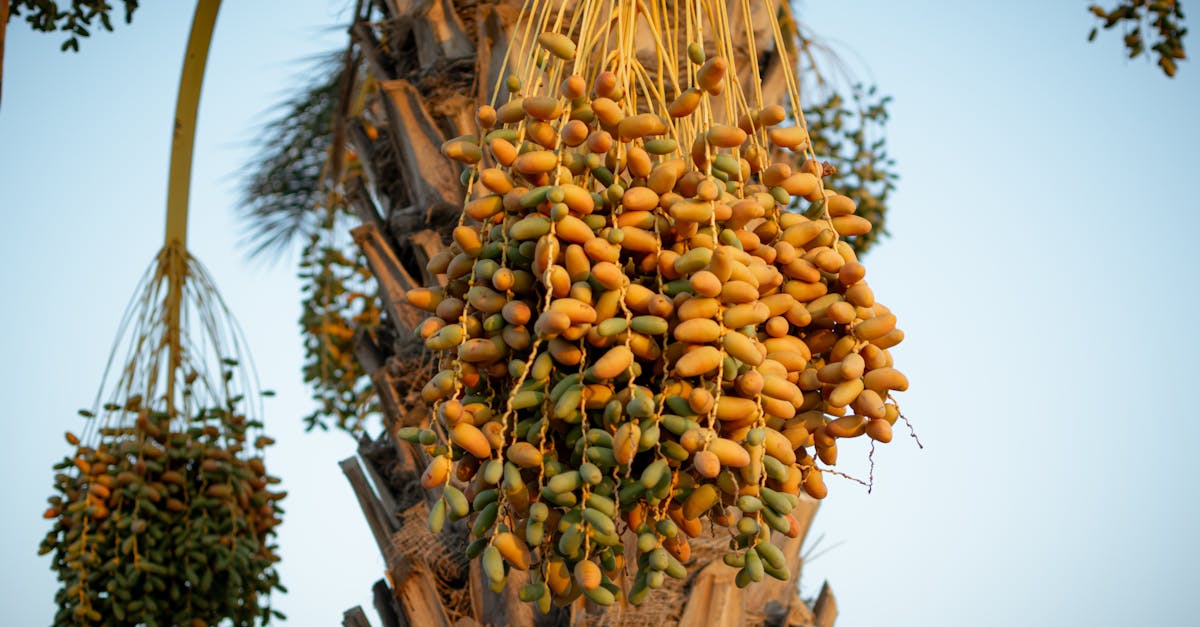
Date palm works commercially in India only in hot, dry, low-rainfall country: Kutch in Gujarat holds roughly 85% of the national area, with newer plantations in western Rajasthan (Barmer, Jaisalmer, Bikaner, Jodhpur) and pockets in Punjab and Andhra Pradesh. It needs tissue-culture plants costing about ₹3,100 to ₹4,700 each, drip irrigation, a pollination routine, protection from monsoon rain at ripening, and three to four years before the first fruit.
India imports far more dates than it grows (282,580 tonnes in 2019), so demand is not the problem. The risks are rain at harvest, palm pests, and the upfront cost per hectare.
Where it grows in India
- Kutch, Gujarat: about 18,286 ha and 171,522 tonnes of fresh fruit are reported for Gujarat, with Kutch the largest district. Barhee (Barhi) was recommended for Gujarat in 2002 and is now the main variety.
- Rajasthan: date farming started in 2007; Barmer began with 22 ha and 11 farmers in 2010-11 and reached 156 ha by 2020-21, with the first crop in 2014. Barmer reports 150 to 180 tonnes a year. The ICAR report names Barhi, Khuneizi, Khalas and Medjool as the cultivars supplied, and calls Barmer the only place in India where Medjool grows well.
- Climate limit: the palm tolerates very high heat but fruit needs a long dry spell to ripen. Where early rain arrives, fruit cannot fully ripen on the tree, so growers pick at the khalal (yellow, crisp) stage and ripen it artificially. Rain at ripening is the main reason the crop belongs in the arid west.
- Andhra Pradesh: some Chittoor, Anantapur and Nandyal growers have shifted from mango to dates after erratic rain damaged mango. Reports from there say officials have little local technical advice and that colour of the fruit can be poorer than in the desert.
Varieties
| Variety | Where used | Notes |
|---|---|---|
| Barhee (Barhi) | Kutch, Rajasthan, Andhra | Recommended in Gujarat in 2002; sold fresh at the khalal stage; about 1,800 ha of Kutch is reported to be tissue-culture Barhee |
| Medjool | Barmer, Rajasthan | Large premium fruit; needs very dry, hot conditions |
| Khalas, Khuneizi, Khadrawy | Rajasthan trials and old orchards | Khadrawy is the cultivar used in ICAR-CIAH Bikaner nutrient trials |
- Plant tissue-culture plants of a named female variety. Seedling palms are half males, fruit is variable, and the wait is longer. Buy only from a lab or supplier that gives the variety and batch in writing.
- Plan for male palms or a pollen source: date palm is dioecious, so female flowers must be hand-pollinated each season with pollen from a male variety. Ask your local horticulture department where to get pollen.
Planting and spacing
- Spacing: Rajasthan's Barmer plantations use 8 x 8 m, which is 156 palms per hectare (about 63 per acre). A farmer account from Telangana uses 27 ft, about 60 per acre. ICAR-CIAH research used 5 x 5 m in a trial, but that is a research density.
- Pit: a CIAH trial found a 1 m x 1 m x 1 m pit filled with field soil, clay and FYM in a 0.5:0.5:2.0 ratio performed best for Barhee tissue-culture plants.
- Irrigation: Barmer growers were required to use drip for plant survival. Young palms need regular water for the first year. See drip irrigation.
- Intercrop: Barmer farmers grew green gram, moth bean and sesame between young palms.
Nutrition
- No Indian age-wise schedule for young Barhee was found. A CIAH Bikaner trial on 35-year-old Khadrawy palms found the best result from 100 kg FYM, 1 kg N, 0.5 kg P2O5 and 1 kg K2O per palm, with 1% FeSO4 and 0.5% ZnSO4 sprays; soil dose in late October, sprays in November and March. That is a dose for old palms, not for young ones.
- An Egyptian trial on sandy-soil Barhee used 450 g N, 225 g P and 225 g K per tree in three splits. Treat it as a reference, and have your soil tested and follow your local KVK for young palms.
Pests and problems
- Red palm weevil and rhinoceros beetle are the serious pests. Red palm weevil is reported to attack young plantations widely, and damage often shows only after the crown is tunnelled; the Andhra report calls both pests fatal. Inspect crowns often and do not plant into land with dead coconut or date palms nearby without advice.
- Rain at ripening causes fruit rot and cracking; bunch covers and picking at khalal stage are the usual response.
- For any spray, follow the label and the advice of your KVK.
Harvest and yield
- Tissue-culture palms can give a first small crop in about 3 years; reports give 3 to 4 years for Barhee in Kutch and Rajasthan.
- Derived field figure: Gujarat's 171,522 tonnes over 18,286 ha is about 9.4 tonnes per hectare (3.8 tonnes per acre) averaged over bearing and young orchards. Spread over 156 palms, that is roughly 60 kg per palm.
- One Telangana farmer account says 10 to 15 bunches of 6 to 7 kg per palm (60 to 105 kg), which is a single farmer's claim, not a trial result. Barmer's 150 to 180 tonnes from 156 ha is only about 1 tonne per hectare, because most palms there were still young.
- The one old Indian economic study (CAZRI Jodhpur, 1985) found an IRR of 13%, just below the 14% bank rate, on seedling-era plantations. It is dated, but it shows that results depend heavily on fruit price and on selling more than one product.
💡 Tip: Visit a bearing orchard of the same variety in your own district before buying plants, and ask the owner for the price they got at the khalal stage in the last two seasons.
Cost and returns
- Plants: ₹3,100 to ₹4,700 per tissue-culture plant (Telangana and Andhra reports). At 156 per hectare that is about ₹4.8 to ₹7.3 lakh per hectare (₹1.9 to ₹2.9 lakh per acre at 63 per acre), before drip, pits, fencing and labour.
- Price: ₹80 per kg is reported by a Telangana grower, and ₹110 to ₹150 per kg in an Andhra report. No official wholesale series was found for fresh Indian dates; treat these as growers' figures.
- Arithmetic (illustration): a mature palm giving 50 kg at ₹80 per kg is ₹4,000; at 100 kg and ₹110 it is ₹11,000. Across 156 palms that is ₹6.2 lakh to ₹17 lakh per hectare in gross, only once palms are in full bearing (years 6 to 8). Claims of ₹10 lakh per acre rest on the highest yields and prices.
- Southfirst reports ₹10,000 to ₹40,000 a year per palm from Andhra, again a grower claim.
Market and subsidy
- Fresh khalal dates are sold to traders in Kutch, Rajasthan and big city mandis and as table fruit; processed dates compete with imports. Check mandi bhav and agree a trader before the first crop.
- Reports say the National Horticulture Board gives a back-ended capital subsidy of 25% of project cost for date palm, and that Rajasthan has offered a high subsidy on tissue-culture plants. Rates change; confirm with NHB, MIDH and your state horticulture department through the subsidy finder. A current rate could not be verified here.
- Land with sandy soil and a reliable water source is needed, and a crop loan through KCC or a bank can bridge the long gap.
Sources
- ICAR, Plantation of date palms has changed fortune of farmers in Barmer
- Date palm cultivation in India: an overview of activities (EJFA, 2014)
- Integrated nutrients management in Khadrawy date palm, hot arid region (Indian Journal of Horticulture)
- Economic appraisal of date palm plantations in western Rajasthan (CAZRI, Annals of Arid Zone, 1985)
- Indian Journal of Arid Horticulture, tissue-culture Barhee date palm trials (ICAR-CIAH)
- Date palm farming in India (Wikipedia, secondary source)
- The South First, farmers in Andhra switching from mango to date palm (secondary source)
- Agrifarming, date palm farmer account from Telangana (secondary source)