
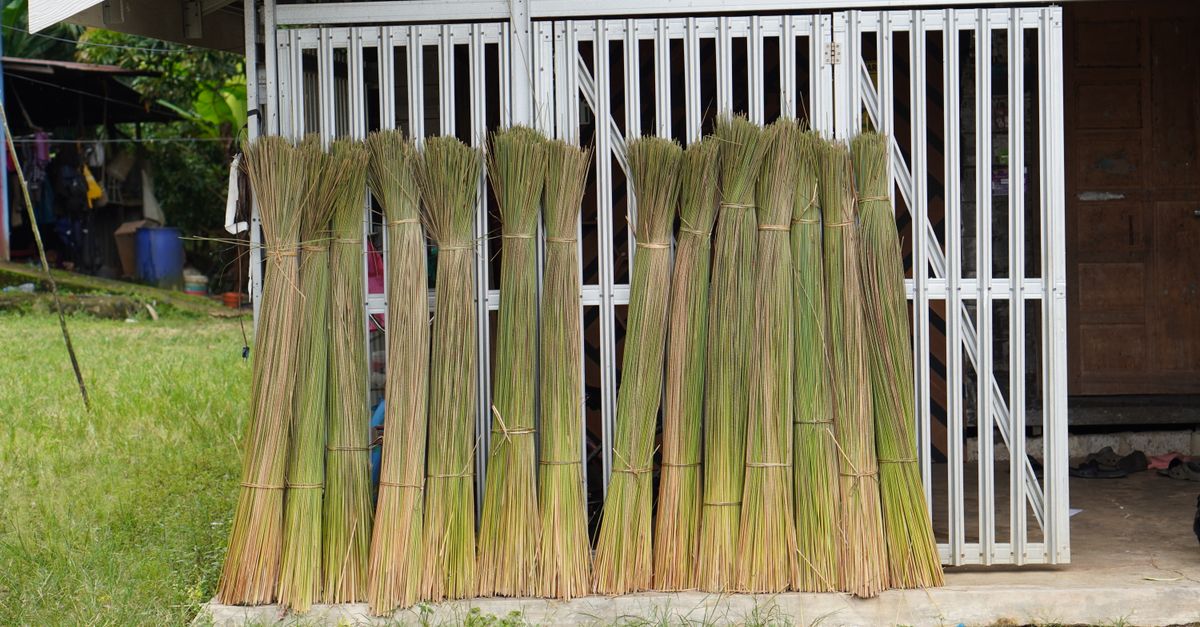
Vetiver (khus) is a working crop in India, but a small, buyer-dependent one: it grows on almost any soil, including saline and waterlogged land, and the oil comes from the roots, so the whole clump is dug at harvest. ICAR-DMAPR says India produces only about 20 to 25 tonnes of oil a year against domestic use of about 100 tonnes, but the farm yield of oil is low (10 to 30 kg per hectare), so income depends on oil price, your own distillation access and how long you wait for roots.
It also has a second use: planted in hedges along contours and bunds, vetiver binds soil and holds back water. That use needs no distillation and no oil buyer.
Where it grows in India
- Systematic cultivation: Rajasthan, Uttar Pradesh, Kerala, Karnataka, Madhya Pradesh and Andhra Pradesh (ICAR-DMAPR, 2014). Tamil Nadu is also named as a producer in the same bulletin.
- North India: Uttar Pradesh is the top oil state, but historically from wild roots, and that supply collapsed to a few hundred kilos by 2004. CSIR-CIMAP's "khus bio-village" programme then spread cultivation in Sitapur, Barabanki, Raebareli, Unnao, Sultanpur, Lucknow, Pratapgarh, Bahraich and Basti (UP) and Madhubani, Vaishali and Siwan (Bihar). CIMAP's own figures show growth from 0.2 ha in 2005-06 to 155 ha in 2010-11.
- South India: cultivated types with thicker stems and wider leaves, high root bulk, propagated only by slips.
- Climate and soil: grows between about -15 and +55 degrees C, best in moderately humid areas with 1,000 to 2,000 mm rain, or irrigated elsewhere. Almost any soil works, including saline and alkaline soils of pH 8.5 to 10, but DMAPR says light sandy soils should be avoided because the roots give very low oil. Well-drained sandy loam and red lateritic soils rich in organic matter are ideal.
Two types and the varieties
DMAPR separates a North Indian type (shallow roots, better perfume quality, 0.15 to 0.2 percent oil recovery, seeds freely) from a South Indian type (thick stems, non-seeding, about 1 percent recovery, grown from slips and better for erosion control). North Indian oil is regarded as the best in the world for perfumery and gets a higher price.
| Variety | Source | Traits (as reported) |
|---|---|---|
| CIM-Vriddhi | CSIR-CIMAP, Lucknow | Short duration (10 to 12 months); 30 to 35 kg oil/ha claimed by CIMAP; 28.3 kg/ha in a 50 kg tank trial with 18.6 q/ha roots |
| Dharini | CSIR-CIMAP | Long, thick, dense roots; tolerates sodic soil; good soil binder; DMAPR lists 39 kg oil/ha, CIMAP's tank trial recorded 14.3 kg/ha |
| Gulabi | CSIR-CIMAP | Rosy odour; tolerates sodic soil; 25 to 30 kg oil/ha; suits marginal soils |
| Kesari | CSIR-CIMAP | Saffron-like odour; about 30 kg oil/ha |
| Sugandha, KS-1, KS-2, Hybrid-8 | South Indian types (KS series from CIMAP) | Sugandha about 19.7 kg oil/ha at 1.4 percent; KS-1 17.8 kg/ha |
Yields differ a lot between trial methods and sites, as the Dharini figures show. Ask the supplier for the test conditions behind any oil-yield claim and buy slips only from CIMAP, DMAPR, a state aromatic mission centre or a nursery they certify.
Planting and spacing
- Season: June to August with the monsoon in the north; February to April in the south (DMAPR). With irrigation, March to April also works. Late planting gives coarse roots and poorer oil.
- Slips: split from healthy clumps, 15 to 20 cm of shoot kept, roots and old leaves trimmed, planted vertically about 10 cm deep.
- Spacing: 60 x 30, 60 x 45 or 60 x 60 cm by soil fertility and irrigation. That is about 55,000, 37,000 or 28,000 plants per hectare (about 22,500, 15,000 or 11,000 per acre). CIMAP's ridge-and-furrow method plants slips 23 cm apart on ridges 48 cm apart, using 150,000 to 225,000 slips per hectare.
- Land: 2 to 3 deep ploughings to 20 to 25 cm, and removal of perennial weeds.
Nutrition and irrigation
- On fertile soil DMAPR says fertiliser is usually not given. On poor soil, 10 t FYM per hectare (about 4 t per acre) with 25 to 50 kg each of N and P2O5 per hectare, with the N split in 2 or 3 doses. The calendar lists N at 25 kg/ha one month after planting and again in March to April.
- Kerala recommends N:P2O5:K2O of 60:22.5:22.5 kg/ha; central Uttar Pradesh advises 60 kg P2O5/ha. Use a soil test and see fertilizers.
- Water: irrigate at planting until established. Rainy, humid areas need little; dry areas need about 8 to 10 irrigations over the crop. Stop irrigation 7 to 10 days before digging. Mulch conserves moisture.
- Weeding and earthing up 2 to 3 times in the first months; once established the dense canopy suppresses weeds. Trim shoots to 20 to 30 cm three times: 4 to 5 months after planting, before flowering in the second year, and about a month before digging.
Pests and diseases
- Vetiver is hardy. DMAPR lists termites in dry areas, white grub (Phyllophaga serrata) in roots, stem borer (Chilo) and scale insects, and root nematodes. It recommends neem cake at 5 t/ha before the final ploughing (about 2 t per acre), neem oil 5 percent for scale, and clean mother stock for nematodes.
- Diseases: Fusarium and Curvularia leaf blight in the rains, which DMAPR says 2 to 3 sprays or drenches of copper oxychloride at 0.3 percent control. Follow the label and local KVK advice. See pests.
Harvest, distillation and yield
- When: DMAPR says roots are dug 15 to 24 months after planting, with 18 months best for oil quality; earlier digging gives more oil but of lower quality, and after two years quality improves but yield falls sharply. CIMAP's annual-crop work shows oil content rising to about 2.65 percent at 12 months and falling to 1.85 percent by 14 months in its trial, which is why CIM-Vriddhi is dug at 10 to 12 months. Digging is in December to February.
- Digging: by hand or with a tractor plough to 35 cm. DMAPR says mechanical digging recovers about 15 percent more roots.
- Processing: wash roots, chop to 5 to 10 cm, shade-dry for 1 to 2 days, then hydro or steam distil. North Indian types take 12 to 14 hours, South Indian types 72 to 96 hours (DMAPR); CIMAP states 18 to 24 hours of continuous hydro-distillation. Long distillation is a fuel and labour cost, so the location of a distillation unit decides whether the crop works for you. Ageing the oil for about 6 months improves its odour.
- Yield: DMAPR gives 10 to 30 kg oil per hectare per crop (about 4 to 12 kg per acre). CIMAP reports that farmers in its bio-villages averaged 15 to 20 kg oil per hectare (about 6 to 8 kg per acre). Root yield in CIMAP trials was about 10 to 19 q/ha; DMAPR gives 3 to 4 t/ha for a two-year plantation but also 2 to 2.5 t/ha on sandy loam and only 1 to 1.5 t/ha on salt-affected land, so treat root yield as site-specific.
Cost and returns
No current oil price has been verified. CIMAP's own series shows cultivated oil at ₹10,000 to 11,000/kg in 2005-06 rising to ₹12,000 to 16,000/kg in 2010-11, and a CIMAP comparison put net profit at ₹1.3 to 1.6 lakh per hectare per year against ₹40,000 to 50,000 for paddy-wheat (2011). Those are old numbers. Web price listings for 2026 vary widely and no reliable source could be traced, so ask distillers or perfumery buyers for a written current rate. The table shows gross per acre at three assumed prices:
| Oil per acre | At ₹5,000/kg | At ₹10,000/kg | At ₹15,000/kg |
|---|---|---|---|
| 6 kg (15 kg/ha) | ₹30,000 | ₹60,000 | ₹90,000 |
| 8 kg (20 kg/ha) | ₹40,000 | ₹80,000 | ₹1.2 lakh |
| 12 kg (30 kg/ha) | ₹60,000 | ₹1.2 lakh | ₹1.8 lakh |
From that, subtract slips, digging labour, fuel and distillation charges (CIMAP lists high digging cost as one reason adoption lagged), and the 12 to 18 months with a single harvest. CIMAP suggests an intercrop such as mentha, basil or wheat in the early months to add income.
Market and selling
- Vetiver oil is a perfumery fixative and base note. DMAPR puts Indian consumption at about 100 tonnes against 20 to 25 tonnes produced. Buyers are aroma-chemical firms and perfumers, usually reached through distillers and oil traders; no public mandi price for it was found, so a written buy-back from a distiller is the key risk control.
- Roots also sell dried for khus mats, screens, fans, pillows and incense, which needs no distillation.
- Soil conservation: the contour hedge use is valued by watershed and bund-stabilisation work. Ask your district watershed or agriculture office about demand for slips.
- Be wary of anyone selling slips with a promise to buy the oil at a high fixed rate. Get a signed agreement and confirm the buyer's distillation capacity.