
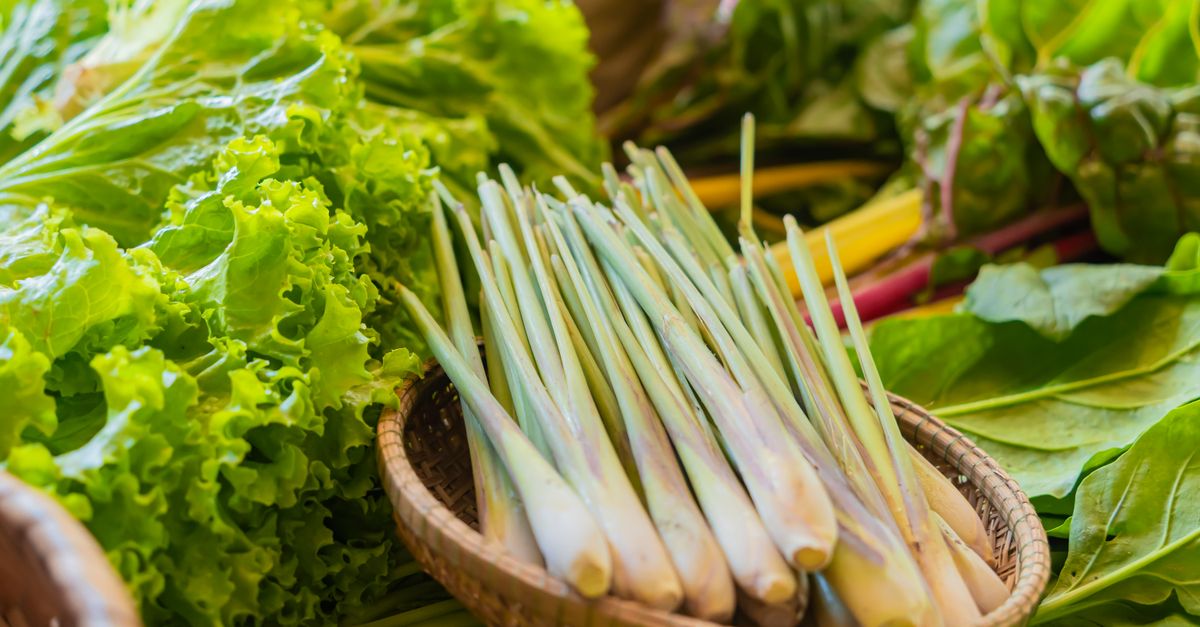
Lemongrass (Cymbopogon flexuosus) is a hardy perennial grass that is grown in India for its citral-rich essential oil, and it can be planted on poor, dry or degraded land because it needs little water and few inputs once established. The crop earns only when the grass is distilled and the oil is sold to a buyer who has quoted a price, so a distillation unit or group access to one decides the economics.
Indian trial evidence on yield and returns is patchy: published studies give very different herbage and oil figures from site to site. The ranges below show that spread, and no verified current oil price was found, so check the rate with a buyer before planting.
Where it grows in India
- Origin and area: the species is native to India, Sri Lanka and Southeast Asia (Wikipedia). A 2024 review in Food Chemistry: X states India has about 4,000 ha under lemongrass producing around 250 tonnes of oil a year, with about 90 percent of global trade passing through Cochin port. This is a review figure and should be taken as indicative.
- Studied locations: field studies come from Bangalore (alfisols), Jorhat in Assam, Alwar in Rajasthan, Telangana and ravine land in Gujarat. This shows the crop works from the humid north-east to semi-arid plains.
- Climate: the same review gives a warm, humid climate with temperatures of 20 to 30 degrees C and heavy rain.
- Marginal land: ICAR-IISWC (Vasad, Gujarat) tested Malabar neem with lemongrass on ravine land from 2019 to 2024 and found soil nitrogen, phosphorus, potassium and organic carbon about 73 to 79 percent higher than on untreated fallow. This supports lemongrass on degraded land, but it does not give a farm income figure.
Varieties
| Variety | Where studied | Reported traits |
|---|---|---|
| I Cauvery | Two-year spacing and nitrogen trial (Singh et al., 1996) | Higher herb and oil yield at 45 x 45 cm spacing and 150 kg N per ha per year |
| Jor Lab L-2 | Regional Research Laboratory, Jorhat (1991 to 1994) | Highest oil at a 90-day harvest interval; citral 88 to 90 percent at all intervals |
| Krishna | Named in harvest-frequency studies (Wikipedia) | No yield figure verified here |
- CSIR-CIMAP and other institutes have released improved lemongrass lines, but their yield and oil data are not given here. Buy planting slips from CIMAP, a state agricultural university or a registered nursery and ask for the variety name and its citral content.
Planting and spacing
- Spacing: in the two-year Singh trial, closer spacing of 45 x 45 cm gave higher herb and oil yield than wider spacing. That is about 20,000 clumps per acre (about 49,000 per hectare).
- Planting material is rooted slips or tillers. Plant when soil moisture is available.
Nutrition and irrigation
- Nitrogen: the Singh spacing trial found 150 kg N per ha per year (about 61 kg per acre) gave higher herb and oil yield, and a Bangalore trial on alfisols (1993 to 1995) found 100 kg N per ha (about 40 kg per acre) best with irrigation. Neither changed oil quality. Use a soil test and see fertilizers.
- Irrigation: the Bangalore trial found that irrigating at an IW:CPE ratio of 0.75 significantly raised herbage and oil yield. In practice this means regular irrigation in dry spells; drip irrigation suits it. A Telangana study found yield tracked soil nitrogen and phosphorus.
- No Indian pest and disease package was found for this guide, so ask your KVK or CIMAP which problems occur locally.
Harvest, drying and distillation
- First cut: a review gives harvest about 4 to 6 months after planting, cutting about 20 cm above the ground.
- Interval: in the Jorhat study (Jor Lab L-2) the best oil yield came from cutting every 90 days. The Telangana plantation below was cut three times in its year.
- Yield, herbage: Alwar, Rajasthan (2021 to 2023, a preprint not yet peer reviewed) reported 20.13 tonnes per hectare herbage (8.1 tonnes per acre). A Telangana plantation established in 2023 gave about 6,140 kg per hectare across three harvests. The difference is large; it depends on site, age, spacing and rain.
- Oil: the Telangana study found shade-drying the cut grass for 36 hours gave the highest oil yield (0.77 to 0.85 percent) compared with oven or sun drying, and citral of 65 to 84 percent. At 0.77 to 0.85 percent, 6,140 kg gives about 47 to 52 kg oil per hectare (19 to 21 kg per acre). A review gives a broader 1 to 2 percent on a dry basis.
- Oil is recovered by steam distillation of the cut leaves. Using a cooperative or neighbour's unit saves the cost of owning a still.
💡 Tip: Before planting, get the oil buyer to state in writing the citral percentage they accept and the price per kg, and ask where you can get your first batch distilled. Do your own sum at the buyer's price, not at a guide's price.
Cost and returns
- Rajasthan preprint: lemongrass net returns of ₹1,40,856 per hectare (about ₹57,000 per acre) with a benefit-cost ratio of 3.35, compared with ₹60,210 per hectare for mustard in the same study. Because this is a preprint and the oil price, cost and year assumptions could not be checked, treat it as an indicative upper case.
- Your own sum: oil yield per acre (roughly 20 kg in the Telangana example) multiplied by the buyer's price, minus slips, labour, harvest, fuel and transport for distillation, and fertiliser. No verified oil price or cost-of-cultivation sheet was found, so no profit figure is given here.
Market and risks
- The oil is sold to traders and processors, and its price moves with the market, so a buyer tie-up or a group stock-holding plan matters. See export buyers and FPO.
- Be careful with schemes that sell slips with promised buy-back and fixed profit per acre. Ask what the buyer pays per kg of oil today and for how many years.
- Support: CSIR-CIMAP promotes aromatic crops under its Aroma Mission; ask CIMAP or the state horticulture department about training, planting material and distillation support. See subsidy finder.
Sources
- Singh, Shivaraj and Sridhara (1996), Effect of plant spacing and nitrogen levels on growth, herb and oil yields of lemongrass var. I Cauvery, Journal of Agronomy and Crop Science
- Singh (1999), Effect of irrigation and nitrogen on herbage, oil yield and water use of lemongrass on alfisols, Journal of Agricultural Science
- Harvest management studies on Jor Lab L-2, lemongrass strain, RRL Jorhat (Ancient Science of Life, 1996)
- Insights into chemistry, extraction and industrial application of lemon grass essential oil (Food Chemistry: X, 2024)
- Singh et al., Evaluation of the economic potential of aromatic crops-based cropping system in Alwar, Rajasthan (Research Square preprint, not peer reviewed)
- Chepyala et al. (2025), Influence of soil nutrients on biomass production and drying methods on lemongrass oil yield in Telangana, Biochemical Systematics and Ecology 122 (abstract on Europe PMC)
- Jinger et al. (2025), silvo-aromatic system for ravine land, ICAR-IISWC Vasad, Journal of Environmental Management 380 (abstract on Europe PMC)
- Wikipedia, Cymbopogon flexuosus (secondary source)