
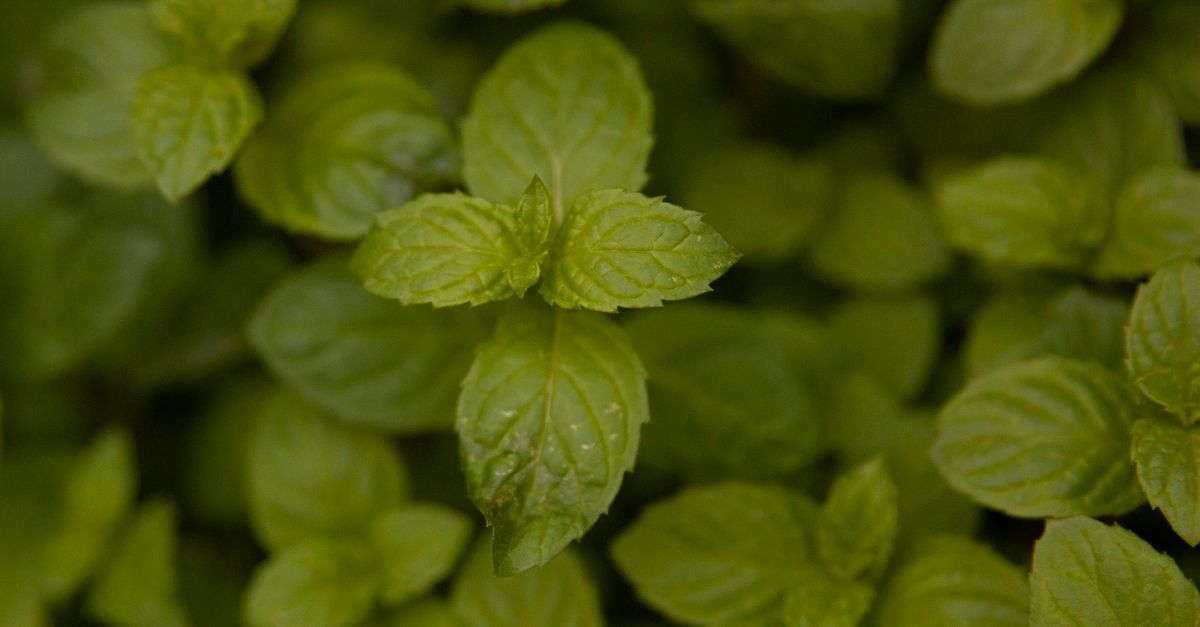
Japanese mint (Mentha arvensis) works well on irrigated plains in Uttar Pradesh and the neighbouring north Indian states, where it is a spring-summer crop of about 100 days that fits after the rabi harvest, and it takes a lot of water and nitrogen. India meets about 80% of the world's demand for mint oil: a 2021 ANDUAT paper citing national data puts production at about 38,000 tonnes from 0.34 million hectares, an average of only 120 kg of oil per hectare (about 49 kg per acre), supporting more than a million farmers.
The money depends on the oil price, which swings sharply from year to year, and on a good yield. A late-2026 price near ₹1,470 per kg is high, so plan on a price range rather than today's rate.
Where it grows in India
- Uttar Pradesh: mentha oil is traded at mandis in Chandausi, Bhehjoi and Sambhal (Sambhal district), Moradabad and Babrala (Budaun district). This is the Indo-Gangetic plain belt where Kosi and Himalaya varieties dominate; a follow-up survey in summer 2002 in the study region of an Indo-Gangetic plains study found 80% of the area under these two varieties and 70% of the mint grown in the summer season.
- Other states: smaller areas are grown elsewhere in north India. No verified state-wise area table was found, so ask your KVK about local acreage.
- Soil and water: mint is shallow rooted and responds to irrigation; water stress cuts yield and oil content. It is a heavy feeder of nitrogen. It needs a canal, tubewell or drip source through spring and early summer, so it is a poor choice where summer water is short.
Varieties
| Variety | Source | Traits |
|---|---|---|
| Kosi | CSIR-CIMAP, Lucknow | The most used variety in the Indo-Gangetic plains; April-transplanted Kosi gave better returns than Kosi suckers or Shivalik in a Lucknow-area study |
| Himalaya | CSIR-CIMAP (hybrid of CIMAP/MAS9 x CIMAP/HY 77) | High menthol, described as tolerant of common mint diseases |
| MAS-1 | CSIR-CIMAP, released 1985 | Oil with 84% menthol and 5.8% menthone |
| Kashi, Shivalik, Kalka, Damroo, Gomti, Saksham, Sambhav, CIM-Kranti, CIM-Saryu, CIM-Unnati | CIMAP list and a Faizabad trial | Other named varieties; ask CIMAP or your KVK which suits your district |
- Planting material: CIMAP lists suckers at ₹100 to ₹150 per kg, seedlings at ₹200 to ₹300 per kg and shoots at ₹400 to ₹600 per kg. For bulk quantities CIMAP asks for contact at least 12 months in advance. Use clean, disease-free planting material from a known source.
Planting and spacing
- Season: planting runs from about January to April. Late-transplanted mint (two-month-old seedlings put out after the rabi crop, about three months later than normal) is a recognised option after wheat, oilseed or pulse harvest.
- Spacing: the Faizabad trial used 45 x 20 cm. Raised beds in paired rows beat flat and ridge planting, giving 136.5 kg oil per hectare against 111.4 on the flat bed. A Lucknow late-planting trial tested 1.66, 2.0 and 2.5 lakh plants per hectare and found the highest density (2.5 lakh per hectare, about 1 lakh per acre) best, with 160 kg N per hectare.
Nutrition and irrigation
- CIMAP schedule (per hectare): 25 to 30 tonnes of FYM at land preparation; 100 kg urea, 300 kg SSP and 60 kg MOP at planting; then 50 kg urea each at 5 weeks after planting, 5 weeks after that, right after harvest, and 5 weeks after that. Per acre this is roughly 10 to 12 tonnes FYM, 40 kg urea, 120 kg SSP and 24 kg MOP at planting, and 20 kg urea per top dressing.
- A 2% urea foliar spray is advised late in the season when soil top-dressing is difficult and on sandy soil, and 0.5% FeEDTA helps prevent chlorosis.
- Trial doses: the Faizabad trial used 160 kg N, 60 kg P2O5 and 60 kg K2O per hectare (about 65, 24 and 24 kg per acre), with half the N and all P and K at planting and the rest at 25 and 40 days. 125% of that N gave the highest yield, but it was statistically similar to 100%.
- Water: the trial gave 6 cm per irrigation. Irrigating at IW/CPE 1.2 gave the highest returns, while 0.8 gave the best water productivity. Drip or sprinkler setups can save water; see drip irrigation and fertilizers.
- Pests and weeds: no verified Indian pest dose is given here. Scout weekly, keep the field weed-free early, and use only chemicals recommended for mint by your KVK, following the label.
Harvest and yield
- The Faizabad trial harvested once at 100 days after planting; the CIMAP fertiliser plan includes a dose right after harvest for the regrowth. The herb is steam-distilled to get the oil.
- Yield range: national average about 120 kg oil per hectare (49 kg per acre). Researcher trials gave 111 to 137 kg per hectare (Faizabad) and 164 kg per hectare (Lucknow, best treatment), i.e. about 45 to 66 kg per acre. Herbage in the Faizabad trial was 15 to 18 tonnes per hectare.
💡 Tip: Check the day's rate on mandi bhav and with your local oil buyer before you decide the area, and keep a share of the crop unsold if you can store the oil safely.
Cost and returns (per acre, illustration)
- Cost: the Faizabad trial put cultivation cost at ₹39,976 to ₹42,976 per hectare (about ₹16,000 to ₹17,400 per acre) in 2016-17. Costs have risen since, so treat this as a floor; ask a local grower for a current figure. Planting material is extra if bought.
- Price: Chandausi APMC reported ₹1,46,900 per quintal (₹1,469 per kg) on 28 September 2026, up 23% in a week, on 5.94 tonnes of arrivals, and ₹1,48,300 per quintal on 7 August 2026. A national price page showed about ₹1,217 per kg on 30 August 2026. Other Sambhal-district mandis were at ₹1,20,000 to ₹1,32,000 per quintal in the same period. Use ₹1,200 to ₹1,500 per kg.
- Gross: 49 kg x ₹1,200 = about ₹59,000 per acre; 66 kg x ₹1,500 = about ₹99,000. At 2016-17 costs the net would be about ₹40,000 to ₹80,000 per acre, less after current costs. The Faizabad trial valued oil at only ₹850 per litre, so today's prices look much better than that trial's returns, but a price that is high now may not hold at harvest.
Market and risks
- Oil is sold to traders and menthol processors in western UP mandis (Chandausi, Sambhal, Moradabad); India is the world's main supplier, so global demand and the Indian crop size set the price.
- Price swings are the main risk, since the rate at harvest may differ a lot from the rate at planting. Water shortage in summer and poor planting material are the other risks.
- For crop insurance and credit see PMFBY and KCC; for a related crop see premium mint. No verified subsidy rate for mentha was found; ask CIMAP, the state horticulture department or your KVK.
Sources
- Lakra and Verma, Water economization in Japanese mint, Indian Journal of Agricultural Sciences 91(5), 2021 (ANDUAT Faizabad trial)
- National Horticulture Board, mint manuring and fertilisation (CIMAP schedule)
- Yield and resource use optimization in late transplanted mint, Lucknow (Indian Academy of Sciences repository)
- New practices in the cultivation of mint in the Indo-Gangetic plains, Experimental Agriculture
- CSIR-CIMAP, planting material and prices
- CSIR-CIMAP AromaDb, Mentha arvensis variety MAS-1
- US plant patent PP10935, Mentha arvensis 'Himalaya' (CSIR-CIMAP)
- ACROP, mentha oil price at Chandausi (Agmarknet data)
- BankBazaar, mentha oil price today (secondary source)