
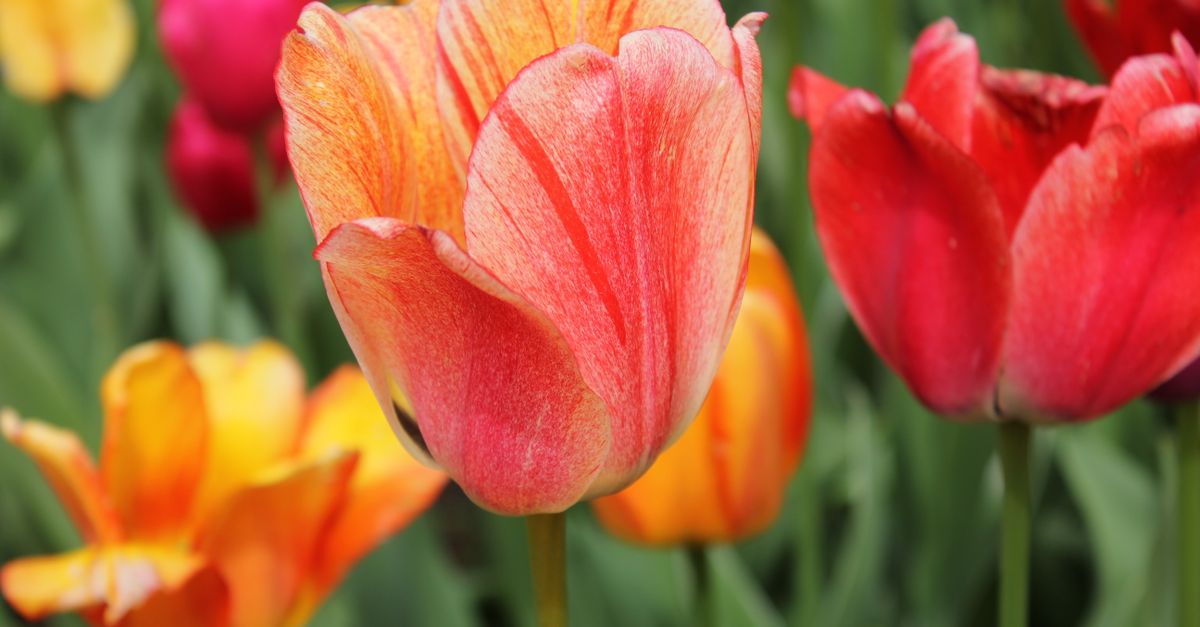
Tulip is a realistic crop in India only in the cold hills: the Kashmir valley, the Lahaul valley and high-altitude parts of Himachal Pradesh and Uttarakhand. In the plains the winters are too warm for the bulb to flower and multiply. Almost all planting bulbs still come from the Netherlands, so the first cost, the bulb, is high, and the crop pays only if you have a market for cut flowers or are in a bulb-multiplication programme.
Indian research on tulip is limited to a few institutions (ICAR-CITH Srinagar, SKUAST-Kashmir, CSIR-IHBT Palampur). This guide gives the figures they have published, and says where no Indian cost or price data is available.
Where it grows in India
- Kashmir valley: tulips were brought from Holland and do well in the valley's climate. ICAR-Central Institute of Temperate Horticulture (CITH), Srinagar ran its trials at about 1,675 m elevation on clay loam to silty clay soil with pH 6.8 and good drainage.
- Himachal Pradesh: CSIR-IHBT, Palampur has run flower and bulb production trials in the Lahaul valley (Udaipur) and trained farmers from floriculture cooperative societies there. The Tribune reports that the aim is to cut India's dependence on imported bulbs.
- Temperature needs: flower formation needs about 17 to 20°C, and forcing needs below 5°C for 10 to 12 weeks (ICAR-CITH paper). This is why plains areas cannot produce flowering bulbs without cold rooms.
- CSIR-IHBT also considers the hilly parts of Uttarakhand and several Himachal districts (Mandi, Chamba, Solan, Shimla, Kullu, Lahaul and Spiti, Kinnaur) suitable, but commercial production remains concentrated in Jammu and Kashmir.
Varieties tested in Kashmir
ICAR-CITH screened 20 Dutch genotypes during 2010 to 2014. The six it found promising for both cut flower and bulb production:
| Genotype | Flowering duration (days) | Vase life (days) | Bulb multiplication (propagation coefficient) |
|---|---|---|---|
| Blessing Lady | 24.5 | 11.7 (highest) | 354% (highest); 3.1 bulbs per plant |
| Purissima Yellow | 27.2 (longest) | 11.0 | 298%; 2.8 bulbs per plant |
| American Dream | 24.7 | 10.5 | 308%; 2.7 bulbs per plant |
| Apeldoorn Elite | 25.2 | not in top group | 303%; scape 33.2 cm |
| Daydream | not in top group | 11.5 | 292% |
| Golden Oxford | 23.7 | 10.7 | not in top group |
- Oxford Wonder gave the longest flower stem (35.5 cm), with Blessing Lady and Apeldoorn Elite close behind. Horizon, Hamilton, Character and Cassini multiplied poorly (under 200%).
- Propagation coefficient is the weight of new bulbs divided by the weight planted, times 100; 300% means the harvested bulbs weigh about three times what was planted.
- The paper notes that tulip has not become a large commercial crop in Kashmir because of scarce quality planting material, short flowering (15 to 27 days) and low multiplication.
Planting
- Bulb size: uniform, healthy bulbs of 8 to 12 cm circumference were used in the trial. Treat with carbendazim (0.05%) before planting to prevent bulb rot; follow the label and local KVK advice.
- Time: first week of November in Kashmir (The Tribune also reports November planting and April bloom). The crop spends the winter underground and sprouts after 72 to 95 days depending on genotype.
- Spacing and depth in the ICAR-CITH trial: 20 cm x 20 cm, 8 to 10 cm deep. At 20 x 20 cm, one acre holds about 1 lakh bulbs before paths and bed gaps are deducted (about 2.5 lakh per hectare).
- Soil: clay loam to silty clay, pH near 6.8, with good drainage and water-holding capacity. Waterlogging rots bulbs.
- Timeline: sprouting in 72 to 95 days, flower buds after about 128 to 151 days, flowering from late March; the plant stays in the field for roughly 175 to 196 days.
Harvest of flowers and bulbs
- Cut flowers: cut the stem at the bud colour-break stage in the morning, pre-cool (the trial used 5°C for about an hour) and sort by length. A vase solution with 8-HQS (300 ppm) was used in the trial to improve vase life.
- Bulb crop: after flowering the bulbs are lifted and the daughter bulbs counted. Each planted bulb gave 1.5 to 3.1 new bulbs in the ICAR-CITH trial, but only some are large enough to flower the next year.
- Stems cut for sale reduce the bulb crop, so growers choose between a flower crop (and buy new bulbs each year) and a bulb crop (and forgo or reduce flower sales).
Cost and returns
- Bulb cost: The Tribune reported in October 2017 that imported tulip bulbs cost ₹15 to 20 each, with about 100 containers of around 3 lakh bulbs imported each year. Prices have not been verified for 2026 and vary by size and variety.
- Arithmetic: at 1 lakh bulbs per acre and ₹15 to 20 per bulb, planting stock alone is ₹15 to 20 lakh per acre (₹37 to 49 lakh per hectare) at 2017 import prices. This is why tulip is a garden, tourism or bulb-programme crop, not a small-plot cash crop.
- No Indian farm-level data on cut flower prices, net returns or cost of cultivation is available from the institutions reviewed. Ask the state horticulture or floriculture department and current buyers before investing.
Market and risks
- Tulip ranks third in the world cut flower trade, and Holland is the largest producer (The Tribune). Indian demand is driven by gardens, flower shows and festive and wedding cut flower sales; the bloom lasts only about a month in the field, which limits selling time.
- Risks: imported bulb cost, bulb rot in wet soil, warm springs that bring bloom forward (reported at Palampur), and a short sales window.
- Check subsidy finder and the state floriculture department for support, and see polyhouse subsidy and the anthurium guide if you are considering protected flower cultivation.
Sources
- Kumar, Sharma and Singh, Screening of tulip germplasm for quality cut flower and bulb production, Indian Journal of Horticulture 74(2), 2017 (ICAR-CITH Srinagar)
- The Tribune: State to go big on tulip cultivation (22 October 2017)
- The Tribune: Tulips bloom in Lahaul's Udaipur (CSIR-IHBT)
- The Tribune: Tulips bloom in Palampur, institute keen to cash in on high demand