
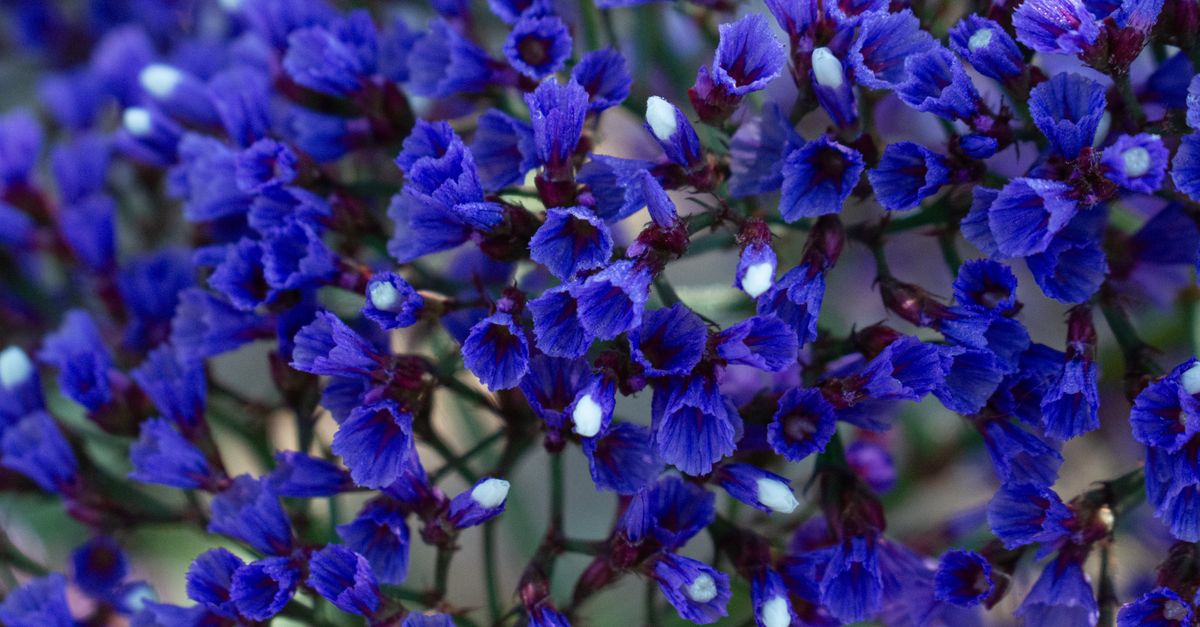
Statice (Limonium sinuatum, sea lavender) can be grown in India as an annual filler and dried flower, and Indian trials at Belagavi (Karnataka), New Delhi and Bengaluru show it flowers well in the cool season in the open field or under shade net. What it takes is a cool-season window, raised beds, a buyer for dried or fresh filler stems, and realistic expectations: it is a small niche crop and no public Indian price series exists for it.
Nothing on this page should be read as a guaranteed income. The ICAR trials give spike counts and agronomy, not prices, so a farmer needs a written offer from a florist, bouquet maker or dry-flower exporter before planting beyond a small bed.
Where and when it grows
- Trial locations: ICAR-IARI, New Delhi (trial over 2014-15 and 2015-16); the Horticultural Research and Extension Station, Kanabargi, Belagavi, Karnataka (2014 to 2017, open field); and UAS Bengaluru (924 m, red sandy loam, pH 6.56, September 2021 to April 2022, under 50% shade net).
- Season: statice is a cool-season annual. The UAS paper notes it is usually grown in the winter in highland tropical areas. Planting in August or September gives flowering from about October at the Bengaluru site.
- Light: long days of at least 14 hours bring earlier flowering and better quality. Up to 40% shade net is suggested only under very harsh light and should be removed once plants have established.
- Soil: well-drained sand or sandy clay is best, and high humidity or wet soil damages plants. No Indian figure for salinity tolerance was found, so test your soil and water before relying on it for saline land.
Varieties
| Collection | Source | Result |
|---|---|---|
| White | Belagavi trial, nine collections | Highest yield, about 4.08 lakh marketable spikes per hectare; longest spike, 62.02 cm |
| Lavender | Belagavi trial | Longest vase life, 13.64 days |
| Yellow | Belagavi trial | Earliest flowering, 92 days after planting |
| Apricot | Belagavi trial | Included in the trial; not among the top performers |
- The Belagavi authors rated White and Lavender as most suitable for the northern traditional zone of Karnataka under open conditions.
- These were trial collections, not notified varieties. Seed is mostly imported hybrid seed from commercial seed houses, so ask the seller for the series name, germination percentage and seed lot.
Spacing and planting
- ICAR-IARI tested 30 x 30, 30 x 45 and 45 x 45 cm on raised beds. The widest spacing (45 x 45 cm) with 20 g nitrogen per m2 gave the most cut flowers per plant (19.66), the widest flower clusters and the longest field flowering (about 61 days). The closest spacing (30 x 30 cm) gave taller plants.
- Plants per acre (4,047 m2, before bed paths): about 44,900 at 30 x 30 cm, about 30,000 at 30 x 45 cm and about 20,000 at 45 x 45 cm. Per hectare these are about 1.11 lakh, 74,000 and 49,000. Beds and paths reduce the real count by 15 to 25%.
- Raise seedlings in a nursery and transplant. Remove the first flower stems until the rosette is 25 to 30 cm across, as the Bengaluru paper advises, so that later stems are longer and more numerous.
Nutrition and irrigation
- IARI trial: basal P and K at 10 g per m2 on all beds, with nitrogen at 10, 20 and 30 g per m2. Best flower number came at 20 g N per m2 (that is 200 kg N per hectare or about 81 kg per acre, on the bed area). Higher nitrogen mainly grew more leaf and shoot weight.
- Bengaluru trial: the standard dose taken was 40:20:20 kg NPK per hectare, the dose used for golden rod. Fertiliser at 125% of that dose with 30 x 45 cm spacing gave the longest panicles (103.67 cm) and the longest vase life (24.33 days). Fertiliser was applied 21 days after transplanting, half the nitrogen from 19:19:19 and half from urea.
- The two trials differ widely in dose, so get a soil test and ask your KVK or horticulture college before choosing a rate. See fertilizers and drip irrigation; keep water off the crown and avoid waterlogging.
- No Indian pest and disease package for statice was found. Watch for root and crown rot in wet beds, and check with your KVK before spraying any chemical, following the label.
Harvest and yield
- Flowering began about 92 days after planting in the earliest Belagavi collection (Yellow); other collections took longer, so budget about 3 to 4 months from transplanting to first harvest.
- Stage: harvest at 50% bloom for fresh use and vase life; harvest at 75% bloom for drying. Cut in the cool hours of the day and pre-cool in clean water.
- Drying: hang bunches in shade. In the Bengaluru study, drying times varied by treatment, with the quickest at 4.33 days.
- Yield: the best Belagavi collection gave about 4.08 lakh marketable spikes per hectare, roughly 1.65 lakh per acre. Treat this as a trial figure under good management; farm yields with poor seed or heat will be lower.
💡 Tip: Plant a 200 to 500 m2 test bed first. Dry a sample of stems and send them to the buyer or to a florist so colour, stem length and bunch size are agreed before you plant an acre.
Cost and returns
- Price: no Indian wholesale price for fresh or dried statice stems was found, and none is quoted here. Ask buyers for a per-bunch price, bunch size (number of stems), colour grading and payment terms in writing.
- Arithmetic to do with your own price: gross income per acre = marketable spikes per acre x price per stem. At the trial yield of about 1.65 lakh spikes per acre, every ₹1 per stem is ₹1.65 lakh gross, so a price of ₹0.50 per stem gives about ₹82,000 and ₹2 per stem about ₹3.3 lakh, before grading losses, labour and bunching. These are arithmetic examples, not market prices.
- Costs: main items are seed or plugs, raised beds, drip, fertiliser, and labour for cutting, drying, bunching and packing. No verified Indian cost of cultivation was found.
Market and risks
- Buyers are florists and bouquet makers needing filler, dry-flower and potpourri exporters, and craft and decoration units. Check demand locally before planting, since statice is a small-volume crop.
- Dried flowers sell on colour, stem length and clean, mould-free stems. Sun-bleached or damp bunches are rejected.
- Humid conditions damage the crop (the Bengaluru paper warns against high humidity, especially during flowering), so drying in a ventilated shade space matters.
- Sellers who promise buy-back or export tie-ups with seed or plant sales need written, signed terms. See export buyers and FPO for group selling, and polyhouse subsidy and subsidy finder for floriculture support under MIDH (no statice-specific rate was verified).
Sources
- Jain et al., Optimization of spacing and nitrogen dose for growth and flowering of statice, Indian Journal of Agricultural Sciences 88(7), 2018 (ICAR-IARI)
- Evaluation of statice varieties for flower yield, quality and vase life (Belagavi, Karnataka)
- Karthik et al., Effect of spacing and fertiliser dose on quality and vase life of statice, Journal of Crop and Weed 19(2), 2023 (UAS Bengaluru)