
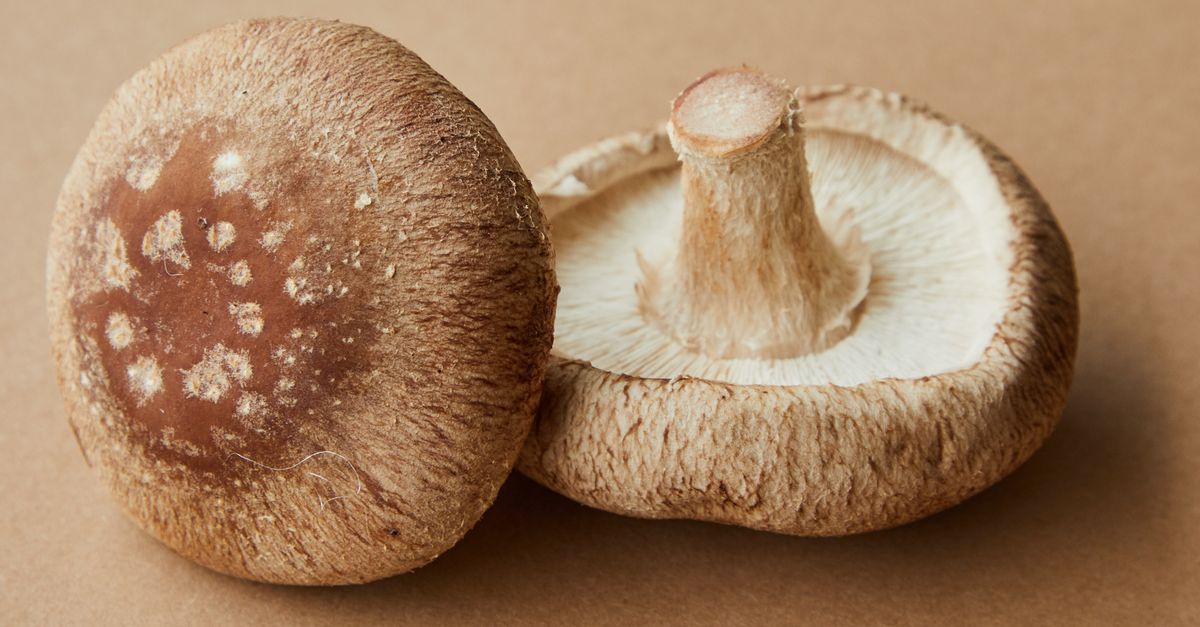
Shiitake (Lentinula edodes) can be grown in India, but it works best where days are cool (about 20°C for fruiting) or in a unit with air conditioning, and it needs sterilised sawdust or straw blocks, an autoclave or pressure steriliser and a cold-shock step. It is a slow, hygiene-sensitive mushroom, not a simple add-on to a button or oyster shed.
Indian research on shiitake is real but small. ICAR-Directorate of Mushroom Research (DMR), Solan, IIHR Bengaluru and TNAU have worked on strains and substrates, yet commercial production is still thin. A DMR paper names the main bottleneck: good hardwood sawdust of suitable tree species is hard to get. Check your sawdust source and a buyer before building anything.
Where it can be grown
- Cool hill belts: Himachal Pradesh (Solan, where DMR is located), Uttarakhand, Jammu and Kashmir and the Nilgiris and Kodaikanal hills in Tamil Nadu have been the areas reported for shiitake work. TNAU, with Japanese partners, set up sawdust-block shiitake work at Coimbatore, the Nilgiris and Mettupalayam.
- Plains: shiitake normally grows at temperatures below 20°C, so plains growers need a cooled fruiting room or a winter-only crop. Running a chiller for months can erase the margin.
- Outdoor logs: the traditional method uses hardwood logs with spawn plugs. A trade report describes willow logs about 40 inches long and 3 to 4 inches thick in open shade in Himachal, fruiting from about 3 months and lasting 4 to 5 years. This is slow and depends on wood supply; check tree-felling rules in your state before cutting any logs.
Strains and substrate
| Strain or substrate | Source | Result reported |
|---|---|---|
| DMRO-327 on wheat straw + bran | ICAR-DMR Solan, Indian Journal of Horticulture 2018 | Best of 9 straw-fruiting strains: 202 g fresh per kg wet substrate, biological efficiency 60%, first harvest about 91 days after spawning |
| DMRO-34 and DMRO-412 on wheat straw | Same trial | Medium: about 140 g per kg, biological efficiency about 42% |
| Other DMRO strains (35, 51, 297, 330) | Same trial | Poor: 38 to 50 g per kg, biological efficiency 11 to 15% |
| Sawdust + 14.5% wheat bran (strains LE-01 to LE-03) | Visva-Bharati University, Intl. Journal of Economic Plants 2025 | 392 to 410 g fresh per 750 g bag, biological efficiency 46 to 55%; rice bran gave 348 to 375 g; unsupplemented sawdust 270 to 292 g |
- Strain matters more than anything else: in the DMR straw trial the best strain gave about five times the yield of the worst. Buy spawn of a named strain from DMR Solan or a state agricultural university, not from an unnamed seller.
- Biological efficiency is fresh mushroom weight as a percentage of dry substrate weight. Trial figures come from laboratory-grade sterile conditions; expect lower on a farm.
How a block crop runs
- Substrate: sawdust or chopped straw (4 to 6 cm) with wheat or rice bran (about 14.5% in the sawdust trial; 80:19:1 straw, bran, gypsum in the DMR straw trial), moisture about 66%, filled in polypropylene bags.
- Sterilise: the trials autoclaved bags at 121°C and 15 psi for 2 hours. A DMR-linked trial reports that pasteurisation at about 80°C also works, with high-pressure sterilisation giving the best yields.
- Spawn: wheat-grain spawn at 4 to 5% of wet weight, under clean conditions. Incubate at 24°C to 25°C. Spawn grown on sorghum or wheat grain colonised fastest in the Visva-Bharati trial.
- Browning and cold shock: the white block turns brown as it matures. When bumps form or about three-quarters has browned, peel the bag and shock the block, either overnight in a refrigerator or in ice-cold water (4°C to 6°C) for about 10 minutes.
- Fruiting room: about 20°C, 85 to 90% humidity, fresh air through an exhaust fan and some light. Harvest before the cap flattens.
- Flushes: rest blocks about 10 days after harvest, then re-soak and fruit again. Two to three flushes are usual, with contamination rising each time.
- Timeline: DMR reports the first harvest at 88 days or less from spawning on straw, and more than 3 months on sawdust for moderate yield. A freshly built room will not earn in its first quarter.
💡 Tip: Do a pilot of 50 to 100 bags in one season. Sell all of it before expanding, and keep a written count of bags lost to contamination.
Cost and returns
- Yield per bag: 0.39 to 0.41 kg fresh in the best sawdust-plus-wheat-bran trial treatment. Use 0.25 to 0.35 kg per bag for planning, since farm conditions are worse than trials.
- Prices are poorly documented. Trade reports vary widely: a 2017 report quoted ₹200 to ₹500 per kg in local markets in Himachal, and later listings quote ₹1,000 to ₹1,500 per kg fresh and about ₹1,600 to ₹2,000 per kg dried. Shiitake has no regular mandi price series, so get a written offer from your hotel, restaurant or processor buyer.
- Illustration (100 bags, 0.3 kg each = 30 kg): at ₹300 per kg the gross is ₹9,000; at ₹800 per kg it is ₹24,000. Subtract sawdust, bran, bags, spawn, steriliser fuel, electricity or cooling and labour from your own quotes, since no verified Indian cost-per-bag figure was found.
- A fruiting room, autoclave, mixer and cooling are the big fixed costs. A small farmer without them will find it hard to compete with button and oyster mushroom on cost.
Pests, disease and quality
- Green mould (Trichoderma) is the main loss. It enters through poor sterilisation, damp bags and unclean inoculation. Discard bags that turn green rather than keeping them in the room.
- Keep fruiting rooms clean and screened. For any pesticide on a food mushroom, follow the label and ask your KVK first.
Market and risks
- Buyers are hotels, restaurants, gourmet retailers, and dried-mushroom traders. India also imports dried shiitake, with customs records showing shipments from China, so dried product competes with imports.
- Sellers of "shiitake blocks" or spawn kits who promise guaranteed buy-back should be checked with DMR or your state horticulture department first.
- Drying and packing raise the price per kg but need a dryer and clean storage. Dried product keeps, which helps if fresh sales are slow.
- See FPO for group selling and subsidy finder for horticulture schemes. Mushroom support rates differ by state, and no shiitake-specific rate has been verified.
Sources
- Sudheer Kumar et al., Enzyme profile of shiitake strains grown on wheat straw, Indian Journal of Horticulture 75(3), 2018 (ICAR-DMR Solan)
- Shanmugaraj et al., Optimizing spawn production and yield of shiitake, International Journal of Economic Plants 12(2), 2025
- FreshPlaza, new method for growing shiitake in India (trade report)
- FreshPlaza, growing shiitake mushrooms in India, TNAU and JICA (trade report, 2016)
- Tridge, dried shiitake India import records