
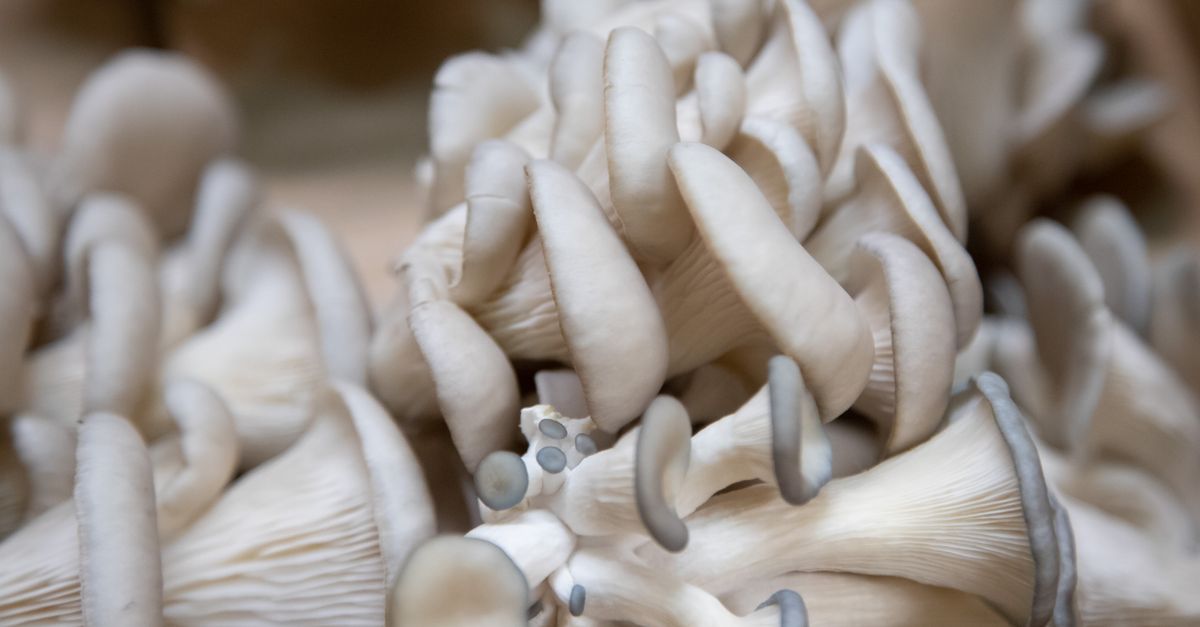
Oyster mushroom (dhingri, Pleurotus) can be grown almost anywhere in India that has a shaded, clean room and cheap straw, at 20 to 30°C and 70 to 90% humidity, but whether it pays depends on selling fresh mushroom within a day or two. It needs no compost and no casing soil: chopped paddy or wheat straw is pasteurised, mixed with spawn in polythene bags, and the first mushrooms come roughly 3 to 4 weeks after bagging.
It is popular in the North-East, Chhattisgarh and Bihar and is taught by ICAR-DMR Solan, ICAR NEH Region centres and KVKs. The yield figures below are research-station results, and the price figures come from a 2020 ICAR article, so test a small batch and check your local market before you build a bigger unit.
Where and when it grows
- Temperature and humidity: ICAR NEH Region (Nagaland) gives 20 to 30°C and 70 to 90% relative humidity. ICAR-DMR Solan ran spawn run and fruiting at 24 ± 2°C with humidity held at 80 ± 5% after the spawn run.
- Season: in the hills, March to October; in the plains, October to March (ICAR NEH, Nagaland). Different species tolerate different temperature, so plains growers can crop in more months by changing species.
- Species tested by ICAR-DMR: Pleurotus djamor (pink oyster) and P. ostreatus var. Florida (white). P. pulmonarius has been tested in the Konkan, and P. sajor-caju in Bihar.
- Room: a shaded room with no direct sun, ventilation for fresh air and a floor or walls that can be washed. A hut, spare room or shed can work if humidity can be held up with water spray.
Strains and traits
Results below are from an ICAR-DMR Solan trial (Mushroom Research, 2023) on wheat straw with wheat grain spawn, at 24 ± 2°C. Your own days and yields will vary.
| Strain (source) | Spawn run | First harvest | Biological efficiency | Fruit body |
|---|---|---|---|---|
| P. djamor DMRP-205 (ICAR-DMR) | 8 days | 20 days | 67.2% | About 8 g, pileus 6.4 cm |
| P. ostreatus var. Florida DMRP-136 (ICAR-DMR) | 12 days | 24 days | 72.8% | About 12 g, pileus 8.3 cm |
Biological efficiency is fresh mushroom weight as a percentage of dry substrate weight, so 67% means about 670 g of fresh mushroom from 1 kg of dry straw. Buy spawn only from an ICAR-DMR, state university or KVK-recommended lab; spawn quality is a key factor in yield, and the same trial found grain spawn gave more yield than cheaper wheat straw spawn.
Substrate and bag preparation
- Straw: paddy or wheat straw cut into 3 to 5 cm pieces. In ICAR trials paddy straw gave about 76% biological efficiency in the Konkan and wheat straw about 75%. Adding wheat bran raised paddy straw to about 85% and rice bran to about 83%. Other farm wastes (sugarcane, cotton waste, maize cob, banana pseudostem and groundnut shell) are also used, but test them on a few bags first.
- Pasteurising (ICAR NEH): soak the cut straw in cold water for 8 to 12 hours, boil in hot water for 15 to 20 minutes and cool it in shade. ICAR-DMR used steam pasteurisation and worked with straw at 60 to 65% moisture. Squeeze the straw: a few drops should come out, not a stream.
- Bags: transparent polythene bags of 60 x 45 cm or 50 x 35 cm with holes about every 10 cm.
- Filling: layers of about 5 cm straw with spawn sprinkled evenly over each layer, 4 to 5 layers per bag; the DMR trial used 3% spawn on a wet-weight basis and 12 to 14 holes in 5 kg bags.
- Hygiene: wash hands, work in a clean place and do not reuse unwashed bags. Throw away bags with green, black or foul-smelling patches far from the room.
Spawn run and fruiting
- Spawn run: keep bags in the dark for 12 to 20 days; full white colonisation takes 20 to 25 days (ICAR NEH).
- Fruiting: remove or slit the polythene and mist with clean water; first mushrooms come 5 to 7 days later. Keep humidity near 80% (inside the 70 to 90% range) with a light spray, give light and fresh air, and avoid wetting the mushrooms heavily.
- Flushes: subsequent flushes follow about 10 days apart, with 3 to 4 flushes per cycle.
- Harvest: twist and pick the clusters when the caps are still curled at the edge and before they flatten and drop spores. Remove stalk base debris. Pick before watering, since wet mushrooms spoil faster.
- After the crop: the spent straw can be composted or used as livestock bedding; do not leave it near the fruiting room because it attracts flies and mould.
Pests and diseases
- Green mould (Trichoderma), other moulds and flies are the usual problems and almost always come from poor pasteurisation, old spawn or an unclean room. Prevention is better than cure.
- Do not spray insecticide or fungicide on mushrooms you plan to eat. If infestation repeats, ask the KVK or ICAR-DMR Solan what is safe to use.
- Check pests for general crop protection guidance; mushrooms need separate advice.
Yield, cost and returns
Using the ICAR figure of about ₹35 production cost per kg and a market price of ₹100 to ₹120 per kg (Indian Horticulture, 2020), the margin is ₹65 to ₹85 per kg. Illustration for 100 kg of dry straw at 60 to 70% biological efficiency:
| Item | Low case | High case |
|---|---|---|
| Fresh mushroom from 100 kg dry straw | 60 kg | 70 kg |
| Cost at ₹35 per kg | ₹2,100 | ₹2,450 |
| Sale at ₹100 and ₹120 per kg | ₹6,000 | ₹8,400 |
| Margin per cycle | ₹3,900 | ₹5,950 |
These numbers assume everything is sold; losses from contaminated bags, unsold stock and your own labour reduce them. A cycle takes about 8 weeks from bagging to the last flush, so a single room cannot earn a full-time income unless you run many bags in staggered batches, and for that you need steady buyers first.
Market and selling
- Fresh oyster mushroom keeps only a day or two, so sell to hotels, restaurants, vegetable shops and weekly markets near the farm. Check the nearest rates on mandi bhav and with local sellers. Pack in perforated polythene or punnets and keep cool.
- Surplus can be sun-dried or oven-dried and sold as dried mushroom, or made into pickle and powder; this needs food licence and labelling, so ask your KVK.
- Many farmers started at once in the same area can crash local prices. Sign up buyers before scaling.
- Be careful with offers that sell spawn, bags or "kits" at high prices with a promised buy-back. Ask for the buyer's written order and buy spawn only from government or university labs.
- A farmer-producer group (FPO) can share a cold room (cold storage subsidy) and a delivery run.
Training and support
ICAR-DMR Solan, ICAR NEH Region centres and KVKs run short training programmes and supply cultures and spawn. Support for mushroom units changes by state and year, so ask the district horticulture office and use the subsidy finder. Loans for a unit can go through KCC where the bank accepts it.
Sources
- Comparative evaluation of different spawn substrates on oyster mushroom, ICAR-DMR Solan, Mushroom Research 32(1), 2023
- Oyster Mushroom Cultivation, ICAR Research Complex for NEH Region Nagaland Centre and KVK Dimapur, 2017
- Suitability of various substrates for Pleurotus pulmonarius in Konkan Region of Maharashtra, Mushroom Research
- Oyster mushroom cultivation for quality protein and income enhancement, Indian Horticulture 64(5), 2020 (ICAR)