
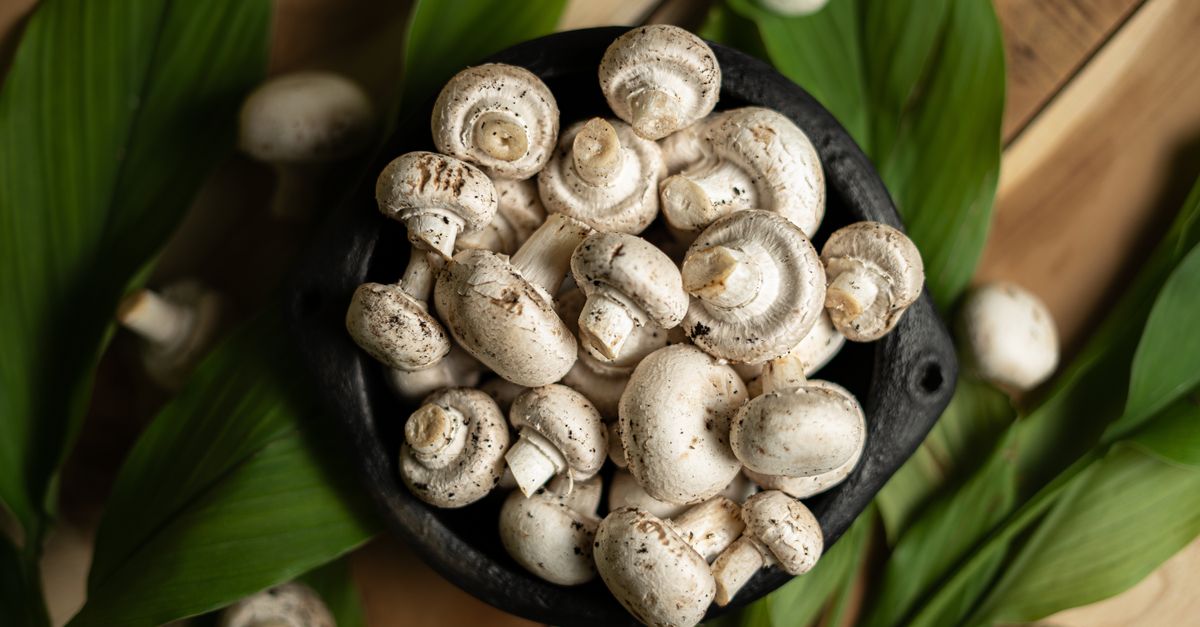
White button mushroom (Agaricus bisporus) works in India as an indoor, temperature-managed enterprise rather than a field crop: it needs about 24 to 25°C for the first two weeks and 15 to 18°C for fruiting, so it is a winter crop in the northern plains and hills, and a year-round crop only where cooling is installed. The practical entry route is to buy ready spawned compost bags or start a seasonal room after training at ICAR-DMR Solan or a state agricultural university or KVK, and to line up a buyer before the first crop.
Returns depend almost entirely on compost quality, hygiene and selling price. Published farm surveys show yields below the best trial numbers, and prices swing sharply between winter glut and summer shortage.
Where it is grown and what it needs
- Regions: button mushroom has long been the main mushroom of the temperate hills and northern plains (Himachal Pradesh, Punjab, Haryana, Uttar Pradesh), with cooled-room units in other states. A study of low-hill Himachal Pradesh growers found about 80% of them took only one crop a year, i.e. the seasonal winter crop.
- Temperature (TNAU package): spawn run at 25 ± 2°C with about 90% humidity, completed in about 15 days; after casing, 24°C and near 100% humidity for one week, then 15 to 18°C and 85 to 90% humidity for the cropping phase.
- Space: no farmland is needed. A shed, hut or room with good ventilation, clean floors and the ability to hold the temperatures above is enough for a seasonal crop; year-round production needs air-conditioning or chilled-air equipment, which is the main capital cost.
Strains and spawn
- ICAR-DMR Solan runs the All India Coordinated Mushroom Improvement Project, in which white button strains such as U-3 and NCS-100 are compared across centres. In one coordinated trial on long-method compost, U-3 gave 16.8 kg per 100 kg compost and NCS-100 gave 15.5 kg at Samastipur.
- Buy spawn only from a recognised spawn laboratory (ICAR-DMR, agricultural universities, or a licensed commercial lab), fresh and within its stated shelf life. Poor spawn is a common cause of crop failure.
- Ask the spawn supplier which strain suits your season. Strains differ in temperature tolerance and fruit size, and no single strain suits every room.
Compost: the step that decides the crop
- Formula (TNAU example): wheat straw 500 kg, chicken manure 200 kg, oil cake 25 kg, rice or wheat bran 50 kg, gypsum 50 kg and urea 4 kg. This is a starting recipe; the mix is composted outdoors in a wetted stack, turned on schedule, and then pasteurised and conditioned indoors before spawning.
- Gypsum and insecticides are added or avoided at specific stages, so follow the schedule given at your training course.
- Compost that is too wet, smells of ammonia or has not been pasteurised properly invites green mould and other competitors. Buying finished, spawned bags from a reliable producer removes this risk for small growers.
- Casing: a 3 to 4 cm layer of casing soil, pressed gently, after the spawn has run through the compost. TNAU lists spent compost, sand and lime (4:1:1) or spent compost, farmyard manure and clay loam (2:1:1) as casing mixes, with soil pH of 6 to 7.8.
Cropping and harvest
- Pinheads appear 12 to 15 days after casing and the first mushrooms are ready about 10 days later. Cropping continues for 6 to 8 weeks, with mushrooms arriving in weekly flushes.
- Pick buttons with the cap still closed, twist gently, trim the stem base, and keep them cool. Opened caps and discoloured mushrooms sell cheaper.
- Yield figures: TNAU gives 4 kg from a 20 kg polybag of compost (20 kg per 100 kg) and 6 to 8 kg per square metre of tray. The coordinated trial above reached 16 to 17 kg per 100 kg. A 2019 survey of Himachal Pradesh growers recorded an average of 3.62 kg per 20 kg spawned compost bag, about 18 kg per 100 kg. Plan on 15 to 18 kg per 100 kg compost, not the higher figures sometimes quoted.
- On that basis one tonne of compost, which fills about 50 bags of 20 kg, gives roughly 150 to 200 kg of mushrooms.
Pests and diseases
- Green mould (Trichoderma): reported as the most serious button mushroom disease in recent decades; it comes from poorly pasteurised compost or dirty rooms. Prevention is hygiene: clean and disinfect rooms, use clean tools and footwear, and remove infected bags promptly.
- Bubble diseases and cobweb: wet bubble (Mycogone), dry bubble (Lecanicillium) and cobweb (Cladobotryum) enter through the casing layer and from infected debris. Pasteurised casing, strict hygiene, and removing and burying infected mushrooms are the base measures.
- Flies and mites are managed with screens on vents and clean rooms. Fungicide and insecticide use on mushrooms is tightly limited, and resistance is a known problem, so use only products recommended by DMR or your KVK, at label doses, and not during picking.
Cost and returns
- Small seasonal unit: a Himachal Pradesh survey (2019) found an average investment of about ₹45,428 for units of 50 or fewer bags. Large units did better because of scale and better marketing links.
- TNAU model unit: investment ₹4,73,800, annual recurring cost ₹1,46,200, total annual production cost ₹3,60,800, income ₹6,12,500 at ₹70 per kg and a net profit of ₹2,51,700. That model assumes 8,750 kg of mushrooms from 25 tonnes of compost, which is about 35 kg per 100 kg if 25 tonnes is the yearly compost, about double the trial and survey yields.
- Re-run with realistic yield: 25 tonnes of compost at 15 to 18 kg per 100 kg gives 3,750 to 4,500 kg. At ₹70 per kg that is ₹2.6 to ₹3.2 lakh, below the model's own cost of ₹3.6 lakh. The unit only pays if the price is higher (₹100 per kg or more), compost costs are lower, or you sell direct. Check current prices in your nearest city before budgeting, and use your own quotations for compost and cooling.
- Prices rise in summer and fall in the winter glut when northern units all pick at once. A year-round cooled unit can sell when prices are better but carries power and equipment costs.
💡 Tip: Do a training course and run one small seasonal crop of 50 to 100 bags before investing in a cooled room. Get the spawn and compost supplier, and the buyer, confirmed in writing first.
Market and risks
- Fresh buttons sell to vegetable markets, hotels, caterers, supermarkets and canning or processing units. Shelf life is only a few days at room temperature, so you need a buyer within a day's transport or a cold chain; see cold storage subsidy.
- Main risks are contamination of a whole batch, a temperature failure or power cut, and a price crash at peak season. Keep a cash margin for these.
- Beware of sellers who offer "buy-back" of mushrooms with expensive kits or bags. Compare their price with DMR and state university rates.
- For loans use KCC or a bank mushroom project; ask your state horticulture department for the current MIDH subsidy rate, since this guide has not verified one. For group selling see FPO, and for related enterprises see oyster mushroom.
Sources
- TNAU Agritech Portal, button mushroom spawning, casing and cropping
- TNAU Agritech Portal, plan for establishing button mushroom cultivation (cost model)
- Indian Journal of Agricultural Research, economic viability of button mushroom cultivation in Himachal Pradesh
- ICAR-DMR Solan, AICMIP annual report 2011-12 (strain trials)
- Control of Fungal Diseases in Mushroom Crops while Dealing with Fungicide Resistance: A Review (Microorganisms, 2021)