
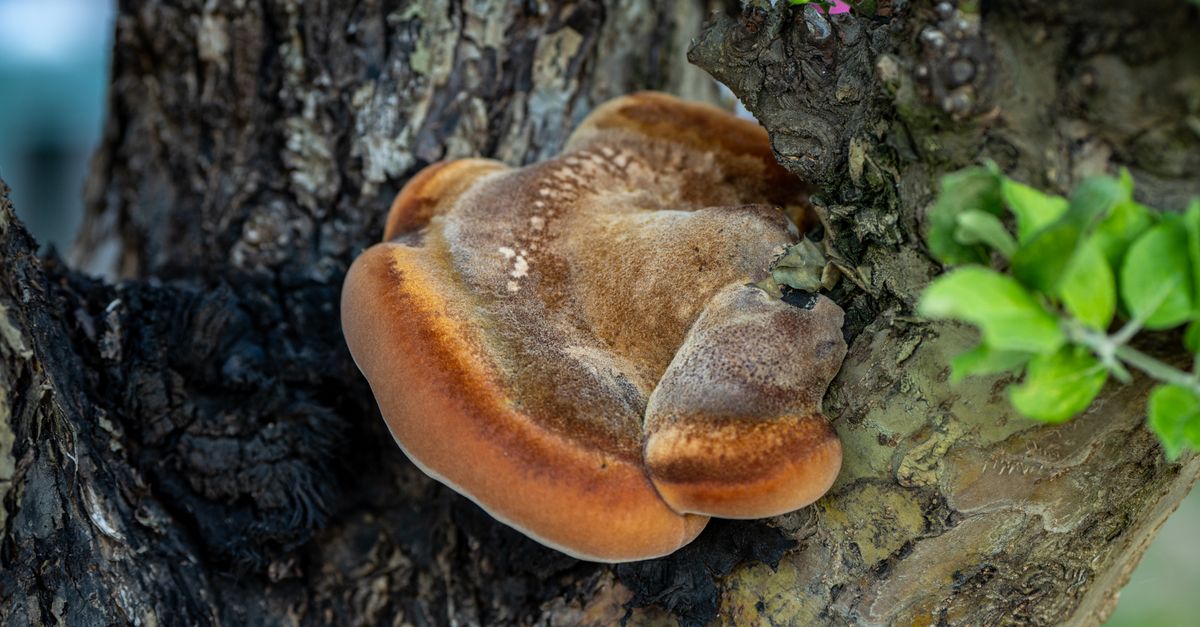
Reishi (Ganoderma lucidum) can be grown in India on hardwood sawdust bags in a low-cost shed or polyhouse, using a method developed at ICAR's mushroom research centre at Solan, but it is a medicine, not a food: the only market is herbal and nutraceutical companies, and growers must find that buyer before they start. The mushroom is bitter and corky hard, so it cannot be sold fresh in a vegetable market.
The research centre's own figure is about 250 g fresh mushroom from 1 kg dry substrate, which dries to roughly 112 g. Prices of ₹4,000 to ₹5,000 per kg for dried product are quoted in press, but no confirmed buyer contract terms were found, so treat prices as unproven until you hold a written offer.
Where it can be grown
- Reishi is grown in closed or semi-closed rooms where temperature, humidity, light and carbon dioxide can be managed, so location matters less than the structure. ICAR-DMR describes seasonal low-cost growing rooms, preferably polyhouses or thatched huts covered with polythene, for farmers, and environment-controlled rooms for industry.
- It tolerates warmer conditions than most food mushrooms: the incubation range given is 28 to 35°C, and fruiting is at about 28°C.
- Sawdust of broad-leaved trees is the base: mango, poplar, coconut and sheesham are named by ICAR-DMR. ICAR-DMR says the sawdust is obtained from sawmills.
- Because it is used as medicine, it has to be grown organically with strict hygiene. ICAR-DMR advises no toxic chemicals for pests or diseases.
Strains and spawn
- ICAR-DMR holds DNA-fingerprinted exotic cultures in its gene bank and describes Korean, Thai and American cultures as excellent. Ask DMR Solan for the current list and the way to obtain cultures or spawn.
- A SKUAST-Jammu trial (Indian Forester, 2014) found shisham sawdust and woodchips in equal parts gave the best of three tree species, with 16.93% biological efficiency overall and up to 19% with strain G-1. Yield therefore depends on the strain and the wood, and 25% is a best case.
- Spawn is wheat grain or sawdust spawn, at 3% of the dry substrate weight, since reishi grows slowly.
Production method (ICAR-DMR)
| Step | Setting |
|---|---|
| Substrate | Hardwood sawdust plus 20% wheat bran, wetted to 65% moisture; gypsum and chalk added to reach pH 5.5 |
| Bag | Polypropylene bag with 700 g dry (2.1 kg wet) substrate, plugged with cotton |
| Sterilising | Autoclave at 22 psi for 2 hours |
| Spawning | Wheat grain or sawdust spawn at 3% of dry weight |
| Spawn run | 28 to 35°C, closed room, dark; about 25 days until the bag is white throughout |
| Pinning | Cut the polythene top; 28°C, 95% humidity, 1,500 ppm CO2, light above 800 lux |
| Cap growth | Once the white top flattens: humidity 80%, more fresh air (1,000 ppm CO2) |
| Maturation | Once the cap margin yellows: 25°C, humidity 60%, until the cap is reddish brown and sheds spores |
| Harvest and flushes | Pull out whole with the base; one cycle is 10 to 15 days; 2 to 3 flushes; about four months per crop |
- Autoclaves, cooling and a clean inoculation area are required; a village-level farmer should plan to buy sterilised bags or spawn from a trained unit rather than build all this at the start.
- Reishi can also be grown on wood logs, which take about 15 days to colonise and 3 to 4 months to mature with about three harvests (as reported in a 2022 article). Yields are not given.
Yield and drying
- Biological efficiency: up to about 25%, which is 250 g fresh per kg of dry substrate. One 700 g bag therefore gives about 175 g fresh over 2 to 3 flushes.
- Dry weight: reishi has about 45% dry matter (450 g dry from 1 kg fresh). One bag gives about 79 g dried, and 1,000 bags about 79 kg.
- Drying: wash, then dry below 50°C in cabinet driers (ICAR-DMR prefers 35°C in a dehumidifying drier). Freeze drying is the best.
- These are the research centre's best-case numbers, not a farm average. Contamination and poor control of humidity or temperature will lower the yield.
Cost and returns
No verified cost-of-production figure for Indian reishi growers was found. The table shows only the sales side for 1,000 bags (700 g dry substrate each) at the ICAR-DMR yield of 250 g fresh per kg, and the 45% dry matter.
| Item | Figure |
|---|---|
| Substrate | 1,000 bags x 0.7 kg = 700 kg dry |
| Fresh mushroom | 700 kg x 25% = 175 kg |
| Dried mushroom | 175 kg x 45% = about 79 kg |
| Gross at ₹4,000 per kg | about ₹3.2 lakh per crop of four months |
| Gross at ₹2,000 per kg | about ₹1.6 lakh per crop |
- Costs to be added by the grower: sawdust, wheat bran, bags, spawn, autoclave or steam, power, a growing room, a drier, packing, labour and transport. Ask the KVK or ICAR-DMR for a current estimate before you plan the unit.
- The ₹4,000 to ₹5,000 figure is a press quote for dried fruiting body or powder. The ₹2,000 line is only a lower case for illustration. Neither is a confirmed contract.
Market and risks
- ICAR-DMR states that anyone growing reishi has to find the market, which is herbal medicine and food supplement makers who process it into capsules, tablets, liquid extracts or other forms. It is not eaten as a vegetable.
- ICAR-DMR reports that India's reishi trade has crossed ₹100 crore a year, mostly imports from Malaysia and China. A 2022 article notes India lacks established chemical analysis, quality assessment and marketing for farmer-grown reishi.
- The first practical risk is no buyer. The second is quality: buyers may test for contamination and moisture, so grow and dry with clean methods.
- Health claims about reishi are a matter for the buyer's regulated products. Do not make medical claims when selling it, and ask the buyer about licences they need.
- For group buying of inputs and selling, see FPO; for support schemes see subsidy finder. No verified subsidy rate for reishi was found.
Sources
- ICAR-National Research Centre for Mushroom (now DMR), Solan: Cultivation of Reishi Mushroom (Ganoderma lucidum) folder
- ICAR-DMR Solan, Reishi mushroom profile
- Down To Earth, Magical mushroom: scaling up Ganoderma lucidum cultivation (April 2022)
- Indian Forester, sawdust and woodchip substrates for Ganoderma lucidum sporophore production