
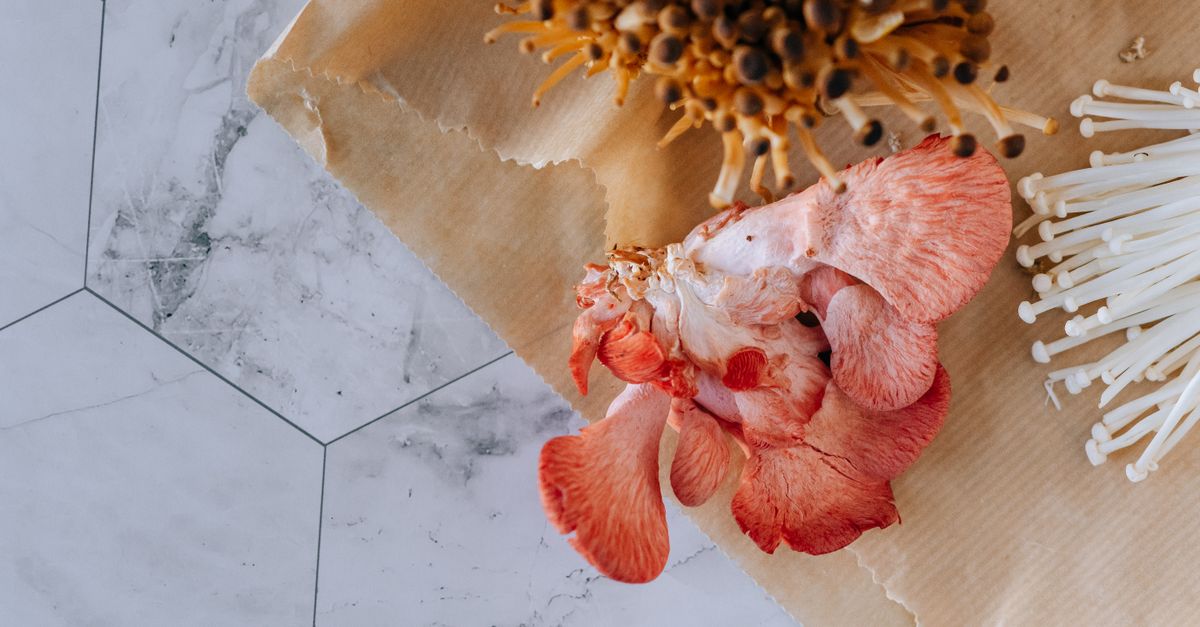
Enoki (Flammulina velutipes) can be grown in India only inside a cold, dark, humidity-controlled room, because it fruits at 10 to 16 °C, a range most Indian plains never reach without refrigeration. It suits a grower who can pay for a chiller room and sterile bottle or bag culture, and who already has a buyer such as a hotel, restaurant or premium retailer.
Unlike oyster or button mushroom, no Indian state agricultural university package or NHB model project report for enoki was found, and no verified Indian cost or yield table exists. The figures below come from ICAR-DMR Solan studies and published research from other countries; treat them as a starting point and test on a small scale first.
What the crop needs
- Temperature: the spawn run (mycelium filling the substrate) takes place at 18 to 25 °C. Pinhead formation is triggered at about 7 to 10 °C, and fruiting is best at 10 to 16 °C. One bottle study found 16 °C optimal.
- Humidity: 95 to 100% during pinning and 85 to 95% during fruiting. The substrate itself should hold about 65% moisture (Korean bottle study).
- Light and air: commercial enoki is grown in the dark, with raised carbon dioxide, which gives the pale, long, thin stem and small cap. Light turns the stems shorter and coloured. Ideal harvest length is about 5 to 10 cm with tightly closed caps.
- Climate fit: in the Himalayan states (Himachal, Uttarakhand, Jammu and Kashmir) the winter months are naturally cool, and ICAR-DMR Solan has collected and studied seven enoki strains from the North East and North West Himalayas. Anywhere else, a refrigeration unit with insulated walls is needed for the fruiting phase.
Substrate and containers
- Enoki grows on hardwood sawdust with a bran supplement. In an ICAR-DMR study at Solan, 10% wheat bran added to sawdust gave the fastest spawn run and the highest biological efficiency, 37.5%. The same study found polypropylene bags the best of the containers tested.
- Biological efficiency is fresh mushroom weight as a percentage of dry substrate weight. A Malaysian study on rubber-wood sawdust, paddy straw and oil-palm waste reported far higher figures (up to 185%) under its own conditions, so results depend heavily on strain, substrate and room control, and cannot be assumed for Indian conditions.
- A Korean bottle study reported 275 to 282 g of fruiting body per 1,100 ml bottle with 10% herb-medicine residue in the medium. This shows the scale of yield per bottle in a well-run facility, not an Indian guarantee.
- Substrate must be sterilised in an autoclave or steam chamber and inoculated in a clean room. Contamination in a bottle ruins the whole batch.
Strains and spawn
- Strains collected from the Indian Himalayas are held at ICAR-DMR Solan, with accession codes such as DMRX-166, DMRX-768 and DMRX-769. Ask the Directorate whether pure culture or spawn can be supplied and on what terms.
- White commercial strains and brown wild strains differ in colour and market. Confirm with your buyer which one is wanted.
💡 Tip: Before building a cold room, run one or two trial batches in a rented or borrowed chiller, and ask a hotel or retailer to taste and price them. Fruiting temperature control is the step where most new growers fail.
Harvest and shelf life
- Harvest the whole cluster when stems reach 5 to 10 cm, cut it at the base, and pack at once. Enoki is delicate and deteriorates quickly outside the cold chain.
- Keep the pack cold until it reaches the buyer, and agree delivery times with the buyer in advance, since delay costs quality.
Cost, returns and market
- Costs: no verified Indian cost-of-production or yield data for enoki was found. The main items are the insulated cold room and chiller, an autoclave, bottles or bags, sawdust, bran, spawn, electricity (the largest running cost for a cold room) and labour. Get written quotes before costing a project, and ask ICAR-DMR Solan or your KVK for the current enterprise costing.
- Price: enoki sells at a premium to oyster and button mushroom, but no reliable published Indian wholesale price series exists. Ask two or three buyers for a written rate per 100 g or per kg pack before you plan.
- Arithmetic to do yourself: (bottles or bags per cycle) x (fresh weight per container in your trial) x (rate you were quoted) minus (cycle cost including electricity). Use your trial weight, not a published figure.
- A 2025 ICAR-DMR survey of 50 mushroom growers in Bihar and Haryana ranked capital-intensive investment, low market prices, high raw-material cost and inadequate market information as the main constraints of mushroom farming. These apply even more to a cold-room crop.
- Buyers are premium restaurants, East Asian cuisine outlets, supermarkets and online grocers. Be careful of "buy-back" spawn or kit sellers who promise fixed returns: put every price and quantity in writing.
- For group sales see FPO, for loans KCC, and for support towards cold chain see cold storage subsidy and subsidy finder. No enoki-specific subsidy rate was verified; ask your district horticulture office about MIDH mushroom support.
Sources
- Wikipedia, Enokitake (cultivation temperatures, humidity, light)
- Mushroom Research 15(2), Effect of supplementation and cultivation containers on the productivity of Flammulina velutipes (ICAR-DMR Solan)
- Mushroom Research, Flammulina velutipes strains collected from the Indian Himalayas (ICAR-DMR Solan)
- Seo et al. 2017, Production of Flammulina velutipes using herb-medicine refuse (bottle culture)
- Harith et al., Cultivation of Flammulina velutipes on agro-residues (University of Malaya)
- Mushroom Research 34(2), Key constraints faced by mushroom growers in Northern India (ICAR-DMR Solan)