
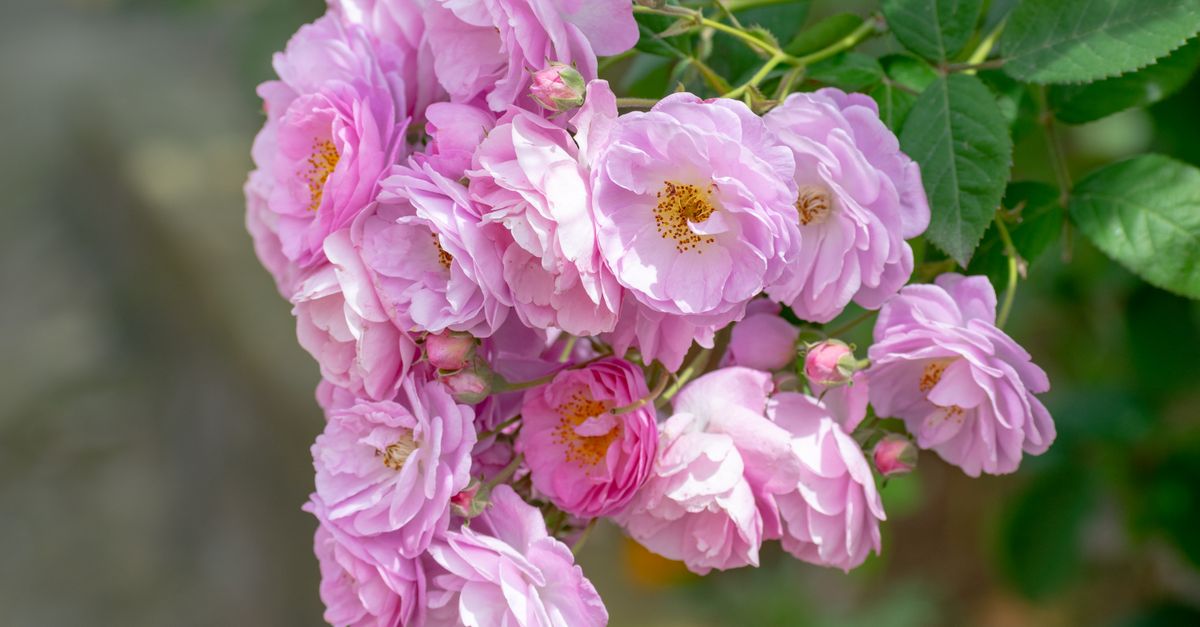
Damask rose (Rosa damascena) can be grown for rose water and rose oil in the north Indian hills and plains, including Himachal Pradesh, Jammu and Kashmir, Punjab, Haryana, Rajasthan and Uttar Pradesh, but only with a distillation route and a buyer arranged first. The flowers last a month or so, must be picked in the early morning and distilled the same day, and give only about 0.03 to 0.045% oil.
Because oil recovery is so low, the crop pays only when flowers are processed into rose water, oil or gulkand close to the field. The published Indian economics is limited and old; the figures below come from CSIR-IHBT Palampur trials and a 2011 Punjab study.
Where it grows in India
- States: a CSIR-IHBT paper lists Himachal Pradesh, Jammu and Kashmir, Rajasthan, Haryana, Uttar Pradesh and Punjab as present cultivation areas, with commercial cultivation dating back to Mughal times, and reports a national output of about 200 kg of oil a year. Kannauj in Uttar Pradesh is the traditional distillation centre.
- Research site: Palampur, Himachal Pradesh, at about 1,320 to 1,393 m, a mild-temperate to sub-temperate and humid climate with about 2,500 mm of rain a year.
- Flowering: at Palampur flowering begins in April and the pick lasts about 30 to 38 days. After that there is no flower crop until next spring.
- Soil and water: well-drained soil; the Palampur trials were rainfed. Avoid waterlogged sites.
Varieties
| Variety | Source | Suited to |
|---|---|---|
| Jwala | CSIR-IHBT, Palampur | Subtropical northern plains, low hills and mid-hills up to about 1,200 m |
| Himroz | CSIR-IHBT, Palampur | Mild to cold temperate areas, about 1,200 to 2,500 m |
| Noorjahan, Ranisahiba | CSIR-CIMAP, Lucknow | Plains; ask CIMAP for current performance and planting material |
- IHBT has also selected clones from Jwala and Himroz; in a Palampur study, fresh flower yield across the clones ranged from 630 to 966 g per plant and oil content from 0.030 to 0.045% of fresh flower weight.
- Get cuttings from the institute or a recognised nursery, not from unknown sellers claiming a high-yield variety.
Spacing and planting
- The Palampur trials used 1.5 m between rows and 0.75 m between plants, which is about 8,900 plants per hectare or about 3,600 per acre.
- Rose is a perennial bush; the plantation in the pruning study was ten years old, so yield is spread over many years once established.
Nutrition and pruning
- Fertilizer: the IHBT clone trial used 120 kg N, 60 kg P and 40 kg K per hectare a year (about 48, 24 and 16 kg per acre). Adjust to your soil test; see fertilizers.
- Pruning time matters a great deal: in an IHBT study, pruning at 5 to 8 cm above ground in the first week of October gave the highest flower yield (62.4 and 53.3 quintals per hectare in two years), while pruning in June gave only 25.9 and 18.3 quintals per hectare. Winter (December) pruning is the traditional practice.
Pests and diseases
The sources used here do not give a verified pest and disease schedule for Indian damask rose. Ask the nearest KVK or CSIR-IHBT for the current advice for your area and follow the product label.
Harvest and yield
- Time of pick: flowers were picked by hand between 6:00 and 9:00 am (one trial 6:00 to 7:30 am) to hold the volatile oils. Flowers must go to the still the same day.
- Flower yield: 0.63 to 0.97 kg of fresh flowers per plant in the Palampur clone study, and 53 to 62 quintals per hectare in the best pruning treatment. In Punjab, a farmer-data study found an average of 942 kg per acre, which is about 9.4 quintals per acre or 23 quintals per hectare.
- Oil: at 0.03 to 0.045% recovery, about 2,200 to 3,300 kg of fresh flowers are needed for 1 kg of oil. The Punjab study counted 942 kg of flowers as about 264 g of oil. For rose water, CSIR-CIMAP offers an improved Deg-Bhapka still and small portable Asvika units suited to small processors.
Cost and returns
- A 2011 study of Punjab growers (Singh and Singh, Journal of Non-Timber Forest Products) put the cultivation cost at ₹36,647 per acre a year for 942 kg of flowers, an oil cost of ₹38,617 per 264 g, and net returns of ₹20,783 per acre a year, with a benefit-cost ratio of 1.54 and IRR of 12.70%.
- These are 2011 rupees. Labour and fuel costs have risen since, so rebuild the sheet yourself: flowers per acre x share converted to products x price, less picking labour (the pick is concentrated in about 5 weeks), distillation fuel, and a still.
- Returns depend on the price of rose water or oil and on selling in a short window. Check what local buyers pay before planting.
Market and selling
- Buyers include perfumery and attar distillers (Kannauj), rose-water and gulkand makers, and cosmetics and food firms. Rose oil is sold by the gram, and quality depends on picking time, distillation and storage.
- Risks: the short picking season, unpredictable spring rain or hail, labour shortages in the pick window. Agree on price and quality terms in writing before planting.
- Selling as a group through an FPO and sharing a still can reduce cost. CSIR-IHBT and CSIR-CIMAP supply planting material and technology; ask the state horticulture or medicinal and aromatic plant board about support available in your state.
Sources
- Phenotyping floral traits and essential oil profiling in clonal selections of damask rose (CSIR-IHBT), Scientific Reports 2023
- Pruning time and damask rose yield at Palampur (CSIR-IHBT), Frontiers in Plant Science 2022
- Singh and Singh, Economics of damask rose plantation in Punjab state of India, Journal of Non-Timber Forest Products 2011 (CSIR-IHBT repository)