
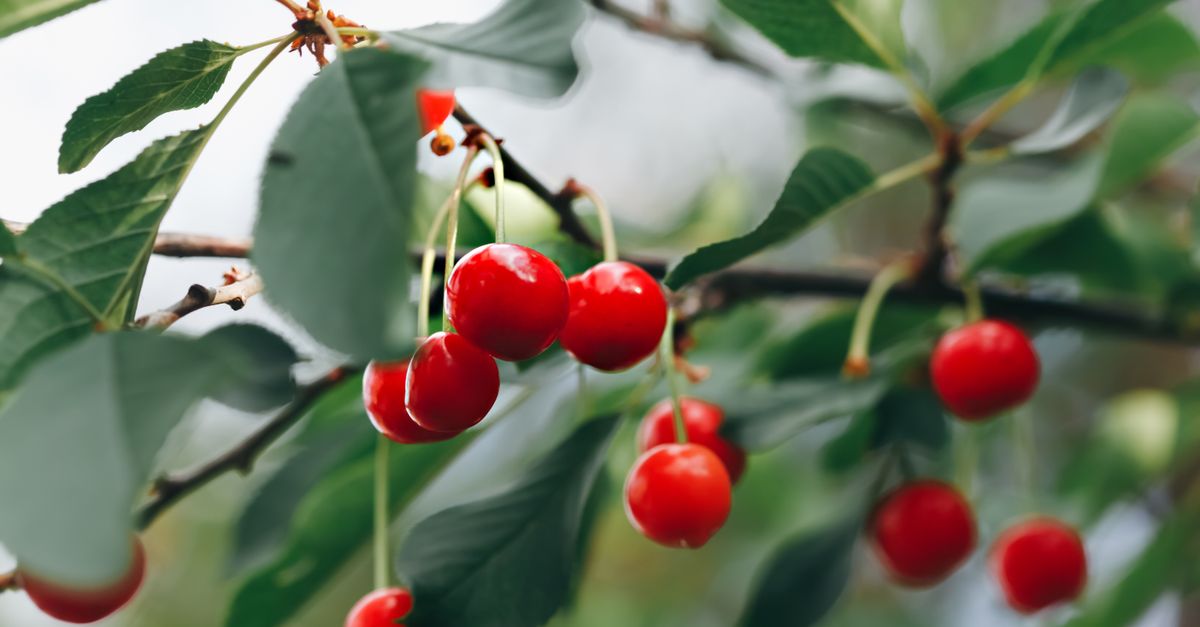
Sweet cherry (Prunus avium) is a high-hill fruit: in India it is grown commercially almost only in Kashmir, with smaller areas in Himachal Pradesh and a little in Uttarakhand, at roughly 1,600 to 2,700 m where winters are cold enough to break dormancy. It needs a grafted plant, 4 to 5 years before the first crop, and protection from rain at ripening, so it is a long-term orchard decision, not a quick cash crop.
Kashmir produces more than 90 percent of India's cherries from about 2,800 hectares, with typical output of 12,000 to 13,000 tonnes. The same orchards show how risky the crop is: a 2023 wet spell cut Kashmir's crop sharply, and in 2026 erratic weather cut production by 35 to 40 percent while prices rose.
Where it grows in India
- Jammu and Kashmir: 2,835 ha and 8,282 tonnes in 2016-17 (ICAR-CITH paper). Main areas are Srinagar, Ganderbal and Shopian, with sizeable area in Baramulla, Budgam and Anantnag. Ganderbal alone was reported at 1,165 ha and about 9,095 tonnes in 2024-25, and Shopian at 613 ha and 4,927 tonnes.
- Himachal Pradesh: a smaller area, mostly in Shimla, Kullu, Mandi, Chamba and Lahaul and Spiti, at higher elevations.
- Climate: cherries are grown at about 1,600 to 2,700 m, needing winter chilling. Where chilling is short, low-chill varieties are needed; ask your state horticulture university which are tested at your elevation.
- Yield gap: the CITH paper puts India's average at 2.92 t per hectare (about 1.2 t per acre), far below the world average, largely due to old seedling-rootstock orchards.
- Season: fruit is harvested in May to June, when little other fresh fruit is in the market, which is why it sells at a premium.
Varieties
| Variety (local name) | Source | What the data show |
|---|---|---|
| Bigarreau Napoleon (Double) | ICAR-CITH Srinagar trial, 3 x 3 m planting | Highest yield, 10.83 t/ha (about 4.4 t/acre); largest fruit, about 10 g; vulnerable to rain splitting as a traditional variety |
| Bigarreau Noir Grossa (Mishri) | Same trial | 7.18 t/ha; highest sugar (17.3 degrees Brix) |
| Steela (Stella) | Same trial | 7.05 t/ha; strongest annual shoot growth. UC Davis lists Stella as self-compatible |
| Van | Same trial | 5.39 t/ha |
| Lambert | Same trial | Lowest yield, 4.42 t/ha |
| Lapins | UC Davis Foundation Plant Services | Self-compatible, 500 chill hours; also grown in Kashmir selection work |
- Makhmali and Awal Number are local traditional types; the Kashmir press lists Siya and Makhmali as early types and Double and Mishri as the main traditional types.
- Newer, mostly Italian, varieties ripen over a longer window, about two months, and stand up better to moderate rain, while traditional types ripen together in mid-June to early July and split readily.
- Most older Indian orchards are on sour cherry seedling rootstock, so trees vary. The CITH paper says new plantations are moving to clonal rootstocks and high-density planting. Ask your nursery for the exact variety and rootstock in writing.
Planting material and spacing
- Plant well-feathered grafted plants in early spring. The CITH trial used 3 x 3 m (1,111 trees per hectare, about 450 per acre) with modified central leader training and dormant pruning in February to March.
- A farming guide (secondary source) gives 6 x 6 m for seedling-rootstock trees, which is about 278 trees per hectare (about 112 per acre).
- Pits of 1 m x 1 m x 1 m filled with 45 kg of farmyard manure and 0.5 kg of single superphosphate about 4 weeks before planting; head back plants to 70 to 80 cm at planting (same guide).
- Pollination: Lapins and Stella are self-compatible, but many sweet cherries need a second variety flowering at the same time. Confirm the pollinizer with your nursery before planting a single-variety block.
Nutrition and irrigation
- Farming-guide doses per tree: year 1, 10 kg farmyard manure, 200 g calcium ammonium nitrate, 160 g single superphosphate and 100 g muriate of potash; year 10 and after, 60 kg manure, 2 kg calcium ammonium nitrate, 1.6 kg superphosphate and 1 kg muriate of potash. This is a secondary source, so confirm with a soil test and your state horticulture department.
- No Indian irrigation schedule for cherry was verified; ask your state horticulture department or KVK for one for your valley. See drip irrigation where water is limited.
Harvest and yield
- Bearing begins 4 to 5 years after planting in high-density orchards on clonal rootstock, with full bearing of about 10 kg per tree after 7 to 8 years in European trials cited by the CITH paper.
- CITH Srinagar trial yields at 6 to 9 years: 4.4 to 10.8 t per hectare depending on variety, about 1.8 to 4.4 t per acre.
- Pick by colour and taste, not size alone. Only about 10 percent of Indian cherries are processed; the rest go fresh.
💡 Tip: Rain at ripening is the main risk. In 2023 growers reported losing up to 80 percent of Mishri to wet weather. Look at rain covers, early varieties and a spread of ripening dates before committing to one variety.
Cost and returns
- Prices (Kashmir, trade and press reports): in July 2023, traditional varieties sold at ₹30 to ₹50 per kg and new varieties at ₹100 to ₹130 per kg. In the 2026 season, premium varieties were reported at US$2.62 to US$4.19 per kg and Double and Mishri at US$1.78 to US$2.10 per kg.
- Gross illustration per acre (not net): 1.8 t at ₹40 per kg (traditional) is about ₹72,000; 4.4 t at ₹100 to ₹130 per kg (new varieties) is about ₹4.4 to ₹5.7 lakh. Packing, labour, commission and transport come out of this.
- No verified orchard establishment cost for cherry in India was found, so get quotes for plants, trellis or support, fencing, irrigation and covers from your horticulture department.
- The orchard earns nothing for the first 4 to 5 years. Plan for this gap in a loan; see KCC and subsidy finder. Check MIDH and state rates for temperate fruits before relying on them.
Market and risks
- Kashmir's cherry trade runs through Shopian and other valley markets. In 2026 early types such as Siya and Makhmali were reported about US$1 per kg above the previous season, and premium late-ripening types fetched the most.
- Crop loss from rain, hail and cold at flowering can wipe out a season: a 2023 report gave Kashmir's annual turnover at ₹130 to ₹150 crore and losses of about 75 percent that year. Check whether cherry is notified under PMFBY in your district.
- Outside the high hills the crop does not suit, so do not buy plants for warm plains on the strength of price reports.
Sources
- Srivastava, Kumar and Barman, Sweet cherry cultivars under high density planting, Journal of Horticultural Sciences 14(1), 2019 (ICAR-CITH Srinagar)
- Indian Journal of Horticulture 71(2), 2014, sweet cherry diversity in Kashmir (ICAR-CITH)
- UC Davis Foundation Plant Services, Lapins cherry
- FreshPlaza, lower Kashmir cherry production offset by higher prices (2026 season)
- Kashmir Despatch, new varieties fetch good rates, traditional ones sold at peanuts (July 2023)
- Down To Earth, wettest May-June in a decade hits Kashmir's cherry growers (2023)
- Agrifarming, cherry fruit cultivation (secondary source)