
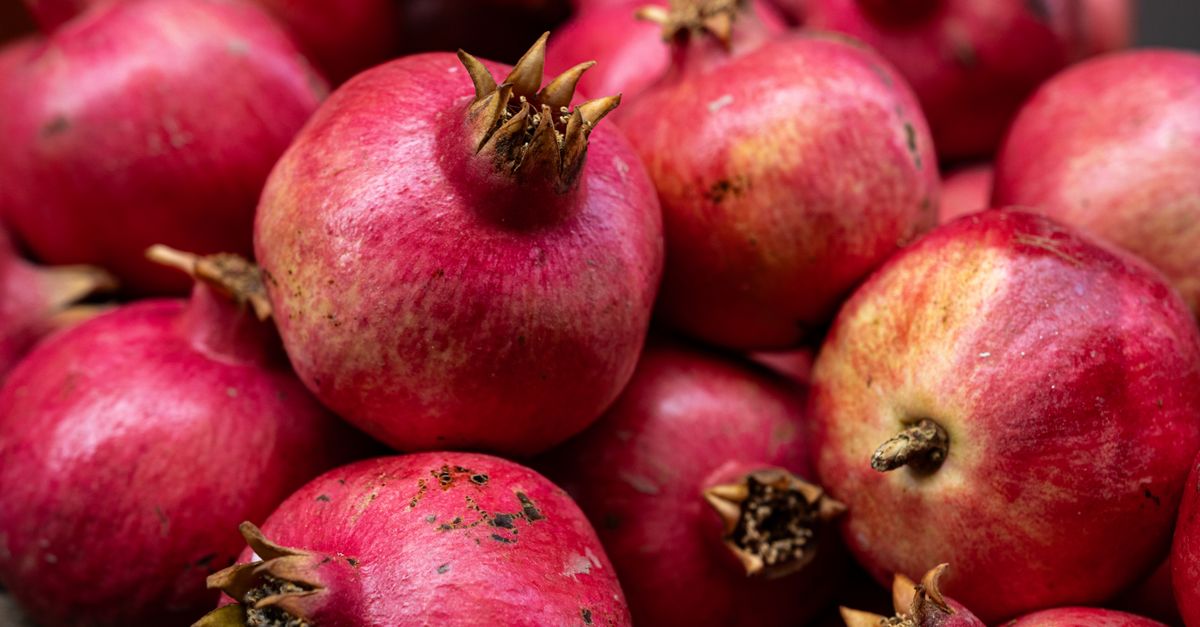
Bhagwa is India's main commercial pomegranate, grown mostly in the dry, light-soil districts of Maharashtra (Solapur, Satara, Sangli) and works best with drip irrigation and a dry flowering season. It can pay well, but the real risks are bacterial blight, rain at flowering and a price that fell to Rs 130 to 160 per kg for export-grade fruit in July 2026.
Below, orchard results from ICAR and state university work are kept separate from news and aggregator figures, with dates.
Where it grows in India
- Maharashtra is India's leading pomegranate state. Solapur district accounts for almost half of India's pomegranate exports, per an APEDA-linked report.
- Pomegranate is a hardy crop of semi-arid and arid regions; MPKV Rahuri authors note it thrives on light soils with limited irrigation. TNAU adds that cool winters and dry summers give high-quality fruit, and the tree tolerates drought, salinity and alkalinity, and grows up to 1,800 m.
- Excess rain disrupts flowering and fruit set and raises fruit rot, bacterial blight and cracking. In the 2025-26 cycle, rain in Maharashtra cut production by about 20 percent compared with the previous year (FreshPlaza, July 2026).
Varieties
| Variety | Notes |
|---|---|
| Bhagwa (Kesar) | Market-preferred (TNAU, IIHR selection); the export variety; susceptible to bacterial blight |
| Ganesh, Mridula, Arakta | Also reported susceptible to bacterial blight |
| Ruby, Jyothi, Co 1, YCD 1, Rudhra | Other types listed by TNAU |
| Sharad King | Newer; reported more uniform size and firmer skin, 2 to 3 days longer shelf life than Bhagwa (FreshPlaza); no yield data seen |
Planting and spacing
- Maharashtra research orchards use 4.5 m x 3 m (ICAR-NRC Pomegranate trials), which is about 300 plants per acre (741 per hectare), worked out here. TNAU gives a closer 2.5 to 3 m spacing for Tamil Nadu conditions, in 60 cm cube pits with 12 to 18 month old rooted cuttings or air layers, planted June to December.
- Buy disease-free, certified air-layered plants from an ICAR or state-accredited nursery. Infected planting material is how blight spreads.
Nutrition and irrigation
TNAU's schedule per plant per year (under Tamil Nadu spacing):
| Age | FYM | N | P | K |
|---|---|---|---|---|
| Year 1 | 10 kg | 200 g | 100 g | 400 g |
| Years 2 to 5 | 20 kg | 400 g | 250 g | 800 g |
| Year 6 onward | 30 kg | 600 g | 500 g | 1,200 g |
At 300 plants per acre, 600 g N per plant is 180 kg N per acre, so a Maharashtra orchard should be tested before copying this table. A survey of 150 Bhagwa orchards (4 to 6 years, drip, hasta bahar) in Solapur, Satara and Sangli (Gosavi et al., Indian Journal of Horticulture 2017, with ICAR-NRC Pomegranate) found calcium the nutrient most needed at flowering, fruit development and first harvest. Use soil and leaf tests; see fertilizers.
- Irrigation: TNAU suggests a 4-day interval. In a trial on heavy soil in a semi-arid region, a 2-day interval gave the best yield and 4 to 5 day intervals raised fruit cracking to 11.6 and 15.5 percent (Marathe et al., IJAS 2016). Uneven watering causes cracking. Install drip irrigation.
- Bahar (flowering season): in the NRC Solapur trial, mrig bahar was controlled by withholding water in January to February and then pruning, defoliating and manuring in the last week of May. Mrig bahar is the season when blight is worst (below), so many growers choose another bahar. Ask NRC Pomegranate or your KVK which bahar suits your rainfall.
Pests and diseases
- Bacterial blight (Xanthomonas axonopodis pv. punicae) attacks leaves, stems and fruit and has caused growers to remove orchards in south India. Losses of 60 to 80 percent are reported when mrig bahar coincides with the peak of the disease.
- A farmer-field demonstration that combined Ambia bahar, antibiotic plus copper sprays and bioagents cut disease severity from up to 69 percent to 10.15 percent over three years, with 5.27 t per hectare against 2.07 t per hectare in the comparison orchard (Indian journal summary found by search). Use pesticide names and doses only as the KVK or NRC Pomegranate prescribes; follow the label.
- TNAU's fruit-borer advice: bag fruits, spray neem oil (3 percent) and release Trichogramma chilonis at 1 lakh per acre. See also pests.
- Remove infected prunings, disinfect tools and keep the orchard dry in the lower canopy.
Yield and harvest
- TNAU: average production reaches 20 to 25 tonnes per hectare per year depending on variety (8 to 10 tonnes per acre).
- In the 150-orchard Bhagwa survey the highest yield was 25.98 t per hectare, and 20 t per hectare was the line between the high and low groups. So many orchards are below 20 t. The blight-affected comparison orchard gave only about 2 t per hectare.
- No verified figure for years to first harvest from an ICAR source was found; the surveyed orchards were 4 to 6 years old and bearing.
Cost and returns
- Price: FreshPlaza (10 July 2026, quoting an FPC) reported farm-gate prices of Rs 170 to Rs 230 per kg for about nine months of the season and Rs 130 to Rs 160 per kg for export-quality fruit then being bought.
- Revenue arithmetic (per acre, worked out here): a blight-hit orchard at 2 t per hectare gives about 0.8 t per acre, about Rs 1.0 to 1.4 lakh at Rs 130 to 170 per kg. A good orchard at 20 t per hectare gives about 8.1 t per acre, about Rs 10.5 to 13.8 lakh at the same prices. The gap shows how much depends on disease control and weather.
- No verified cost of cultivation from NHB or NABARD is available to subtract, so work out your own: plants, drip, labour, sprays, bagging and packing, then deduct from these revenues.
Market and selling
- Buyers are APMC mandi traders, exporters and processors. Check prices on mandi bhav and see export buyers.
- Export: Europe is seen as a major long-term opportunity, and growers face stricter residue limits, traceability and GAP certification. APEDA arranged the first commercial sea shipment of Bhagwa to the USA (4,620 boxes, about 14 tonnes, arrived in under five weeks, with shelf life extended to 60 days) after the USA gave market access in 2023.
- Export means meeting residue rules, so keep spray records from day one. Joining an FPO helps with GAP and traceability.
For insurance and loans see PMFBY, KCC and the subsidy finder. Current MIDH subsidy rates for pomegranate are not verified.
Sources
- TNAU Agritech Portal, Pomegranate
- Gosavi, Deshpande and Maity, DRIS in pomegranate, Indian Journal of Horticulture 74(4), 2017
- Marathe et al., irrigation frequencies in pomegranate, Indian Journal of Agricultural Sciences 86(12), 2016
- FreshPlaza, Indian pomegranate supply stays short (10 July 2026)
- AIR News, APEDA first commercial sea shipment of pomegranates to USA
- Bacterial blight of pomegranate, Journal of Pure and Applied Microbiology