
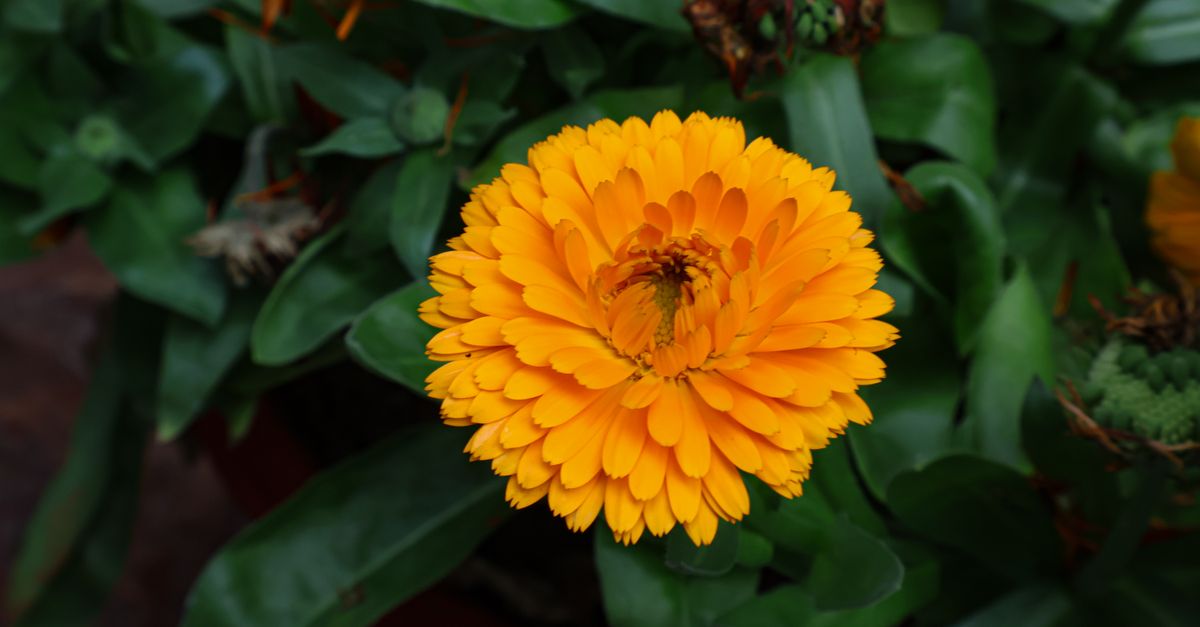
Calendula (pot marigold, Calendula officinalis) can be grown in India as a cool-season annual, but there is no ICAR or state university package of practices for it as a commercial herbal crop, and no published Indian farm-gate price for dried petals. It is worth planting only on a small trial area, and only if a herbal, tea or cosmetic buyer has agreed to take dried petals from you.
Do not confuse it with the orange and yellow Tagetes (African and French marigold) grown for garlands. That is a large, established flower trade with its own varieties and mandi prices. Calendula is a different species with small flowers, a niche petal market and no organised Indian trade.
Climate, soil and crop duration
- Season: calendula is a frost-sensitive annual that prefers mild, cool weather. Hot spells shorten flowering, and humid weather raises the risk of powdery mildew.
- Soil: well-drained soil with near-neutral pH. Waterlogging and heavy clay should be avoided.
- Timing: FAO EcoCrop records seed germination in 4 to 5 days and first flowers 40 to 50 days later, with flowering continuing until autumn frost in cold climates. A Canadian extension guide gives about 70 days to flower-head maturity. In India, seed sellers advise sowing in the cooler months, and in the hills in spring. Confirm the sowing window for your district with the local KVK, since calendula has no state package of practices.
Planting and spacing
- Seed is sown directly or raised in a nursery and transplanted about 4 to 6 weeks later. Ontario guidance (OMAFRA) gives in-row spacing of 5 to 25 cm and row spacing of 15 to 70 cm.
- A trial at Novi Sad, Serbia (outside India) compared 40, 50, 60 and 70 cm row spacing and got the highest flower mass, 5,379 kg/ha, at the closest, 40 cm. As a starting point, 40 cm rows with 15 to 20 cm between plants is about 50,000 to 65,000 plants per acre (1.2 to 1.6 lakh per hectare). This is an inference from foreign data, not an Indian recommendation.
- Named garden varieties sold in India are mostly ornamental. Petal buyers usually want the orange, deep-coloured, fully double types, so ask the buyer which colour and form they accept before buying seed.
Nutrition, irrigation and pests
- OMAFRA reports that research from Poland, Iran and India points to 80 to 100 kg nitrogen per hectare (32 to 40 kg per acre) as the best range for flower and seed yield. Split it and add organic manure at land preparation.
- Give light, regular irrigation and avoid wetting the foliage late in the day; drip works well (see drip irrigation).
- The diseases reported in extension guides are powdery mildew, bacterial leaf spot, alternaria and other leaf blights, rust and botrytis. Wide spacing, drainage and removing infected plants help. Follow the label and local KVK advice for any spray, because the petals go into skin and tea products. See pests.
Harvest and drying
- Flowers keep opening over many weeks, so they are picked by hand repeatedly, usually just as the flower is fully open and before the petals fade. Seed-oriented crops are harvested once, while flower crops are picked many times.
- Pick in the cool part of the day, remove field heat and dry in shade with good air movement (OMAFRA). Poorly dried or mouldy petals are rejected by herbal buyers.
- Ask your KVK or the state medicinal plants board for local dried-petal yields. Foreign trials report flower mass of several tonnes per hectare fresh, and the petals are only a fraction of the head by weight, so the dry petal yield is much lower. Measure it on your own 0.1 acre trial.
💡 Tip: Dry a first lot, weigh it and send a sample to the buyer before planting more. Pick-and-dry labour is the biggest cost, and only your own figures will show whether the price covers it.
Cost and returns
- Price: a Coimbatore herbal-ingredient trader's online listing, seen in October 2026, showed dried calendula flower at ₹450 per kg. That is a trader's selling price, and imported petals (an Egyptian-origin product is listed by a Kolkata trader) are also sold in India, so a grower should expect to receive well below it.
- Arithmetic to run yourself: gross income per acre = dry petal kg x the price your buyer commits to in writing. For example, at the listing price a harvest of 100 kg dry would be ₹45,000, but both the yield and the price are untested for Indian growers, so treat this only as a template.
- Ask your KVK for local cost figures. Count seed, manure, irrigation, repeated picking labour, drying space and transport.
Market and risks
- Buyers are herbal tea blenders, cosmetic and soap makers, Ayurveda and herbal product companies, and natural colour extractors. Contact them before sowing and ask for grade, moisture limit and payment terms.
- The market is small. A few acres from many farmers can saturate it, and imported petals compete.
- Beware of anyone selling seed with a buy-back promise. Get terms in writing. For group selling see FPO, and for medicinal-plant support see subsidy finder. Ask the state horticulture department or the State Medicinal Plants Board whether calendula is covered.
Sources
- OMAFRA (Ontario), Calendula crop guide
- FAO EcoCrop, Calendula officinalis
- Mrda et al., Effect of row spacing on calendula flower production (University of Novi Sad)
- PR International, Coimbatore, dried calendula flower listing (trader price)
- Primus Intertea Trade, Kolkata, Egyptian calendula petals listing