
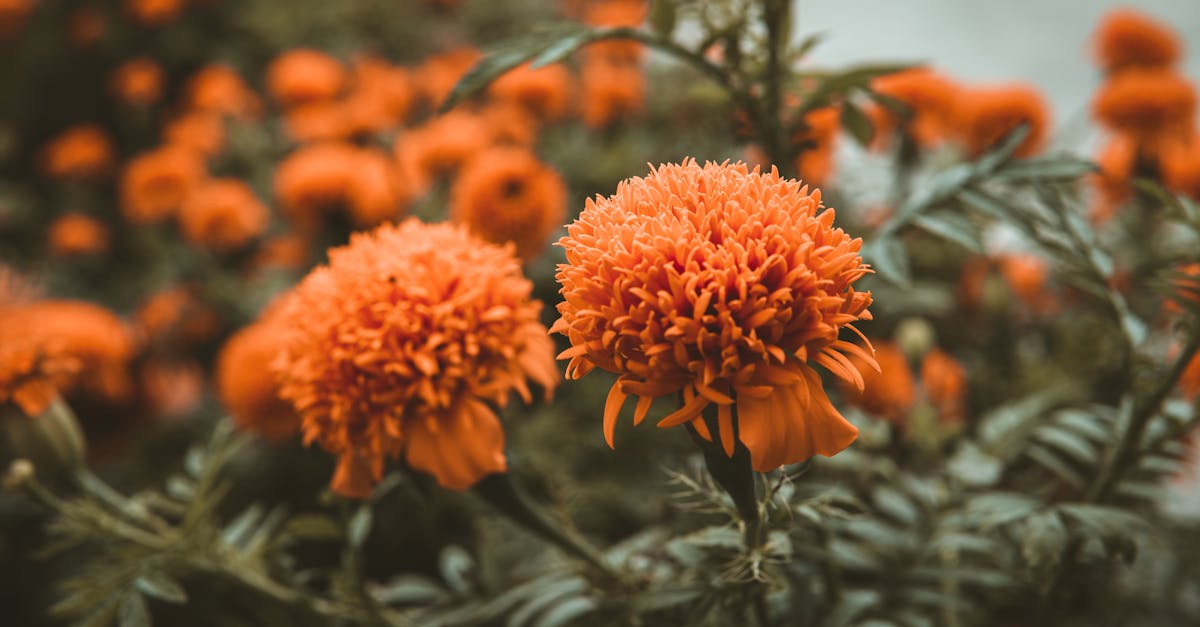
Marigold for lutein works in India only as a contract crop: an extraction company supplies seed, collects flowers from the farm gate, and pays an agreed rate. Without a signed buyer, the crop is just ordinary loose marigold, with the same price swings as the festival flower trade.
The growing is the same as for flower marigold (African marigold, Tagetes erecta, 130 to 150 days). What changes is the variety (a high-carotenoid hybrid), the buyer, and how the harvest is handled. The only published Indian contract-farming study found is from 2010 and showed a thin margin, so current rates must come from the company in writing.
What the crop is used for
- Marigold petals are rich in xanthophylls (lutein and zeaxanthin) and other carotenoids. ICAR-IARI notes that T. erecta and T. patula are grown for natural pigment used in poultry feed to deepen egg-yolk and broiler-skin colour, as a food colourant, and in supplements.
- IARI measured total carotenoids on a fresh-weight basis of 525.68 mg/100 g in the selection Af/w-6, 339.92 mg/100 g in Pusa Narangi Gainda and 160 mg/100 g in Pusa Arpita. Pigment content differs sharply between varieties, so use the variety your buyer specifies.
- ICAR-IIHR, Bengaluru, evaluated pre-breeding lines with total carotenoids of 1.35 to 2.49 g per 100 g dry weight, for developing carotenoid-rich hybrids, and promotes pigment-rich hybrids such as Arka Shubha for processing.
Varieties and seed
| Variety | Source | Traits | Use |
|---|---|---|---|
| L3 hybrid | Listed by TNAU for xanthophyll extraction | TNAU's precision-farming figures for this crop: 30 to 35 t/ha of flowers with 1.7 to 1.9 g xanthophyll per kg | Contract pigment crop |
| Pusa Narangi Gainda | ICAR-IARI, New Delhi | African marigold, orange; carotenoid content 339.92 mg/100 g fresh weight; retained carotenoids best among three varieties in IARI dried-petal storage trials | Loose flower and pigment |
| Arka Shubha (F1) | ICAR-IIHR, Bengaluru | Pigment-rich hybrid promoted by IIHR; shown at a KVK demonstration farm | Processing |
- Hybrid seed is supplied by the extraction company or a seed firm. Do not save seed from a hybrid. Ask the buyer which variety they need before buying any seed.
Planting and nutrition
- Nursery: TNAU gives 1.5 kg seed per hectare (about 600 g per acre) for a standard nursery, with transplanting after about four weeks. Seed can be sown through the year, but ask the buyer for the planting calendar they collect against.
- Spacing: standard 45 x 35 cm (about 63,000 plants per hectare, or 25,700 per acre). TNAU's precision method uses 90 x 22.5 cm, 44,400 plants per hectare (about 18,000 per acre), with fertigation.
- Soil: well-drained loam, pH 7.0 to 7.5; avoid standing water.
- Manure and fertiliser (TNAU standard): 25 t/ha FYM (10 t per acre) at the last ploughing, 45:90:75 kg N:P:K per hectare basal (18:36:30 kg per acre) and 45 kg N per hectare (18 kg per acre) at 45 days after planting. Precision fertigation: 90:90:75 kg per hectare.
- Pinching: remove the growing tip 30 days after planting to encourage branching.
- Irrigation: once a week or as needed. See drip irrigation.
Pests and handling
- TNAU lists mealybugs, thrips, spider mites, leaf spot and root rot. Follow the label and ask your KVK or the company's field staff for products and doses; buyers of feed-grade and food-grade pigment may test for residues. See pests.
- Plant hairs on stalks and flowers caused itching and skin peeling among pickers in the Erode study; gloves and long sleeves help.
- Pigment is lost after harvest. In IARI storage trials, vacuum-dried petals kept the most carotenoids, cold storage at -20°C kept more than 4°C, and ambient storage lost the most. Pick at full bloom, deliver fast, and dry and store as your buyer instructs.
Harvest and yield
- Picking starts about 60 days after planting and continues every 3 days. The crop lasts 130 to 150 days. TNAU's standard yield is 18 t/ha (about 7.3 t per acre) of flowers, and 30 to 35 t/ha (12 to 14 t per acre) under precision management.
- In the Erode contract study, contract farmers averaged 32.36 t/ha (13.1 t per acre) against 20.50 t/ha (8.3 t per acre) for non-contract farmers. This was in 2010.
- No verified Indian figure for dried-petal yield per acre was found. If your buyer takes dried petal rather than fresh flower, ask what moisture level and drying method they accept.
💡 Tip: Get the agreement in writing before nursery sowing: variety, rate per kg and how it is graded, collection point and days, who pays transport, and when payment is made. Check what happens if flowers are rejected or the plant is closed.
Cost and returns
- Dated example (TNAU thesis, Erode, Tamil Nadu, 2010, contract with a processing firm): cost ₹43,757 per hectare, gross ₹89,015 and net ₹45,258 per hectare, or about ₹1.35 cost and ₹2.75 return per kg of flowers. Costs and rates are higher now; use these only to see the structure, not as a forecast.
- Current rate: no verified current buy-back rate for pigment-grade marigold was found. Ask the company for the rate in writing.
- Arithmetic template: gross per acre = tonnes per acre x rate per kg x 1,000. At 7.3 t per acre (TNAU standard yield), every ₹1 per kg of rate equals ₹7,300 per acre. At an assumed ₹4 per kg that is ₹29,200 and at ₹8 per kg it is ₹58,400, before picking labour, seed, fertiliser and transport. These rates are assumptions, not quotes.
- Labour for picking every 3 days is the biggest cost to plan for.
Market and risks
- Buyers are extraction companies that make marigold oleoresin and lutein for feed, food colour and supplement makers. In the Erode study the company supplied seed and technical advice through the contract.
- In the Erode study, contract farming gave an assured buyer, no rejection of produce and farm-gate collection. The main problems reported were a low price, labour scarcity and no advance from the firm.
- Without an agreement, flowers must go to the flower market, where festival-season prices swing widely. Check mandi bhav.
- Use an FPO to negotiate as a group. Ask your state horticulture department about support for marigold under MIDH; no rate was verified. See also subsidy finder.
Sources
- TNAU Agritech Portal, marigold cultivation
- TNAU thesis (2010), economic analysis of contract farming in marigold in Erode district
- Indian Journal of Agricultural Sciences 2017, carotenoid pigments in marigold flowers (ICAR-IARI)
- Indian Journal of Horticulture 2018, storage and carotenoid retention in marigold petals (ICAR-IARI)
- Journal of Horticultural Sciences, marigold pre-breeding lines for carotenoid content (ICAR-IIHR)
- ICAR-IIHR, awareness programme on carotenoid-rich marigold hybrids