
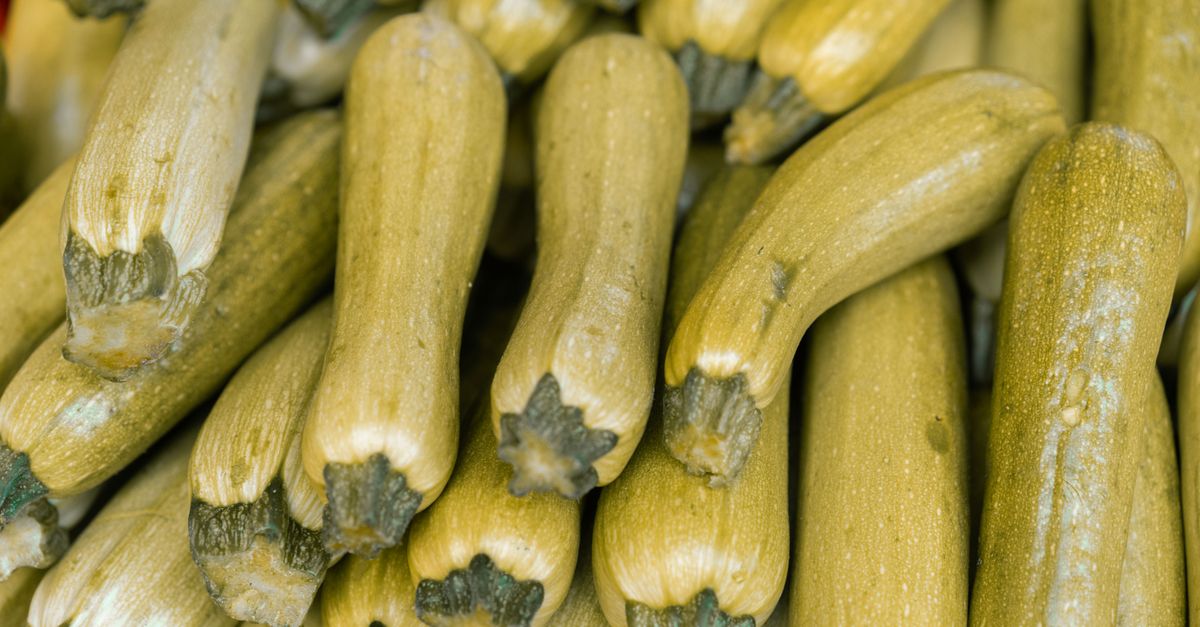
Zucchini (summer squash, chappan kaddu) is an easy, fast crop that works in the open field in north Indian plains in the cool season and in spring, and in low-cost polyhouses for winter supply; it pays only if you can sell tender fruit within a day or two to hotels, retail or a metro mandi. ICAR reports it grown in Punjab, Haryana, Delhi, Uttar Pradesh, Jammu and Kashmir, Himachal Pradesh and West Bengal, and the first harvest comes in about 45 to 56 days from sowing.
Yields vary a great deal with season: winter crops are reported at 25 to 40 tonnes per hectare while spring-summer crops give about 8 to 16 tonnes. The price is the other swing factor, so plan around a confirmed buyer.
Climate, season and soil
- Temperature: optimum 24 to 27 degrees C. The plant is sensitive to frost and low temperature, and growing in the northern plains from December to February is difficult in the open because of cold.
- Sowing windows in north Indian plains: winter crop September to November, with 20 October to 10 November reported as best for yield and return; spring-summer crop from the first fortnight of February. Under a low-cost polyhouse, sow from the third week of October to the first week of November.
- Soil: grows on most soils but prefers well-drained loam and sandy loam rich in organic matter.
Varieties
| Variety | Source | Traits |
|---|---|---|
| Pusa Pasand | ICAR-IARI, New Delhi | Heat-tolerant, flattish round light green fruit of 70 to 80 g; first harvest 45 to 50 days after sowing; average 16.0 t/ha in the open, 24.5 t/ha in a naturally ventilated polyhouse and 22.8 t/ha under a plastic low tunnel |
| Pusa Alankar, Australian Green | ICAR-IARI | Long cylindrical fruit, the classic zucchini shape |
| Kashi Shubhangi, Punjab Chappan Kaddu-1 | ICAR-IIVR Varanasi; PAU Ludhiana | Listed among suitable varieties for northern India |
| Private hybrids (for example Cora, Green Star, Orelia, Goldy) | Seed companies | Listed in ICAR guidance as options; compare with your buyer's preferred shape and colour |
- IARI notes that consumer preference in the North Indian plains is for flattish round, medium-size fruit of 70 to 80 g, while the long cylindrical types suit salad and restaurant use. Decide the shape with your buyer first.
Sowing, spacing and nutrition
- Spacing: ICAR guidance gives rows 60 to 75 cm apart and 50 cm between plants, which holds 25,000 to 30,000 plants per hectare (about 10,000 to 12,000 per acre). Seed rate is 2.25 kg per hectare (about 0.9 kg per acre) for field sowing; 3 to 5 kg per hectare for polyhouse beds at 90 x 60 cm.
- Raising seedlings: polybag seedlings with soil, vermicompost or farmyard manure and sand (2:1:1); 25-day seedlings with two true leaves are planted out.
- Basal: 15 to 20 tonnes per hectare of well-rotted farmyard manure at land preparation (6 to 8 tonnes per acre).
- Fertilizer: 60 to 80 kg N and 40 to 50 kg each of P2O5 and K2O per hectare (24 to 32 kg N and 16 to 20 kg each of P2O5 and K2O per acre) is recommended in one ICAR article; another summary gives NPK of 100:50:50 kg per hectare. Give all P and K and half the N as basal and top-dress the remaining N about four weeks after sowing.
- Polyhouse dose (IARI): for a 100 square metre polyhouse, 250 kg farmyard manure, 1.2 kg N, 800 g P and 600 g K, with the N split in three.
- Boron: 1 g borax per hill, or two foliar sprays of borax at 0.03% at 30-day intervals, is reported to raise yield.
- Irrigation: plant on 80 to 90 cm raised beds with surface irrigation, or use drip with water-soluble fertilizer in 8 to 10 splits. In November to February, drip is given every third day for 45 to 60 minutes. See drip irrigation.
- Weeds and mulch: one weeding with hoeing and earthing up at 20 to 25 days; plastic mulch cuts weeds, water need and aphids.
Pollination
- Zucchini bears separate male and female flowers. Hand pollination in the morning (about 8 to 10 am) of freshly opened flowers is advised in polyhouses and low tunnels, where bees are scarce. The flowers are large and solitary, so it is easy to do.
Pests and diseases
- Leaf miner: usually marginal in winter; weekly 4% neem seed kernel extract (NSKE) is advised.
- Whitefly, aphids and virus: imidacloprid at 0.3 ml per litre is recommended in the IARI guidance; keep to the label and local KVK advice. Plastic mulch helps lower aphids.
- Mites: can be serious in spring-summer; use a miticide on label advice.
- Powdery mildew and downy mildew: prone at fruit set and development; remove old leaves for airflow and use fungicides recommended by your KVK. Observe a gap of at least 15 days between the last synthetic spray and harvest.
- See pests for identification help.
Harvest and yield
- Harvest tender fruit 9 to 12 days after flowering, when 20 to 23 cm long, 4 to 4.5 cm across and about 200 to 325 g. An IIVR study found taste scores fell after 12 days and fruit beyond 15 days was too hard and seedy for fresh use.
- Total of 10 to 12 pickings from about 55 days after sowing; 10 to 12 fruits or about 3.5 to 4 kg per plant.
- Reported field yield ranges: 25 to 40 t/ha in winter (10 to 16 t/acre), up to 70 t/ha under ideal conditions, and 8 to 10 t/ha in spring-summer (3 to 4 t/acre).
Cost and returns
- An ICAR article (Indian Horticulture, 2020) gives cost of cultivation of ₹1,40,640 per hectare (about ₹56,900 per acre) for a winter crop of 100 to 110 days, marketable yield of 320 quintals per hectare (about 130 quintals per acre) and a bulk selling price of ₹18 per kg.
- That works out to gross income of 320 q x ₹1,800 per quintal = ₹5,76,000 per hectare (about ₹2,33,000 per acre) and net income of about ₹4,35,000 per hectare (about ₹1,76,000 per acre). Prices are from 2020 and a bulk rate; check mandi bhav now.
- These are best-case winter figures at the reported yield. Spring-summer yields of 8 to 10 t/ha would give less than half the winter revenue at the same price. Polyhouse structures add substantial cost; see polyhouse subsidy.
Market and selling
- Buyers are hotels, restaurants, retail chains, online grocers and metro vegetable mandis. Demand is concentrated in metro cities, so the market is thin and can glut easily; agree volumes and price before sowing.
- Quality is lost quickly as the glossy look turns dull with maturity, so pick often and sell the same or next day. Grade for even size and colour.
- Stagger sowings every two to three weeks to keep supply steady rather than one big picking.
💡 Tip: Start with a quarter acre sold to one or two named buyers before scaling up.