
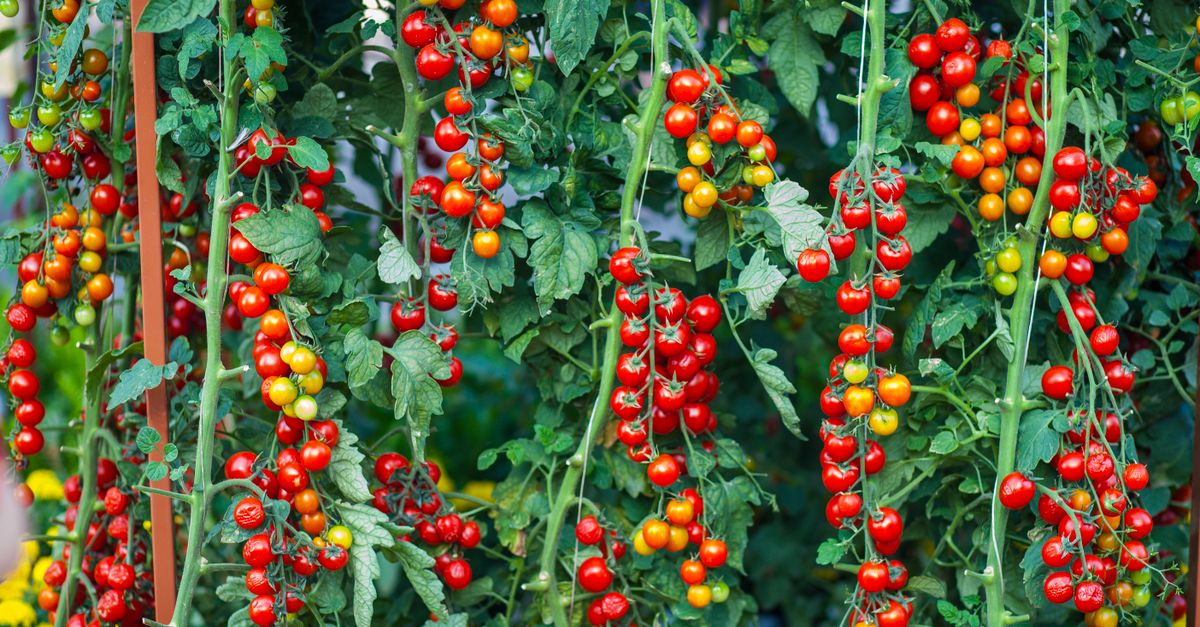
Cherry tomato works in India mainly as a long-season trellised crop in a naturally ventilated polyhouse or net house, planted around September and picked until about April or May. ICAR-IARI has released Indian varieties for exactly this system, but picking small fruit takes a lot of labour, and the crop only pays if a hotel, salad or retail buyer is lined up before the structure is built.
Open-field cultivation is possible in the plains in autumn-winter and spring-summer, at much lower yields than protected cultivation and with more rain and virus damage.
Where and when it grows
- Climate: a warm-season crop. ICAR-IARI gives 20 to 25 degrees C as the best range for fruit set and colour, and says it can be grown round the year only in a fully climate-controlled polyhouse.
- Low-cost polyhouse season: in naturally ventilated or low-cost polyhouses, transplant in the last week of September (nursery in the first week of September) and the crop continues to April or May.
- Open field: Pusa Red Cherry Tomato-3 is recommended for the Indian plains in autumn-winter and spring-summer, and was identified through AICRP trials for Zone I (Uttarakhand, Himachal Pradesh, Jammu and Kashmir and Ladakh).
- Soil: well-drained sandy loam, pH 6.0 to 7.0.
Varieties
| Variety | Source | Traits |
|---|---|---|
| Pusa Red Cherry Tomato-3 | ICAR-IARI, notified September 2025 | Indeterminate, round deep red fruit about 13.6 g, 10.1 degrees Brix; 35.78 t/ha in open field over 6 to 7 months, about 15% above Pusa Cherry Tomato-1 (30.25 t/ha); open or protected |
| Pusa Cherry Tomato-1 | ICAR-IARI | Older popular red variety; used as the check variety above |
| Pusa Golden Cherry Tomato-2 | ICAR-IARI | Golden yellow, 7 to 8 g, thin skin, 9 degrees Brix; 3 to 4.5 kg per plant, 9 to 11 t per 1,000 m2 in polyhouse; first picking at 75 to 80 days, cropping 270 to 300 days |
| VL Cherry Tomato 1 (VT 95) | Listed in ICAR annual report 2020 | Red, firm, 15 to 25 g; 250 to 300 q/ha open, 400 to 450 q/ha polyhouse |
Private-company F1 hybrids are also sold; ask for the grower trial data for your season and location rather than brochure yields. Seed cost and supply have been flagged as a constraint for cherry tomato growers, so confirm availability for your sowing window.
Nursery, spacing and planting
- Nursery: sow in plug trays in cocopeat, perlite and vermiculite (3:1:1) inside an insect-proof net house or polyhouse. Seedlings are ready in 22 to 25 days at 10 to 12 cm with four true leaves, then hardened for 2 to 3 days by holding water.
- Seed: about 10 g is enough for a 1,000 m2 polyhouse (Golden Cherry-2 recommendation); open-field and hectare rate is about 100 to 125 g per hectare (40 to 50 g per acre).
- Beds: 10 cm high beds 0.75 m wide with 30 cm between beds, two rows per bed, under drip with black plastic mulch.
- Plant spacing: 45 cm apart within the row (Pusa Red Cherry-3) or 60 cm (Golden Cherry-2). With these beds that is roughly 3,200 to 4,200 plants per 1,000 m2 of floor (beds plus 30 cm paths), or about 13,000 to 17,000 per acre (calculated from the bed layout; walkways and borders reduce it further).
- Training: stake or tie to twine 20 to 25 days after transplanting, from overhead wires 8 to 10 feet high; keep one or two stems and remove side shoots all season; strip leaves up to one foot from the ground after the first picking.
- Pollination: in cloudy or foggy weather, shake plants or use a vibrator or air blower between 10 and 11 am and 2 and 3 pm.
Nutrition and irrigation
- Base dose per hectare (per acre): 30 t well-rotted farmyard manure (12 t), 80 kg P (32 kg) and 90 kg K (36 kg), applied before transplanting, after a soil test.
- Nitrogen: 150 kg per hectare (61 kg per acre) for Golden Cherry-2, 180 kg per hectare (73 kg per acre) for Pusa Red Cherry-3: one third at transplanting, the rest in four top dressings at 25 to 30 days, at 50 to 60 days or flowering, after the first picking, and after the second picking. A 1% urea foliar spray after each harvest and 0.5% micronutrient mixture with calcium and boron at flowering are advised.
- Water: even moisture matters, and IARI notes it also helps colour development. IARI gives irrigation every 8 to 10 days in winter and every 3 to 4 days in summer; use drip irrigation with fertigation.
Pests and diseases
- Whitefly, mites, aphids, leaf miner and root-knot nematodes are the main problems inside warm, humid structures, and nematodes are listed as a major polyhouse problem.
- Prevention first: 200-micron UV-stabilised film, 40-mesh insect-proof net with a double-door foyer, a protected nursery, soil solarisation, mulch, and yellow sticky traps (8 x 12 inch, about 5 per 100 m2, replaced when 70% covered).
- IARI's guide lists propargite or spiromesifen for mites, flonicamid for whitefly, and carbendazim plus mancozeb for fungal diseases. Follow the label and your KVK, and observe the waiting period because the fruit is eaten raw.
- See pests for identification.
Harvest and yield
- First picking: about 70 to 75 days after transplanting (Pusa Red Cherry-3) or 75 to 80 days (Golden Cherry-2). Picking then continues for months (270 to 300 days for Golden Cherry-2 in the right climate).
- Stage: IARI advises mature-green fruit for long-distance transport, pink stage for short distances, and fully ripe red fruit for processing.
- Yield: Golden Cherry-2 at 9 to 11 t per 1,000 m2 equals about 36 to 45 t per acre of polyhouse floor; this is a variety potential, not a farm average. In open field, the AICRP average for Pusa Red Cherry-3 is 35.78 t/ha (about 14.5 t per acre).
- Fruit weight falls when too many trusses and berries are kept: an IARI polyhouse study found 10 berries per truss gave 8.21 g berries against 5.88 g at 20 per truss.
Cost and returns
- Ordinary tomato mandi rates do not apply to a punnet product, so there is no mandi benchmark to quote. Get written rates per kg and per punnet from your buyer for the months you will pick.
- Arithmetic to repeat: at 9 t per 1,000 m2 (low end of the Golden Cherry-2 potential), every ₹10 per kg of realised price is ₹90,000 per 1,000 m2, or about ₹3.6 lakh per acre of polyhouse. Subtract structure depreciation, drip and mulch, seed, labour for tying and picking, packing and transport.
- The structure is the largest cost. Subsidy for polyhouse or net house is available through state horticulture missions; see polyhouse subsidy and the subsidy finder. Current per-square-metre cost norms should be confirmed with your district horticulture office.
- Use KCC or a bank term loan only after a buyer is confirmed.
Market and selling
- Buyers are hotels and restaurants, salad and ready-to-eat suppliers, modern retail and online grocers in cities. These need clean, graded fruit in punnets or boxes and steady weekly supply, not a one-time glut.
- Ask each buyer for grade, packing and delivery-day requirements in writing before you plant.
- Check mandi bhav only as a floor for ordinary tomato. Groups of growers can share packing and transport through an FPO.
- Related guides: coloured capsicum, another polyhouse vegetable.
Sources
- Indian Horticulture, March-April 2026: Pusa Red Cherry Tomato-3 (ICAR-IARI)
- Indian Horticulture, Jan-Feb 2022: Pusa Golden Cherry Tomato-2 for protected cultivation (ICAR-IARI)
- Indian Journal of Agricultural Sciences 84(11), 2014: truss retention and berry pruning in cherry tomato under polyhouse structures (IARI)