
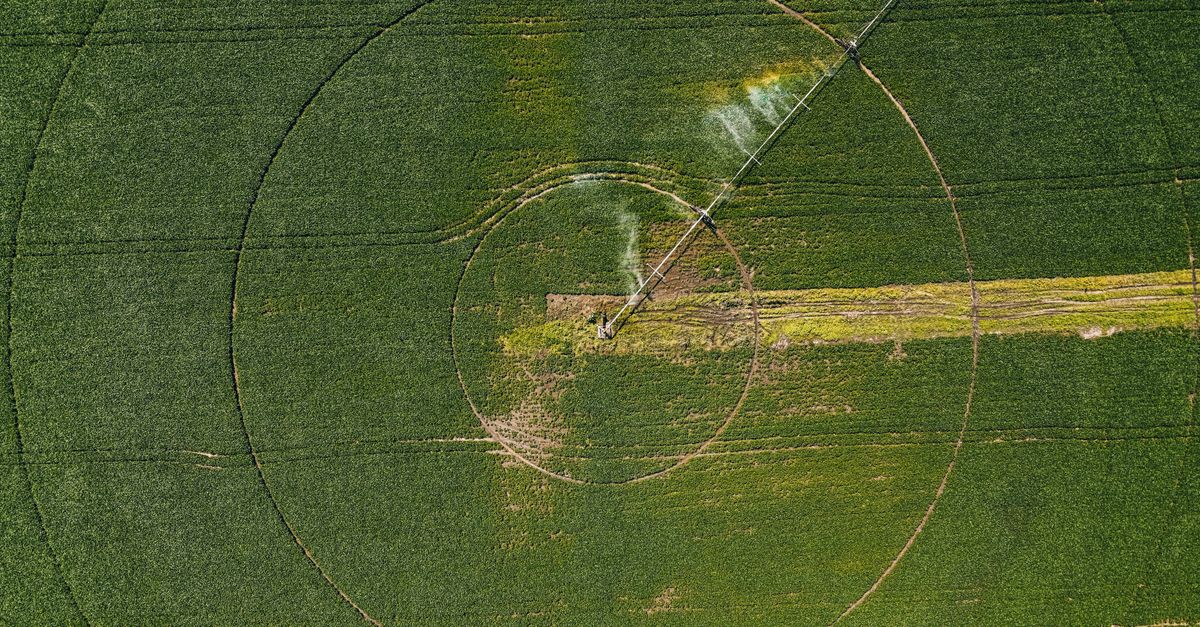
Precision farming in India is realistic for most farmers at the entry level: a soil test, drip irrigation with fertigation, and timely weather advice. Sensors, drones and automation are worth buying only for high-value crops or as a hired service. It is a way of managing any crop, not a crop of its own, and the first steps are cheap and government-supported.
The idea is to give each field, or each part of it, the water, nutrients and crop protection it needs instead of one uniform dose. The sections below take the tools in order of cost, with the verified subsidy rates and costs, and are blunt about what has and has not been shown in Indian conditions.
The practical ladder, cheapest first
| Step | What it does | Cost and support (verified) |
|---|---|---|
| 1. Soil Health Card | Tests 12 parameters: N, P, K, sulphur, zinc, iron, copper, manganese, boron, pH, EC and organic carbon, and gives a fertilizer recommendation | Free for farmers; one card per holding every two years. Over 25 crore cards had been distributed by July 2025 (PIB) |
| 2. Drip irrigation and fertigation | Delivers water, and soluble fertilizer through the same lines, to the root zone | Subsidy of 55% for small and marginal farmers and 45% for others under Per Drop More Crop, up to 5 ha per beneficiary |
| 3. Weather and advisory data | Timing of irrigation, spraying and sowing from forecasts and local advisories | Free; see the weather page and your KVK |
| 4. Drone spraying as a hired service | Even application of liquid fertilizer and pesticide over large or hard-to-reach fields | Buying a drone is the Namo Drone Didi route for women self-help groups; farmers can hire from such groups |
| 5. Sensors, GPS, variable-rate machinery | Soil moisture, yield mapping and machine guidance | No standard government price or subsidy found for this guide; justify only against a high-value crop and a large area |
Soil testing first
- How samples are taken: soil is taken from 15 to 20 cm depth in a V-shaped cut, from four corners and the centre of the field, after harvest or when no crop is standing.
- Grid: samples are collected on a 2.5 ha grid in irrigated areas and a 10 ha grid in rain-fed areas, using GPS and revenue maps. A card therefore reflects a sample point near your field and not every corner of it.
- Use: the card feeds into the crop-wise fertilizer recommendation. Compare with fertilizer guidance and re-test every two years. Contact the district agriculture office or the nearest KVK for a test; the scheme is now part of "Soil Health and Fertility" under Rashtriya Krishi Vikas Yojana.
Drip with fertigation
- Why it is the core: the micro irrigation guidelines say drip facilities are under-used if not used for fertigation, and states are asked to promote water-soluble and liquid fertilizers through them. See drip irrigation; for sprinklers see sprinkler irrigation.
- Subsidy: Per Drop More Crop pays 55% of the unit cost to small and marginal farmers and 45% to others, shared between the Centre and states 60:40 (90:10 in the North-East and Himalayan states, 100% central in Union Territories). The ceiling is 5 ha per beneficiary. Farmer groups and FPOs can apply together.
- Indicative system cost (used to calculate subsidy, from the 2023 operational guidelines): actual quotes differ by supplier and water source.
| Plant spacing | Cost per 1 ha (₹) | Cost per 2 ha (₹) |
|---|---|---|
| 12 m x 12 m (widely spaced fruit trees) | 24,586 | 39,098 |
| 6 m x 6 m | 34,687 | 57,987 |
| 3 m x 3 m | 47,751 | 82,654 |
| 2 m x 2 m | 83,085 | 1,61,263 |
| 1.5 m x 0.6 m (row crops) | 1,09,531 | 2,07,860 |
| 1.2 m x 0.6 m or closer (vegetables) | 1,27,501 | 2,42,422 |
Example arithmetic: a 1 ha vegetable plot at 1.2 m x 0.6 m has an indicative cost of ₹1,27,501. At 55% subsidy for a small or marginal farmer the grant would be about ₹70,125 and the farmer's share about ₹57,376; at 45% the grant is about ₹57,375 and the share about ₹70,126. Final amounts depend on the state and the approved system.
What has been measured in India
- TNAU describes a Tamil Nadu precision farming package of chisel ploughing, community hi-tech nurseries and drip with fertigation, with a target of 12,800 ha across 28 districts in 2007-08. TNAU lists crops such as sugarcane, cotton, maize, pulses, banana, turmeric and vegetables, and claims 30 to 40% water saving and 30 to 40% pesticide reduction, along with 60 to 80% higher yields.
- These are programme-reported figures from the implementing university, not an independent trial, and the yield gain is far above what most field studies report. Treat them as an upper bound; your result depends on crop, soil, starting practice and management.
- Drone use is promoted by the government for precise application of fertilizer and pesticide with the stated aim of reducing overuse. The scheme itself states an expected additional income of at least ₹1 lakh a year per self-help group; no independent field audit was found.
Drones and the Namo Drone Didi scheme
- What it is: a central scheme to give drones to women self-help groups, who rent spraying services to farmers. The announced target was 15,000 groups over 2024-25 and 2025-26; ask the district agriculture office whether it has been extended or what replaced it.
- Support: 80% of the drone and accessory cost, up to ₹8 lakh. The remaining 20% can be borrowed from the Agriculture Infrastructure Fund with a 3% interest subvention.
- Training: 15 days for one qualified group member, of which 5 days are mandatory drone pilot training and 10 days cover nutrient and pesticide application. A second member is trained as drone assistant.
- For a farmer: the practical route is to hire a local service, not to own one. Ask for the per-acre rate, the chemical used and the pilot's certification before booking, and spray only products labelled for your crop.
Where precision tools pay and where they do not
- Fit best: widely spaced orchards and plantation crops, vegetables, banana, sugarcane and cotton, where water and fertilizer costs are high and drip is established.
- Weak fit: small plots of low-value rain-fed cereals, where a soil test is the sensible first step and expensive equipment is hard to justify.
- Common failures: clogged emitters from poor filtration, fertigation with fertilizer that does not dissolve, systems bought and left unused, and expensive sensors with no one to read them. Plan for filter cleaning and yearly maintenance.
- Power: pumping cost can be cut with a solar pump, and credit is available through the Kisan Credit Card. Check the subsidy finder and FPOs for shared equipment.