
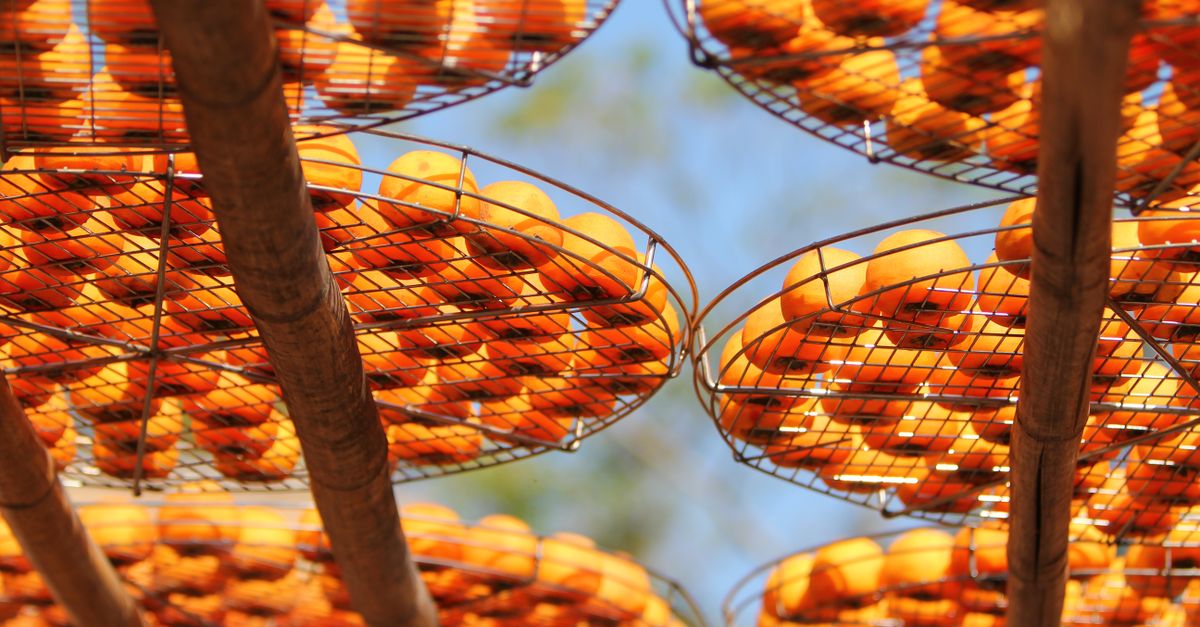
Persimmon (Japani phal, amlok) is a realistic orchard crop only in India's cool hill belts, mainly Kullu in Himachal Pradesh, where it is replacing apple, pomegranate and cereals on some farms. It needs winter chill, well-drained soil, bird netting and 4 to 5 years before the first useful crop, and there is little published Indian data on cost per acre.
The fruit sells for roughly ₹120 to ₹180 per kg locally, and the crop needs fewer sprays than apple. Plant a small block first and check the market before expanding.
Where it grows in India
- Kullu valley: Kullu district accounts for nearly 90% of Himachal's persimmon. The area was about 200 ha in 2023 and 404 ha in 2025, with 1,250 tonnes produced in 2023-24 (reported in an industry news item). Production in 2019-20 was highest at Banjar (324 t), Kullu (297 t) and Naggar (185 t).
- New clusters: the Himachal project HP SHIVA (funded by the Asian Development Bank) is setting up clusters of the Fuyu variety in Mandi (Barot valley, Prashar valley), Kangra, Sirmaur, Bilaspur and Solan, about 358 ha in all, with planting in January to March 2026.
- Other areas: research on persimmon has been done at SKUAST-Kashmir (Srinagar), and the fruit is also reported from the Nilgiris and Assam hills. It was brought to the Kullu valley by European settlers in the 1920s.
- Climate and soil: temperate climate with real winters and warm summers, sandy loam soil rich in organic matter, pH 6.5 to 7.5 (secondary source). Hot plains are unsuitable because the tree needs winter chilling.
Varieties
| Variety | Type | Notes | Where used in India |
|---|---|---|---|
| Fuyu | Non-astringent; can be eaten firm | Being planted in the HP SHIVA clusters; can be harvested at three stages of ripeness | Himachal Pradesh clusters |
| Hachiya | Astringent; edible only when soft | In a Srinagar trial it gave higher yield and larger fruit than the cultivar "Round", but showed 38.75% fruit drop | Kashmir valley trial; older Kullu plantings |
| Tamopan | Named in older Himachal university research on fruit keeping quality | Check current availability with the university or nursery | Ask YSPUHF Nauni or the horticulture department |
- Choose Fuyu if you want to sell firm fruit to city markets without a ripening step. Hachiya needs the astringency removed or the fruit left to soften.
- Buy grafted plants from the state horticulture department or a registered nursery; grafted trees are reported to bear within 4 to 5 years.
- No Indian trial giving the full yield comparison of Fuyu against other varieties was found. Ask Dr YS Parmar University of Horticulture and Forestry (Nauni, Solan) or your district horticulture officer which variety suits your altitude.
Spacing, soil and planting
- Spacing quoted for the crop runs from 4 x 4 m to 6 x 6 m (a secondary source). At 6 x 6 m that is about 112 trees per acre (278 per hectare); at 4 x 4 m about 250 per acre (625 per hectare).
- On slopes plant on the contour or on terraces to limit soil loss.
- Himachal currently gives a planting subsidy of ₹62,500 per hectare, along with 50% support on power tillers and sprayers and up to 80% on protective nets (as reported in 2025). Confirm the current rate and eligibility at the district horticulture office.
Nutrition, irrigation and care
- One guide suggests about 500 g per tree per year of a balanced NPK mix, split between spring and mid-July, avoiding excess nitrogen. This is a single secondary source for bearing trees; ask the university or KVK for age-wise doses based on a soil test.
- The tree tolerates dry spells but gives better fruit with even moisture during fruit development. See drip irrigation for water saving on slopes.
- Persimmon needs fewer sprays than apple. Birds are one of the main problems, and netting is the standard answer.
- Fruit drop is common. The Kashmir trial recorded 33% to 39% fruit drop between the two cultivars studied, so expect some thinning without any action from you.
Harvest, yield and storage
- Season: September to October in early pockets, with the main harvest in November and December in Kullu.
- First crop: within about 4 years of planting grafted trees, with full bearing later.
- Yield: one guide says a mature tree gives 150 to 200 kg, a figure that looks high, and a news report says a few Kullu trees gave over 1,800 kg of fruit in total. In a Turkish trial Fuyu gave 50 to 52 kg per tree. No Himachal yield trial was found, so budget on 20 to 50 kg per tree for mature trees until your own orchard shows otherwise.
- Astringent types: a Himachal university thesis found that dipping Hachiya fruit in 40°C warm water for 3 to 4 minutes and holding it at 20°C for about 15 hours, or treating with ethanol, removes astringency. Fuyu does not need this.
- Storage: one guide reports 2 to 3 months at 0 to 2°C, with a risk of chilling injury and fungus if handled badly.
Cost and returns
No published cost-of-cultivation figure for Indian persimmon was found, so the table shows only the sale arithmetic at ₹120 to ₹180 per kg (reported local prices in 2025), per acre of 112 trees at 6 x 6 m. These are illustrations, not forecasts.
| Yield per tree | Per acre (112 trees) | At ₹120 per kg | At ₹180 per kg |
|---|---|---|---|
| 20 kg | 2,240 kg | ₹2.7 lakh | ₹4.0 lakh |
| 35 kg | 3,920 kg | ₹4.7 lakh | ₹7.1 lakh |
| 50 kg | 5,600 kg | ₹6.7 lakh | ₹10.1 lakh |
- These are gross sales before grading losses, netting, labour, packing and commission.
- The orchard earns nothing for the first 4 years, so budget for upkeep and netting in that period.
Market and risks
- Ask the Kullu horticulture office and nearby growers which fruit markets and commission agents buy persimmon, and check rates on mandi bhav where listed.
- The market is small and new, and the area doubled in two years, so today's price may not hold as more trees come into bearing.
- Fresh fruit is soft and bruises easily, so careful picking, padded crates and quick transport matter.
- For group selling and processing (dried and pulp products), see FPO; for support schemes see subsidy finder.
Sources
- India Region, Persimmon acreage in Himachal's Kullu valley doubles (area, price, subsidy)
- FreshPlaza, India expands persimmon cultivation in Himachal Pradesh clusters (HP SHIVA)
- Agricultural Science Digest, flowering and fruiting of persimmon cultivars in Kashmir (SKUAST-K)
- Dr YS Parmar University thesis, removal of astringency and storage of Japanese persimmon (1989)
- Krishi Jagran, persimmon farming guide (secondary source)