
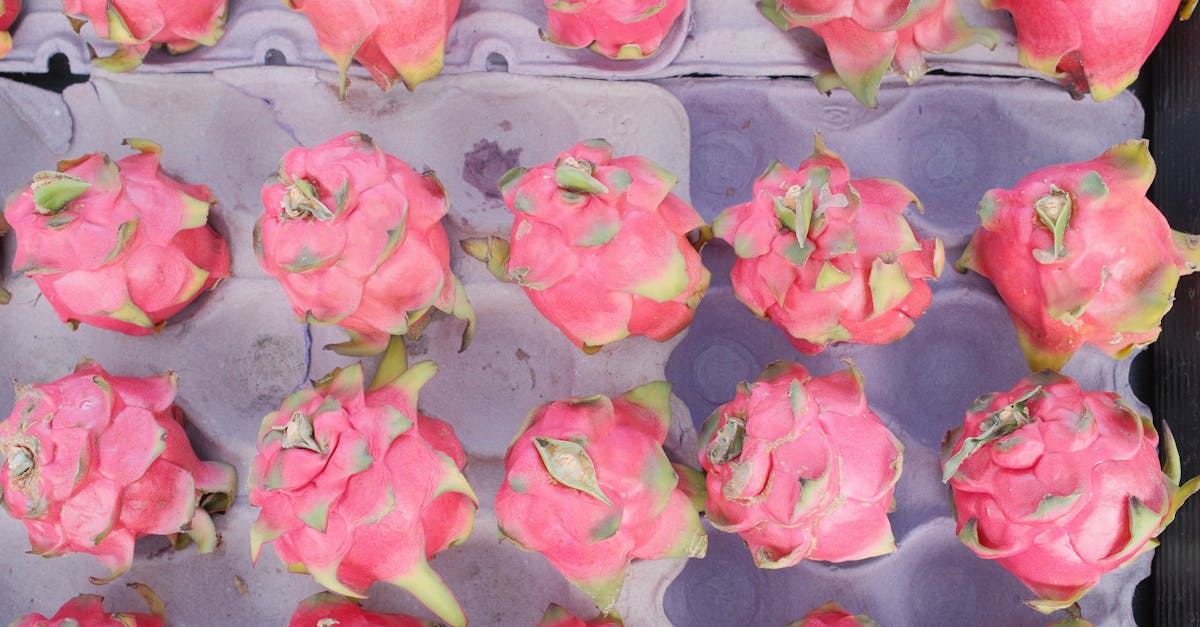
Dragon fruit (officially called kamalam in India) does work across most of the country except frost-prone and waterlogged land, with Gujarat, Karnataka and Maharashtra the leading states. It starts flowering 14 to 18 months after planting and reaches full bearing in the third year, but the building cost is high (about ₹25 lakh per hectare at 2 x 2 m in an ICAR cost table) and the national average yield is only a fraction of the 62 to 85 t/ha quoted in research papers.
Both facts matter. ICAR figures put India's area at about 14,500 ha and production at about 53,700 tonnes, an average near 3.7 t/ha. Treat the high-yield numbers as what well-run plots reach, not what a new planter should expect in the first years, and check the local market before you buy poles.
Where it grows in India
- Leading states: Gujarat, Karnataka and Maharashtra (ICAR Indian Farming, August 2025). Almost every state has trial or commercial plantings, including Tripura, Mizoram and Nagaland in the Northeast, and parts of Himachal Pradesh, Jammu and Kashmir and Rajasthan.
- Climate: tropical and subtropical, humid to dry. Optimum 25 to 40 degrees C in summer and 6 to 20 degrees C in winter; rainfall from about 500 mm (Baramati, Maharashtra) to 2,500 mm (Tripura). Frost injures the plant; long heat above 40 degrees C, or cloudy humid weather with heavy rain, hurts growth and flowering.
- Soil: any soil that drains well, best loose, fertile sandy loam with organic matter and pH 5.0 to 7.0. Water standing around the stem base rots it.
Species and varieties
| Type | Skin / flesh | Notes (ICAR) |
|---|---|---|
| Selenicereus (Hylocereus) undatus | Red or pink skin, white flesh | Most widely grown; adaptable with stable yield; less sweet |
| S. monacanthus (polyrhizus) and S. costaricensis | Red skin, red to purple flesh | Preferred for colour, betalain content and better price in urban and export markets. Named types include Moroccan Red, Jumbo Red, Vietnam Red |
| S. megalanthus | Yellow skin, white flesh | Sweetest but slow growing; limited in India |
ICAR-IIHR's Centre of Excellence at Hirehalli (Bengaluru) is evaluating selections (CHES-D1, D2, D3, Hirehalli White) that are not yet released varieties. Quality planting material matters because stems carry anthracnose, bacterial spot, mealybug and aphids. Buy from a nursery that raises mother plants under a disease-control protocol.
Planting material, spacing and plants per acre
- Cuttings: 20 to 30 cm lengths from one-year-old stems, rooted in poly bags (soil, sand, FYM 3:1:1, or cocopeat). Plants are ready for the field in 5 to 8 months; planting time July to August (ICAR Indian Farming).
- Square planting: 2 x 2 m or 3 x 3 m, one pole per point, with 2 to 4 plants per pole. At 3 x 3 m that is about 1,100 poles per hectare (about 445 per acre); at 2 x 2 m, 2,500 poles per hectare (about 1,012 per acre).
- Plants per acre: with 4 plants per pole, 3 x 3 m gives about 1,800 plants per acre and 2 x 2 m about 4,050. ICAR notes that two plants per pole make canopy management easier.
- Poles: concrete pole 6 to 7 ft tall and 4 to 6 inches thick, set 1 ft in concrete, with a tyre or ring on top. The ICAR cost table uses ₹500 per pole and ₹100 for a tyre. Angle-iron T-bars with 2 to 3 wires are an alternative.
Nutrition and irrigation
ICAR's Indian Farming (August 2025) gives the schedule below; quantities are grams of urea, SSP and MOP per plant, plus kilograms of vermicompost and FYM. Convert to nutrients from the bag analysis and base it on a soil test; see fertilizers.
| Stage | Urea + SSP + MOP (g/plant) | Vermicompost + FYM (kg/plant) |
|---|---|---|
| 1 month after planting | 13 + 12.5 + 5 | 1 + 1 |
| 12 months | 40 + 38 + 15 | 3 + 4 |
| 24 months | 92 + 88 + 32 | 7 + 8 |
| 36 months and after (full bearing), each of 5 splits a year | 143 + 138 + 52 | 12 + 12 |
The five yearly splits for bearing plants fall in the last week of May, last week of July, last week of September, November and February. The ICAR article also lists foliar 19:19:19 at 2 g/litre in January and August, and zinc (0.1 percent) and boron (0.5 percent) sprays in June, July and August. Add VAM and Azotobacter (50 g per plant each) in the planting pit.
Water: drip with four drippers of 6 to 8 L/h per four plants, plus mulch. In dry spells give 1.5 to 2 litres per plant per day, or irrigate every 15 to 20 days depending on mulch and season. The plant saves water through its night-time gas exchange (CAM), but fruit set and size still depend on moisture.
Flowering, pollination and pruning
- Flowers open at night (7 to 9 pm). Flowers are hermaphrodite but the style outgrows the stamens, so ICAR recommends hand pollination at 7:30 to 8:30 pm for better fruit set; bats are the only reported natural pollinator.
- Fruiting comes in 3 to 4 flushes between June and October. Fruit is ready 35 to 40 days after flowering.
- Prune weak, diseased and overcrowded shoots for light and airflow. Sterilise secateurs and treat cut ends with a copper paste to avoid spreading cactus virus X and canker.
Pests and diseases
- Anthracnose (Colletotrichum) infects stems and fruit; ICAR reports incidence of 10 to 60 percent in some Northeast plantings, drying plants. Stem canker (Neoscytalidium), stem rot (Xanthomonas), brown spot on fruit, bacterial spot and cactus virus X are also reported.
- Insects: mealybugs, aphids, mites, fruit fly and termites. Fruit cracking is a physiological disorder, and ants are a nuisance in tropical areas (ICAR-IIHR, 2026).
- Follow the label and your local KVK for fungicide choice and waiting periods. See pests.
Harvest and yield
- Harvest when the skin and bracts turn fully red or pink. Fruit averages 300 to 400 g with TSS about 13 to 14 degrees Brix. It is non-climacteric (does not ripen after picking) and keeps 7 to 20 days.
- Research-plot yield: 25 to 35 kg per pole, around 62 to 85 t/ha (ICAR Indian Farming, 2025).
- National average: about 14.5 thousand ha and 53.7 thousand tonnes in the same article, which is about 3.7 t/ha (1.5 t per acre). Many plantings are young, but this shows how far the field result can be from the plot result.
Cost and returns
ICAR's table for 2 x 2 m spacing (per hectare, 2,500 poles, 10,000 plants) is:
| Item | Amount per hectare |
|---|---|
| Field preparation and pits | ₹50,000 |
| 2,500 concrete poles at ₹500 | ₹12.5 lakh |
| 10,000 plants at ₹50 | ₹5 lakh |
| 2,500 tyres at ₹100 | ₹2.5 lakh |
| Manure, fertiliser, irrigation, mulch, per year | ₹3 lakh |
| Weeding, intercrop, sprays, per year | ₹2 lakh |
| Total (ICAR) | ₹25.5 lakh (about ₹10.3 lakh per acre) |
Drip, a borewell or farm pond, land and labour for picking are not in that table. ICAR gives a fresh-fruit price of ₹200 to ₹300/kg (2025); a 2023 agri-trade report quoted ₹100/kg; and news reports from 2023 mention ₹250 to ₹400/kg. Prices have no single source and fall as supply grows.
| Yield per acre | Gross at ₹100/kg | Gross at ₹200/kg |
|---|---|---|
| 1.5 t (national average) | ₹1.5 lakh | ₹3 lakh |
| 10 t (mature, good management) | ₹10 lakh | ₹20 lakh |
| 25 t (ICAR plot, 25 kg x about 1,000 poles) | ₹25 lakh | ₹50 lakh |
The 10 t row is a planning scenario, not a published average. Compare the first row to the cost of about ₹10 lakh per acre to see why the payback ranges from the 3 to 4 years often claimed to much longer in a plot that yields at the national average. Check mandi bhav and your nearest city wholesale price before assuming ₹200.
Market and selling
- Domestic demand was historically met partly by imports (from Thailand, Malaysia, Vietnam and Sri Lanka); a 2023 report put imports at 9,162 tonnes in 2019. India has exported small quantities to Qatar, Maldives and Saudi Arabia (ICAR, 2025).
- Shelf life is short and fruit does not ripen after picking, so sell within days to supermarkets, juice and ice-cream makers and city retailers. Staggered flushes help.
- ICAR-IIHR has developed Arka Kamalam RTS (a ready-to-serve drink) and dragon fruit powder (about 6 months shelf life at room temperature) because supply is increasing and value addition is needed to stabilise prices. A FPO is the practical route to processing.
- Avoid sellers who offer plants at inflated prices plus buy-back promises. Check the nursery for disease-free mother plants and a record of earlier buyers.
Subsidy
Dragon fruit is covered under MIDH with state-wise rates, and the Centre has a target of 50,000 hectares. No current per-hectare rate has been verified, so check subsidy finder and your district horticulture office before spending.
Sources
- ICAR, Indian Farming, August 2025: Dragon fruit cultivation, a potential crop for the north eastern hill region (Das et al.)
- ICAR, Indian Horticulture, July-August 2026: Dragon fruit, a new-age fruit for nutrition, income and sustainable farming (ICAR-IIHR)
- AgroSpectrum India (14 March 2023): dragon fruit area and imports