
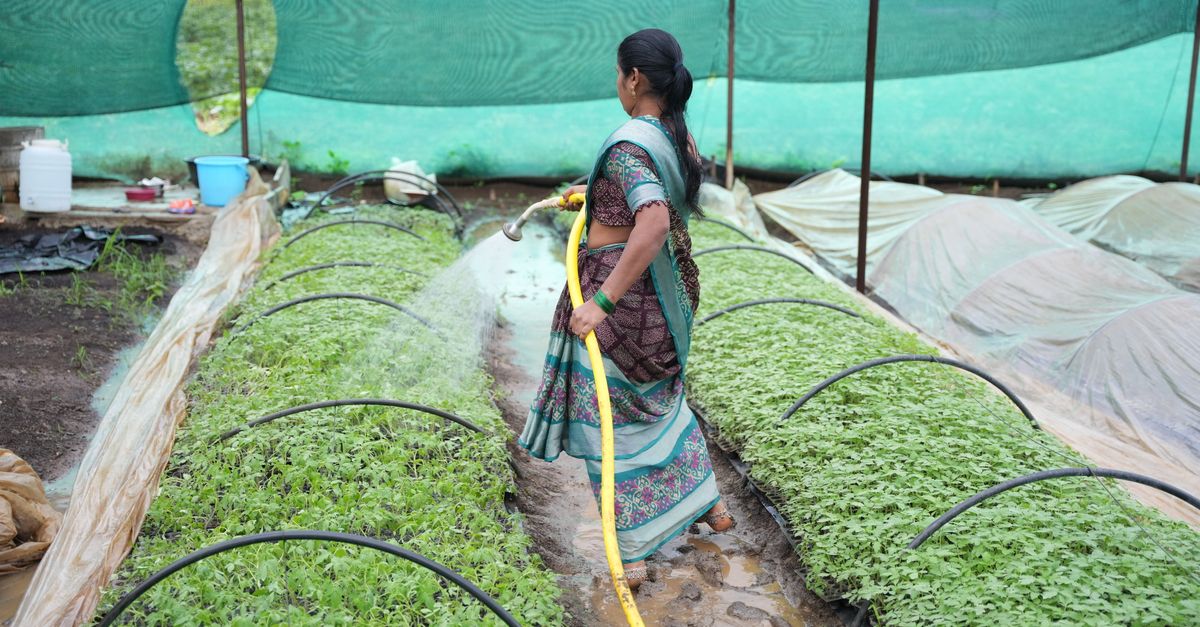
A shade net house is a frame covered with woven HDPE shade net or fine insect-proof net instead of plastic film. It works best for nurseries, summer vegetables such as tomato and capsicum, leafy greens and ornamentals, and costs far less than a closed polyhouse, but it only pays if the crop you put inside sells at a price that covers the structure over its 5 to 7 year net life.
The net cuts sunlight and heat, softens hail, heavy rain and wind, and (with fine mesh) keeps out whitefly, thrips and aphids. It does not warm the crop in winter or stop frost, and it does not make a disease-free environment, so crop management still decides the result.
Shade percentage by crop
| Use | Usual net | Basis |
|---|---|---|
| Summer hybrid tomato, capsicum | 35% shade | TNAU recommends 35% shade net for summer tomato; Tamil Nadu trials found 35% best for sweet pepper |
| Nursery hardening, ginger | 35% | Farming guide (secondary source) |
| Leafy vegetables in summer | 50% | Farming guide (secondary source) |
| Orchids, anthurium, ferns, some medicinal plants | 75% | Farming guide (secondary source) |
| Keeping out whitefly, thrips, aphids | Insect-proof net, about 40 to 50 mesh | Farming guide (secondary source) |
- Too much shade makes plants thin and weak; too little gives no benefit. Match the net to the crop and season, and ask your KVK or state horticulture department.
- Fine insect-proof mesh reduces airflow and raises humidity inside, so plan ventilation and side height.
Structure and cost
Under the MIDH cost norms used by the National Horticulture Board (XII Plan appendix), a shade net house is costed per square metre by structure type:
| Structure | Norm cost, plains | Norm cost, hilly areas |
|---|---|---|
| Tubular (GI pipe) | ₹710 per sq m | ₹816 per sq m |
| Wooden | ₹492 per sq m | ₹566 per sq m |
| Bamboo | ₹360 per sq m | ₹414 per sq m |
- Subsidy: the norms give assistance at 50% of cost, within the norm cost and a per-beneficiary area limit set by the scheme. The same appendix puts planting material and cultivation of high-value vegetables in a shade net house at ₹140 per sq m. These are norm figures from an older plan period; state rates and current guidelines may differ, so confirm with your district horticulture office. See polyhouse subsidy and subsidy finder.
- Market cost: a farming guide quotes about ₹200 to ₹400 per sq m for a GI pipe structure (10 to 15 year frame life) and ₹80 to ₹150 per sq m for bamboo with GI wire (3 to 5 years), with UV-stabilised HDPE shade net at ₹15 to ₹25 per sq m lasting 5 to 7 years, and insect-proof net at ₹40 to ₹80 per sq m. Get at least three written quotes, since design for wind load decides both cost and survival.
- Arithmetic: 1,000 sq m is about a quarter acre. At the guide's ₹200 to ₹400 per sq m the structure is ₹2 lakh to ₹4 lakh. At the 50% norm assistance, out-of-pocket is roughly ₹1 lakh to ₹2 lakh, only if the subsidy is sanctioned before you build and is based on approved cost.
Crops, spacing and yield
- Tomato in summer (TNAU): hybrid tomato under 35% shade net on a paired-row system at 80 x 40 x 60 cm (between pairs, rows and plants), with a reported hybrid yield of 80 to 95 t per hectare (32 to 38 t per acre), crop duration 110 to 115 days from transplanting. This is a research-station figure; field results are usually lower.
- Nursery raising: vegetable seedlings, grafted plants and ornamental saplings are a common use because the net protects young plants from hot sun and rain.
- Pair the net house with drip irrigation for water and fertiliser control. Fertiliser doses depend on crop and soil test; see fertilizers.
- Pests such as whitefly and thrips can still enter during door openings and through torn nets. Use a double-door entry and repair holes; see pests.
Returns and risks
- Illustration only: if 32 t of tomato per acre were achieved and sold at an assumed ₹10 per kg, gross would be ₹3.2 lakh per acre per crop. Replace the price with your own mandi rate from mandi bhav and the yield with what your KVK says is realistic before you decide.
- Tomato and other vegetable prices swing sharply, and a net house raises quality and off-season supply but not the market price on its own.
- Repayment is easier if the project is financed with a KCC or a bank term loan sized to cash flow. Be wary of vendors who quote profit per square metre without showing crop, yield and price assumptions.
- Net sheets degrade in sun and are usually replaced after 5 to 7 years; include this in the cost.