
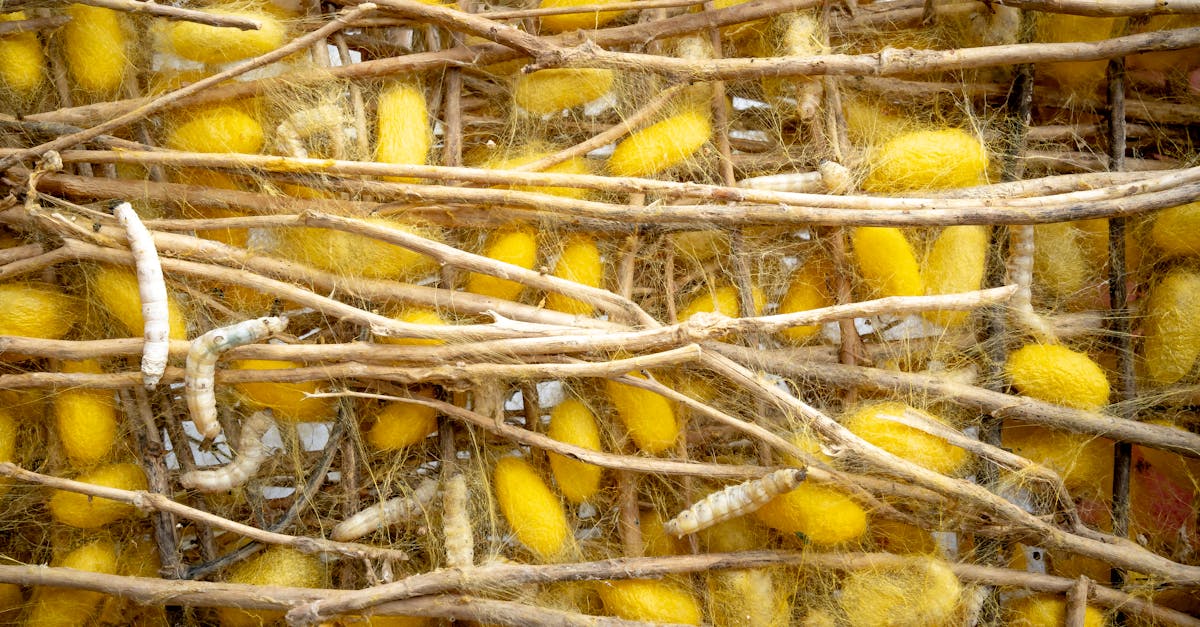
Mulberry sericulture works in India where irrigation, a state sericulture department and a nearby cocoon market all exist, mainly in Karnataka, Andhra Pradesh, Tamil Nadu, Jammu and Kashmir and West Bengal. It combines a mulberry garden with an indoor rearing shed, runs 5 to 6 rearing crops a year, and pays only if leaf supply, shed hygiene and the cocoon market line up.
Income depends on the cocoon price on the day, which swings widely. The TNAU figures for yield and profit used below are old, so treat the rupee amounts as an illustration and check the current cocoon rate at your nearest market.
Where it grows in India
- Silk output: India produced 38,913 tonnes of raw silk in 2023-24, of which mulberry silk was 29,892 tonnes (about 77%). Mulberry area rose from 2.24 lakh hectares in 2017-18 to 2.63 lakh hectares in 2023-24. Preliminary figures for April to January 2024-25 were lower at 34,042 tonnes.
- States: mulberry silk is produced mainly in Karnataka, Andhra Pradesh, Tamil Nadu, Jammu and Kashmir and West Bengal. Non-mulberry silks come from Jharkhand, Chhattisgarh, Odisha and the north-east.
- Fit: the crop needs assured irrigation for mulberry, a clean, ventilated rearing shed and access to a government silkworm seed supply and a cocoon market within a day's transport. Without these three, do not start.
Mulberry varieties and spacing
| Variety | Source | Notes | Suited to |
|---|---|---|---|
| V1 | Central Silk Board recommendation | High leaf yield; widely grown in southern plains under irrigation | Irrigated southern plains |
| G4 | Compared with V1 in a Bhavanisagar (Tamil Nadu) study | Similar trends to V1, slightly lower silkworm performance values | Tamil Nadu |
- A 2025 study at Bhavanisagar tested tree-type mulberry at 5 x 5, 6 x 6 and 7 x 7 ft (about 1,742, 1,210 and 889 trees per acre). Silkworms fed on V1 leaf from the 6 x 6 ft spacing did best on larval weight, survival and cocoon traits. Another study notes that research institutes have no fixed recommendation for tree-form V1, so growers follow their own spacing and pruning.
- Choose variety and plant form (bush or tree) with your state sericulture department or the Central Silk Board's regional centre.
Nutrition and irrigation
- TNAU recommends 20 tonnes of FYM per hectare (about 8 tonnes per acre), oil cake at 2 tonnes per hectare a year and zinc sulphate at 10 kg per hectare in two split doses, and notes that weeds matter most in the first 45 days after planting.
- Leaf yield: TNAU's sericulture FAQ gives 12 tonnes per acre a year under traditional practice and 24 tonnes per acre with improved practice. Get a soil test and the NPK schedule from the sericulture department's technical service centre, since it varies by district.
- Mulberry needs regular irrigation all year; see drip irrigation. Do not spray any pesticide on mulberry close to rearing, because residues on leaf kill worms.
Rearing silkworms
- Farmers buy silkworm eggs as disease-free layings (dfls) from government grainages or licensed seed centres. Many rearers buy young worms after the second moult from a chawki rearing centre, then raise them to cocoon themselves.
- TNAU's late-age rearing model uses a 1,200 sq ft rearing shed for 2 acres of mulberry.
- Disinfect the shed and equipment before each batch (the Bhavanisagar study used bleaching powder and a commercial disinfectant solution). Keep the shed clean, dry and ventilated, and keep rearing trays, leaf and people movement separate between batches. The state sericulture department gives training and the disinfectant schedule.
- The uzi fly is a known shed pest; TNAU lists releases of the parasitoid Nesolynx thymus at one lakh adults per 100 dfls as a control. TNAU also lists releases of Tetrastichus howardii (50,000 per hectare) and Trichogramma chilonis (5 cc per hectare) for mulberry pests.
- Silkworm diseases such as flacherie, grasserie, muscardine and pebrine spread fast; remove dead and sick worms and burn or bury them, and call the department's service centre at the first sign.
Cocoon yield
- TNAU gives an average of 60 to 70 kg of cocoons per 100 layings, 5 to 6 crops a year, and 800 to 1,200 layings per acre of mulberry a year.
- TNAU's late-age rearing model assumes 70 kg per 100 dfls. Supplements listed by TNAU raise yield by 7 to 10 kg per 100 dfls, but use them only after trying a batch.
💡 Tip: Visit a working farm in your district and the cocoon market on an auction day before planting. Ask the sericulture department about the current mulberry planting and rearing-shed support.
Cost and returns
- Price: the Central Silk Board monthly average at Ramanagaram in September 2024 was ₹481 per kg for cross-breed cocoon and ₹569 per kg for bivoltine cocoon. Prices move month to month; use the rate at your nearest market.
- Arithmetic (illustration): 60 to 70 kg of cross-breed cocoon per 100 dfls at ₹481 is ₹28,860 to ₹33,670 per 100 dfls. At 800 to 1,200 layings per acre a year (480 to 840 kg of cocoon) the gross is about ₹2.3 lakh to ₹4.0 lakh per acre a year before costs.
- Older TNAU figures: the FAQ gives mulberry establishment of ₹80,000 to ₹1 lakh per acre and net income of ₹60,000 to ₹75,000 per acre a year. The late-age rearing model gives a ₹1.25 lakh shed and cocoon sold at ₹120 per kg. These costs and prices are out of date, so ask the department for today's estimate.
- Family labour is the main input; TNAU says an acre can employ about 5 people through the year.
Market, risks and support
- Cocoons are sold at government or APMC cocoon markets to reelers. The reeling units spin raw silk, which goes to weavers and exporters. Silk exports were ₹2,027.56 crore in 2023-24.
- Risks: disease outbreaks, heat waves, leaf shortage in dry spells and falling cocoon prices.
- The central Silk Samagra-2 scheme gave ₹1,075.58 crore of assistance for 2021-22 to 2025-26. Exact per-farmer rates vary by state, so ask the state sericulture department. See also subsidy finder, KCC and FPO.
Sources
- TNAU Agritech Portal, Sericulture FAQs
- TNAU Agritech Portal, Economics of late age silkworm rearing
- TNAU Agritech Portal, Sericulture technologies
- Susikaran et al., Effect of tree spacing on silkworm growth, V1 and G4, Madras Agricultural Journal, 2025
- IANS, India's raw silk production and exports (Ministry of Textiles data)
- Ministry of Textiles, Central Silk Board monthly average prices of cocoon and raw silk, September 2024