
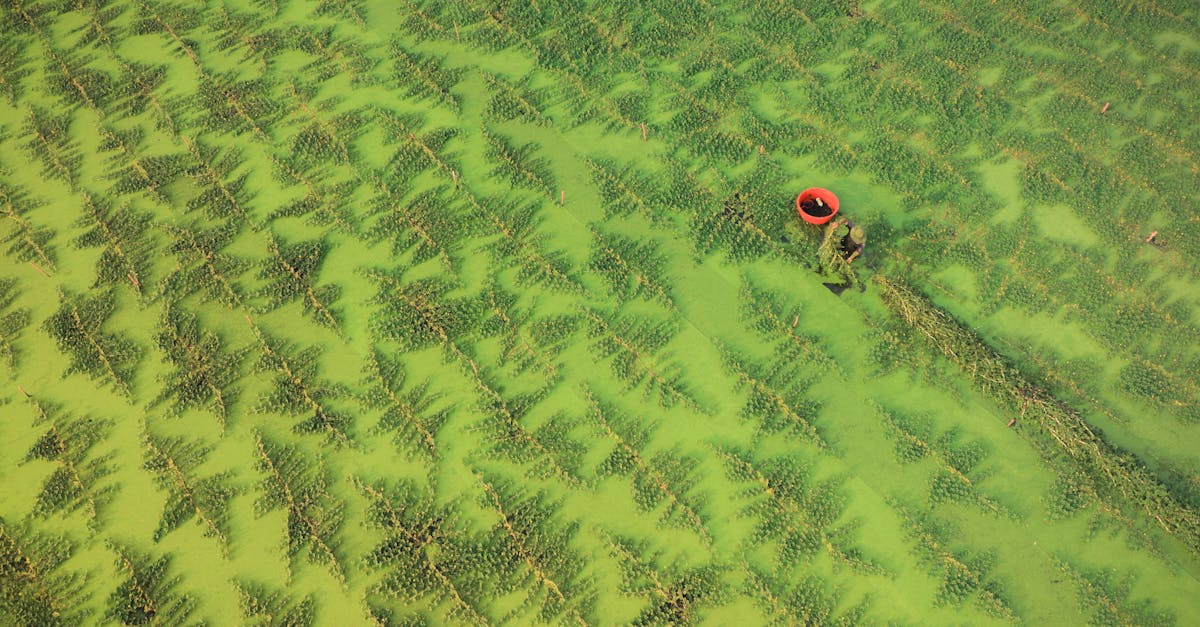
Azolla can be grown almost anywhere in India that has shallow water, shade and a cool enough season, but it is a feed supplement for your own animals, not a crop you sell. Research reviews report that fresh azolla fed at up to about 2 kg a day raised milk yield by about 11% in cattle, and that it can replace part of bought concentrate; it will not replace the whole ration.
The fern is the easy part. The work is daily: harvest, topping up nutrients, keeping water cool and clean, and restarting a bed when it crashes. Heat above 35 degrees Celsius stops growth, so hot plains summers need shade and cooling.
What azolla is and its limits
- Growth: it doubles its biomass roughly every 2 to 5 days under good conditions, because it hosts a nitrogen-fixing cyanobacterium (Anabaena azollae). Review data give an optimum of 18 to 28 degrees Celsius, slower growth below 15 and no growth above 35.
- pH: best growth at pH 5.5 to 7.5. Salty water, heavy-metal contamination and pH swings harm it.
- Light: too much sun in a hot spell burns it and warms the water; partial shade suits most of India. See weather for your local summer peaks.
- Species: Azolla pinnata is the species used in most Indian feeding trials; A. microphylla and A. filiculoides are also grown elsewhere.
- Field yield in India: an Indian rice-field record for A. pinnata is 37.8 tonnes fresh weight per hectare (2.78 t dry weight), which shows the fern's potential, not what a backyard tank will give.
Growing it
- Beds: shallow lined pits or tanks in shade. Deep water reduces light and gas exchange and so lowers growth.
- Nutrients: azolla needs phosphorus, potassium and trace minerals as well as organic matter. A lab-scale Indian study on A. pinnata (monsoon, 28 to 33 degrees Celsius) found the best growth with 10% cow dung in the water or 0.5% cow urine. A Malaysian trial with sheep manure at 1 g per litre gave 132 g fresh weight per m2 in 14 days, with 21.2% crude protein, 14.4% fibre and 19.6% ash on a dry basis.
- No verified Indian standard for pit size, superphosphate dose or daily yield per m2 was found. Get the current schedule from your KVK or State Animal Husbandry university and start with one small bed.
- Seed culture: inoculate from a healthy bed with young, green, fast-growing fern; brown or dark fern signals trouble.
Nutrition value
- Crude protein is reported as 25 to 30% of dry matter in A. pinnata reviews (15 to 35% across conditions), but fresh azolla is mostly water: dry matter was 7.3% in the Malaysian trial. On a fresh-weight basis the protein is only a few percent (3.9 to 5.2% in one review).
- Calculation: 2 kg fresh at about 7% dry matter is about 0.14 kg dry matter, or roughly 35 to 45 g protein at 25 to 30%. That is a useful top-up for a milking cow, not a replacement for concentrate.
- Azolla contains tannins, oxalates and phytic acid that reduce protein digestibility and mineral availability, and a review states that inclusion is generally limited to about 25% of the diet.
- Fresh azolla decomposes within days; feed it fresh, or dry it carefully if you store it.
Feeding rates reported
| Animal | Reported level | Reported effect |
|---|---|---|
| Dairy cattle | Up to 2 kg fresh per day; or 10 to 25% of concentrate replaced | Milk yield up 7 to 20% across studies, 11.2% in one |
| Goats and sheep | Up to 15% of concentrate (goats) | Safe replacement reported; sheep feed conversion improved at 6% |
| Broilers | 5 to 10% of diet | Above 10% gave diminishing returns |
| Pekin ducks (Odisha trial) | 5 or 10% fresh azolla | Better feed conversion at 10% in week 6; profit per bird ₹16.73 against ₹2.61 for control |
| Tilapia | Up to 20% of diet | No growth loss reported |
💡 Tip: Run one bed for a month and measure what it gives per day before building more. Feed it to a few animals, and watch milk, droppings and feed intake, before changing the whole herd's ration.
Cost and savings
- Studies report a 15 to 20% cut in bought-feed use when azolla is fed, and the Odisha duck trial shows a profit gain per bird. No verified Indian cost per kg of azolla was found, so the numbers below are a method, not a promise.
- Arithmetic (illustration, assumption): if a cow gets 4 kg of concentrate a day at ₹30 per kg (check your local price), replacing 10 to 15% saves 0.4 to 0.6 kg, or ₹12 to ₹18 a day, about ₹4,400 to ₹6,600 a year. Subtract your labour and bed material before calling it profit.
- The extra milk is separate: 11% on a 8 litre cow is about 0.9 litre a day. Prices vary by dairy; check with your milk society.
Other uses and cautions
- Green manure in rice: reviews report azolla fixing 1.1 to 3.5 kg N per hectare per day and supplying 30 to 60 kg N per hectare per season. See fertilizers.
- Safety: a 2024 study reported no BMAA toxin in the Azolla and cyanobacterium pair, though no long-term human safety studies exist, and azolla grown in polluted or salty water can take up heavy metals. Use clean water, wash before feeding and never feed discoloured or smelly fern.
- Market: there is no established selling market for fresh azolla. Treat it as an input to your own dairy, poultry or fish enterprise. No azolla subsidy rate was verified; ask your animal husbandry department and check the subsidy finder.
Sources
- Role of Azolla in sustainable agriculture and climate resilience: a comprehensive review (Frontiers in Plant Science, 2025)
- Azolla pinnata for livestock: a sustainable protein with economic promise (Tropical Animal Health and Production, 2025)
- From ponds to pastures: Azolla as a feed resource for poultry and livestock (Poultry Science, 2026)
- Dietary fresh Azolla and the performance of White Pekin broiler ducks (Veterinary World, Odisha, 2015)
- Growth-dependent CO2 sequestration of Azolla pinnata using cattle wastes (Heliyon, 2023)
- Cultivated Azolla filiculoides as ruminant feedstuff (Tropical Life Sciences Research, 2024)
- Azolla (Wikipedia, secondary source)