
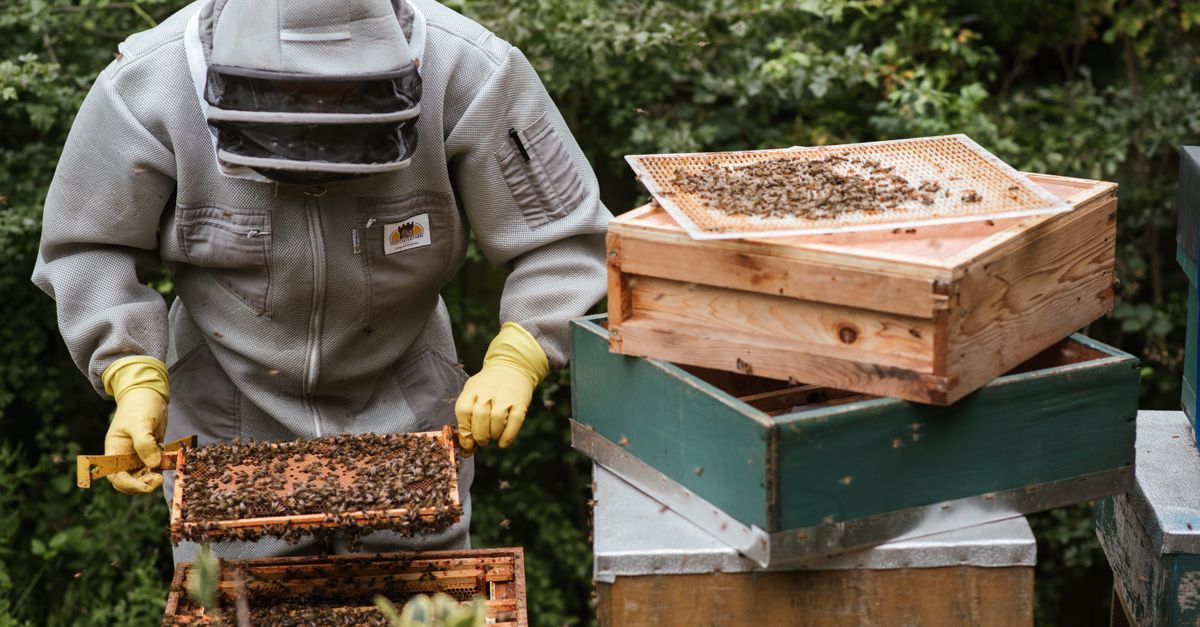
Beekeeping works in most Indian states that have flowering crops or forest flora for much of the year, and it needs almost no land or water. It pays only when colonies are kept strong, moved to where the flow is, and when honey is sold at a fair price, and the income figures in the literature mix honey with by-products that most beekeepers cannot sell in volume.
ICAR-IIVR notes that the European bee Apis mellifera is the species widely used for commercial beekeeping in India, while the native Apis cerana indica is also easy to keep in boxes. The rock bee (Apis dorsata) and little bee (Apis florea) are wild and are not kept in boxes.
Where it works in India
- States: ICAR-IIVR lists Punjab, Uttar Pradesh, Madhya Pradesh, Bihar, Assam, Odisha, Kerala, Karnataka and Tamil Nadu as leading beekeeping states, with the Eastern and Western Ghats and the Himalayan north-east also favourable.
- National picture: India produced about 1.4 lakh tonnes of natural honey in 2024 and exported about 1.07 lakh tonnes worth USD 177.55 million in 2023-24, making it the second largest honey exporter, according to a PIB document on the National Beekeeping and Honey Mission.
- Flowers decide everything: in a Haryana farmer-apiary study at CCS HAU Hisar, honey stores peaked in February (the mustard season) and dropped in March after extraction and the end of the flow. A site needs a major flow (mustard, eucalyptus, litchi, sunflower, forest flora or similar) plus minor flora to carry bees through dearth months. The exact calendar depends on district, so ask the local KVK or horticulture department.
- Species by situation: Apis mellifera gives much higher honey per colony and suits commercial, migratory apiaries. Apis cerana indica yields less but is hardier in hills and in areas with scattered flora.
Colony yield: what to expect
| Bee | Honey per colony per year (reported) | Source |
|---|---|---|
| Apis mellifera | 20 to 50 kg in general; 30 kg used in ICAR-IIVR costing | Indian Horticulture, ICAR, March-April 2023 |
| Apis cerana indica | 6 to 8 kg | Encyclopaedic summary (secondary source) |
- These are averages. A colony in a poor year, in a dearth area, or lost to disease gives far less, and no Indian dataset found here gives a reliable spread across seasons.
- Colony strength at the start of the flow matters. In the HAU Hisar study (2014-16, 36 colonies), colonies started with 15 frames held much more honey than those with 10 frames, and those with 5 frames held least: mean honey area 885.9, 523.4 and 276.7 square inches per colony. The authors note that India has no set standard for the ideal starting strength of Apis mellifera colonies.
Starting out
- Buy colonies in movable-frame boxes from a registered beekeeper or an agricultural university or KVK, not from a stranger who promises returns. Check queen age, brood pattern and the number of frames covered with bees.
- Start with a small apiary (for example 10 colonies) for a season to learn handling, swarm control and seasonal feeding before scaling. Colonies multiply by division of strong colonies.
- Training: KVKs, state horticulture departments and agricultural universities run beekeeping courses; the National Bee Board lists support under NBHM. Registration and traceability of honey sources is done on the Madhukranti portal.
- Pollination rental is an extra: ICAR-IIVR says 3 to 9 good colonies per hectare are needed for vegetables, depending on the crop, and bee pollination can raise vegetable seed yield, for example 22 to 100 percent in radish and 100 to 300 percent in cabbage (reported ranges).
Pests, diseases and losses
- An apiculture module from Udai Pratap College lists ants and other enemies, Nosema disease and viral sacbrood disease (larvae turn sac-like and die) among the problems of honey bees. Ask the KVK about mites and wax moth, which this guide could not verify. Weak colonies are usually hit first.
- Chemical treatments for mites and disease must follow the label and local KVK or university advice. Honey is a food, and antibiotic or acaricide residues can make a lot unsaleable, especially for export.
- Pesticide sprays on flowering crops kill foragers; place apiaries away from heavily sprayed fields and talk to neighbours before spraying.
Harvest and products
- Extract only sealed, ripe honey from combs in a hygienic extractor so the frames are reused. Unripe honey ferments.
- Beeswax, pollen, propolis and royal jelly are possible by-products, but each needs its own equipment, skill and buyer. Honey is the main product for most farmers.
💡 Tip: Before buying boxes, count the flowers within 2 to 3 km and ask the local beekeepers which months bees starve. If there is a gap longer than two months, plan migration or feeding costs into the budget.
Cost and returns
- ICAR-IIVR (citing Tripathi, 2021) costs a 50-colony Apis mellifera apiary at annual expenditure of ₹6,54,900 against total income of ₹8,77,500, a net of ₹2,22,600. That is about ₹4,450 net per colony.
- Honey alone in that table is 1,500 kg at ₹175 per kg = ₹2,62,500, which is less than the expenditure. The table gets to a profit by adding 1,000 kg of pollen at ₹500 per kg (₹5,00,000), which is 57 percent of income. The assumption of 20 kg of pollen per colony and a ready buyer at that price is not supported by other Indian data found, so treat the net figure as an upper illustration and not a plan.
- A cautious plan counts honey at 20 to 30 kg per colony, a realistic farm-gate price you have checked locally, and the cost of boxes, migration, labour, feeding and losses. Do the sum for your own site.
Market and risks
- Honey is sold to households and retail brands, processors and exporters. The export route is competitive and quality-tested, so exporters buy from beekeepers who can show source traceability and residue-free honey. See export buyers and FPO for group selling.
- Adulterated honey in the market depresses prices for honest producers. Labelling, testing and a recognised brand or buyer relationship matter more than volume.
- Risks: colony loss from disease or pesticide, dearth months, swarming, theft and stings near homes, and transport of hives across states.
- Support: the National Bee Board implements NBHM, a central sector scheme (₹500 crore for 2020-21 to 2022-23, extended to 2025-26 per PIB). Current subsidy rates per colony could not be verified here, so check the National Bee Board, the state horticulture department and the subsidy finder. A Kisan Credit Card may help with working capital.
Sources
- Indian Horticulture (ICAR), Honey bees for enhancing vegetable seed production, March-April 2023
- Indian Journal of Agricultural Sciences 88(10), Apis mellifera colony productivity and initial frame strength (CCS HAU, Hisar)
- PIB, National Beekeeping and Honey Mission fact sheet, November 2025
- Apiculture, applied zoology module (Udai Pratap College, Varanasi)
- Beekeeping in India (secondary source)