
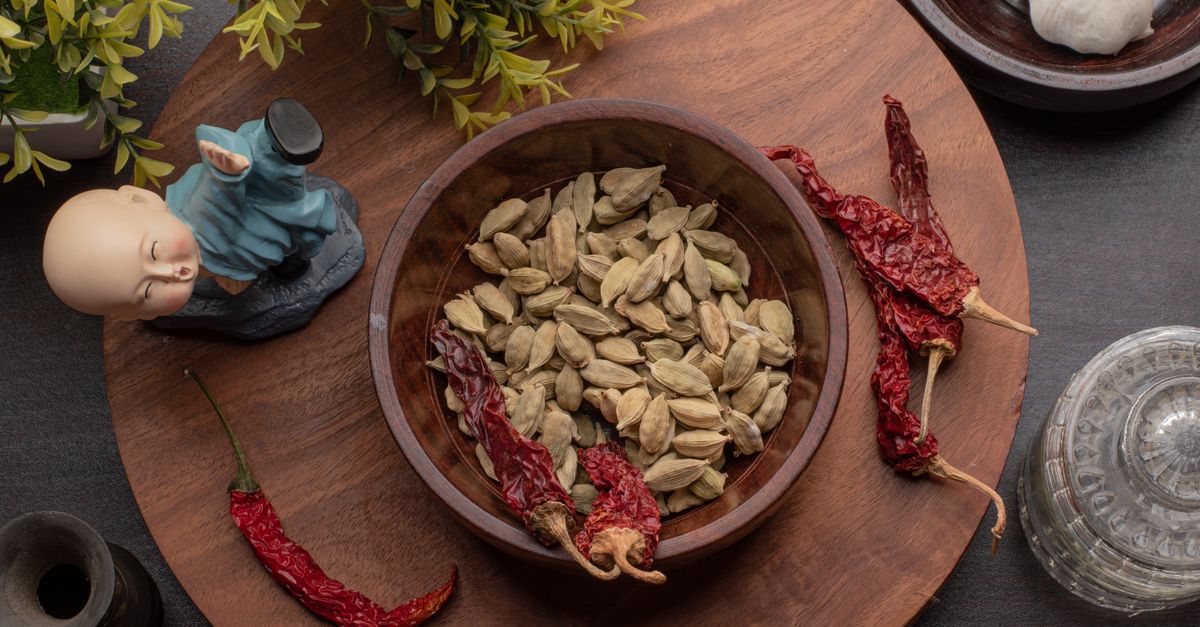
Large cardamom (Amomum subulatum, badi elaichi) is a shade-grown hill crop that realistically works only in the eastern Himalaya: Sikkim, the Darjeeling and Kalimpong hills of West Bengal, and parts of Arunachal Pradesh and Nagaland, at roughly 600 to 2,400 m under tree shade. It is a long-term perennial where the bigger risks are virus disease and old plantations, not price: Gangtok wholesale was ₹1,450 per kg for the large grade on 8 August 2026.
It does not suit the plains, and it is not the same crop as small (green) cardamom, which is grown in Kerala, Karnataka and Tamil Nadu. Average yields are modest, so the economics rest on healthy planting material and careful disease control.
Where it grows in India
- States: Sikkim is the largest producer, reported at about 80% of national production. Kalimpong and Darjeeling in West Bengal are second. The crop has spread to Arunachal Pradesh, Nagaland, Mizoram, Meghalaya, Manipur and Uttarakhand in small areas.
- Sikkim numbers: a Down To Earth report puts Sikkim production at 5,152 tonnes in 2004 on 22,714 ha, falling to about 4,385 tonnes on 17,735 ha in 2017-18. That is only about 250 kg per hectare. In 2015-16 Darjeeling and Kalimpong had 3,305 ha with an average productivity of 300.5 kg per hectare.
- Climate: cool, humid hills between 600 and 2,400 m, with the Himalayan alder (Alnus nepalensis) the preferred shade tree. Sikkim trial sites recorded about 3,045 mm annual rain, 57 to 91% humidity and 11 to 18°C average temperature.
- Why output fell: climate change (warmer, drier winters), viral diseases, old plantations, poor management and thin irrigation; the share of household income from the crop in Sikkim fell from half before 1997 to 29% in 2016.
Varieties
| Variety | Source | Suited elevation |
|---|---|---|
| Seremna | Local cultivar | Below 975 m |
| Dzongu Golsey | Local cultivar | Low elevation up to about 1,300 m |
| Sawney, Varlangey | Local cultivars | Mid (975 to 1,515 m) and high (above 1,515 m); Varlangey is about 90% of area in Darjeeling and Kalimpong and was rated best for yield and profit by 60 surveyed farmers |
| Ramsey | Local cultivar | Above 1,515 m |
| ICRI Sikkim 1, ICRI Sikkim 2 | Indian Cardamom Research Institute, Gangtok (released 2004) | ICRI Sikkim 1 above 1,515 m; ICRI Sikkim 2 at 975 to 1,515 m |
Match the cultivar to your elevation; the Sikkim cultivar trial found productivity depends on elevation. The Spices Board research station at Gangtok holds 254 accessions and gives advisory service, bio-agents and planting material.
Planting and spacing
- Pits of 30 x 30 x 30 cm on the hill contour after the first monsoon showers. Spacing of 1.5 x 1.5 m (about 1,800 plants per acre, 4,400 per hectare) is general; 1.8 x 1.8 m (about 1,250 per acre, 3,100 per hectare) is advised for vigorous cultivars such as Sawney, Varlangey and Ramsey.
- Take suckers or seedlings only from disease-free clumps. Planting virus-infected suckers is the quickest way to lose a plantation.
- Plant under thinned natural forest or alder shade; keep the slope covered to hold soil and water.
Nutrition and disease
- Manure and fertiliser: a reported recommendation is farmyard manure or compost at 5 kg per plant and N:P2O5:K2O at 75:75:150 kg per hectare (about 30:30:60 kg per acre), split before and after the southwest monsoon. Do a soil test and confirm with ICRI Gangtok or your KVK.
- Chirke (mosaic streak): pale green to yellow stripes on young leaves. Foorkey (bushy dwarf): stunted shoots and no flowers or fruit. Both are viral. Uproot and burn affected plants as soon as they are seen; remove them before they spread.
- Fungal leaf spot and blight: spray or drench once before the monsoon and once after flowering with 1% Bordeaux mixture or 0.2% copper oxychloride around the clumps.
Harvest and curing
- Fresh capsules contain about 80 to 85% moisture and must be dried immediately, traditionally in a wood-fired kiln (bhatti). The smoky aroma is the market character of the crop.
- Time to first harvest and yield per plant by age were not verified for this page; ask ICRI Gangtok or your KVK for the figure for your cultivar and elevation.
- Yield: averages of about 250 to 300 kg per hectare (about 100 to 120 kg per acre) of dry capsules are reported for Sikkim and Darjeeling, and ICRI Gangtok can tell you what healthy plantings of your cultivar give.
Cost and returns
- Prices (Spices Board weekly report, 8 August 2026): Gangtok badadana ₹1,450 per kg and chotadana ₹1,300; Siliguri badadana with tail ₹1,775 and without tail ₹1,825; Delhi kanchicut ₹1,640 to ₹1,650. A year earlier (20 September 2025) Gangtok badadana was ₹1,400. These are indicative wholesale rates, not farm-gate rates.
- Arithmetic (illustration): 300 kg per hectare x ₹1,450 = ₹4.35 lakh gross per hectare (about 120 kg per acre = ₹1.75 lakh per acre). Costs depend on labour, kiln fuel and replanting; no verified cost table was found, so budget with your local KVK.
- Rates differ by grade and market centre (badadana, chotadana, with or without tail); check the weekly Spices Board report before agreeing a rate.
Market and risks
- Sold through Gangtok and Siliguri traders to Delhi and other northern markets. Down To Earth reports that Nepal has overtaken Sikkim as the largest world supplier, with about 68% of the global market.
- Risks: virus spread through infected suckers, warmer and drier winters, and fuel for the kiln. Prices move year to year.
- For group selling see FPO, for credit KCC, and export buyers. Ask the Spices Board for current planting and replanting support; no rate was verified here. Small cardamom is a different crop; see small cardamom.
Sources
- Elevation determines the productivity of large cardamom cultivars in Sikkim Himalaya, Scientific Reports 2023
- Varietal preferences in large cardamom, hill region of West Bengal, IJBSM 2023
- Down To Earth, Rise after the fall (Sikkim large cardamom)
- Spices Board, Spices Market Weekly, 8 August 2026
- Spices Board, Spices Market Weekly, 20 September 2025
- Spices Board, Indian Cardamom Research Institute
- Vikaspedia, cultivation of large cardamom in Sikkim (secondary source)